Bundled tracker vs CAPI feedermedia buyer software
AdsBridge vs AnyTrack
By Dana Rourke, Lead reviewer. Reviewed by Campaign Buyer Editorial. Updated 27 September 2026.
Quick answer
Pick AdsBridge if you run affiliate or network offers across several traffic sources and want one cheap cloud tool that tracks your clicks, syncs your ad cost into profit by source, and builds and split-tests your landing pages; pick AnyTrack if you run a Shopify store or your own site and mainly need conversions fed back to Meta, Google and TikTok through their conversion APIs without wiring server-side tracking yourself. For most buyers weighing these two, AdsBridge is the stronger default: it tracks, syncs your ad cost and builds your pages in one tool, and it shows which source and offer actually made money. AnyTrack wins the narrower case where feeding clean CAPI conversions to the ad platforms is the whole job and you are content to read ROI inside Meta and GA4.
Side by side
| AdsBridge | AnyTrack | |
|---|---|---|
| What it is | Cloud tracker with a page builder | No-code conversion feeder |
| Best-fit user | Affiliate & network media buyers | Shopify, DTC & affiliate marketers |
| CAPI to ad platforms | No native CAPI, uses postbacks | Six platforms, native CAPI |
| Ad-cost sync & ROI by source | Yes, automatic | No, you read ROI in the ad platform |
| Landing page builder | Yes, drag-and-drop, built in | No, tracking only |
| Split testing | Yes, built in | No |
| Setup | Tag plus network postbacks | No-code tag, connect accounts |
| Free plan | No, 14-day trial only | Yes, 5k sessions, no CAPI |
| Priced by | Visits, from $29/mo | Sessions, free then $100/mo |
| Outside proof | Thin, mostly affiliate blogs | Thin: two G2, 3.4 of 5 Trustpilot |
These two get shortlisted together because both promise to solve the same problem: the browser pixel drops conversions, iOS and ad blockers eat more, and the ad platforms bid on data that is half missing. They fix it from opposite ends. AdsBridge is a full cloud tracker that holds your click and conversion data, builds your pages and works out which source and offer made money. AnyTrack is a no-code layer that catches conversions on your site and feeds them back to the ad platforms. The first is a media-buying command center, and the second is a pipe. Which you want depends on whether you need the reporting or just the feed.
A tracker versus a feeder
AdsBridge, running since 2013 on AWS across 160-plus countries, assigns every click an id, follows it through your page and offer, and records conversions server to server so a blocked pixel does not cost you the sale. Around that it folds in a drag-and-drop landing page builder, split testing, a URL rotator, an anti-fraud filter and a redirectless mode, all in one subscription. It connects to more than 100 affiliate networks with one-click postback setup.
AnyTrack is built for a marketer who would rather not write code. You drop in a no-code tag, connect your ad accounts and conversion sources, and it maps the events. Client-side and server-side tracking run together, it rebuilds the journey with its own click id rather than a third-party cookie, and it pushes that enriched data to Meta, Google, TikTok, Microsoft, Taboola, Outbrain and ChatGPT Ads in real time. It covers 90-plus affiliate networks out of the box. By its own docs, it does not pull your ad spend in to compute ROI across sources, so its job ends once the conversion reaches the platform.
Which one shows what made money
This is the sharpest split. AdsBridge holds your data and lets you bring cost in, so it answers the media buyer's real question: which source, lander and offer actually turned a profit. AnyTrack deliberately leaves that job to the ad platforms. It sends clean conversions to Meta and Google so their bidding engines optimize on revenue instead of last-click guesses, and you read the resulting ROI inside those platforms and GA4. Practitioner threads describe it as a CAPI feeder aimed at Facebook conversions specifically. If you run pop, push or native across several sources and want one table that reconciles cost against revenue, AdsBridge is the tool built for that. If you run one store or site and the ad platform's own reporting is where you already live, AnyTrack's narrower job fits.
CAPI and the ad platforms: where AnyTrack pulls ahead
The one capability AnyTrack has that AdsBridge does not is a native conversion API. AnyTrack feeds seven ad platforms server-side out of the box. AdsBridge has no native Meta or Google CAPI. It relies on server-to-server postbacks, which is the right method for affiliate networks and survives ad blockers, and AdsBridge itself admits that leaves a paid-social buyer who needs CAPI events in Meta poorly served. So the CAPI question flips the default: if native conversion-API feeding to the platforms is the capability you are buying, AnyTrack has it and AdsBridge does not. In that one case the cheaper, higher-ranked tool is the wrong pick.
Pages, setup and support
AdsBridge bundles the pages, which is its main draw over a standalone tracker: the page you build is already wired to the campaign you track, one bill instead of two. The recurring complaints about it are speed, where a community redirect test clocked it slower than several rivals and it hurts most on mobile, and thin independent proof, since its G2 profile is too small to lean on. AnyTrack's setup is lighter to start but heavier to get right. Attribution holds only while the click-id chain stays intact, Shopify stores commonly hit duplicate GA4 events in the first week, and the loudest negative pattern is service: unanswered tickets and trial-cancellation disputes across a thin public footprint of two G2 reviews and 3.4 of 5 from eleven Trustpilot reviews. AdsBridge offers a 14-day trial with no refund on cancellation, and AnyTrack has a free plan plus a 14-day trial. Send each support desk a real question during that window.
The tool that sits between them
If your reason for looking at these two is that you are bolting tracking onto a funnel you already run, ElasticFunnels is a third option, one layer up from both. Neither AdsBridge nor AnyTrack builds and hosts the checkout the click lands on, and ElasticFunnels does, keeping the click, the order, the rebill and the refund on one record so you are not reconciling a tracker's export against a checkout's. Its lead feature for a paid-traffic team is same-URL split testing: variants rotate server-side under one campaign link, so Meta, Google and TikTok keep their learning and a test never sends the ad back through review. Its drawback is that it is newer than either tool here, with very little independent review coverage to check its claims against, so until you run real volume through it you are largely taking the vendor's word. That is what you would expect of a platform this recent, and it matters less if you use the 14-day trial, which needs no card, to prove it on your own campaigns first. It suits the store owner who came to AnyTrack because the checkout and the ad accounts disagree, and would rather the sale be recorded where it happens.
Which one for you
For a media buyer running offers across several sources, AdsBridge is the stronger default and the reason it ranks fourth in our best ad tracker ranking while AnyTrack ranks eighth: it tracks, it syncs your cost into profit by source, and it builds your pages, all for less. Reach for AnyTrack when the whole job is feeding clean conversions back to the ad platforms through their conversion APIs, you run a Shopify store or your own site, and you do not want to hire a developer to wire it. AnyTrack is built squarely for that need. Budget for a setup week and watch the session bill.
AdsBridge
What works
- Tracking, a drag-and-drop landing page builder and split testing come in one subscription, so a beginner does not pay for a separate page tool.
- Cheaper entry than Voluum or RedTrack: $29/mo for 100,000 visits, and every plan carries the full feature set with no features gated to higher tiers.
- Prices by monthly visits rather than events, which is easier to predict than event-based billing when a campaign scales.
- Established since 2013 on AWS infrastructure, with 100-plus one-click network integrations, an anti-fraud filter and a redirectless tracking mode.
What to watch
- Redirect speed is the recurring complaint. A community speed test clocked its redirects slower than several rivals, which matters most on mobile traffic.
- Reviewers report stability flaws once daily volume gets extreme, and the dashboard can feel slow at times.
- No native Meta or Google conversion API. It leans on server-to-server postbacks, so paid-social buyers who want CAPI are better served elsewhere.
- Thin independent proof. Its G2 profile has too few reviews to be useful, so most write-ups are affiliate blogs rather than heavy buyer feedback.
- No permanent free tier, only a 14-day trial, and AdsBridge states it issues no refund on cancellation.
AnyTrack
What works
- No-code setup. You connect the tag and your ad accounts from a dashboard instead of standing up a server-side Google Tag Manager container.
- Server-side and client-side tracking run together, so a blocked pixel or an iOS restriction does not silently drop the conversion.
- Feeds conversions back to seven ad platforms through the Conversion API, and covers 90+ affiliate networks, ecommerce platforms and CRMs out of the box.
- A real free plan and a 14-day trial with no credit card, so you can prove the tracking before you pay.
What to watch
- Support and billing draw the most complaints. Unanswered tickets and trial-cancellation disputes recur across Trustpilot and PPC threads, so test support inside the trial.
- Thin independent proof. Two reviews on G2 and 3.4 out of 5 from eleven reviews on Trustpilot make it hard to sanity-check against the crowd.
- Session-based pricing with automatic overage. A traffic spike pushes you past your cap and bills $0.40 to $0.20 per 1,000 sessions, and you cannot switch it off on a paid plan.
- No automatic ad-spend sync. Unlike RedTrack or Voluum it does not pull your cost in, so ROI across sources has to be computed somewhere else.
Pricing
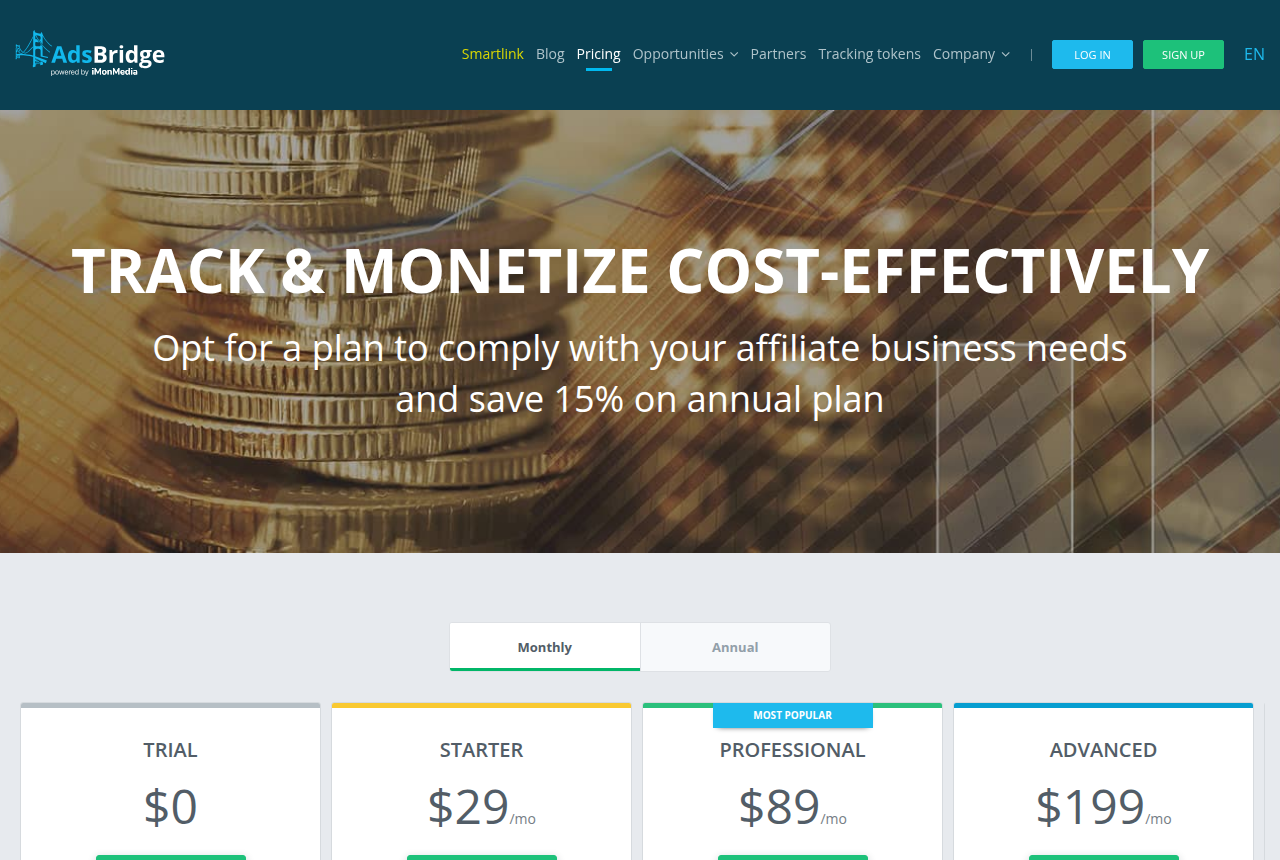
AdsBridge: from $29/mo. AdsBridge prices by monthly visits. Starter costs $29 a month for 100,000 visits. Professional is $89, Advanced $199, Business $379, Agency $499 and Enterprise $799, and Exclusive is quoted individually. Visits over the limit bill per 1,000, from $0.07 on Starter down to $0.029 on Enterprise. Annual billing saves up to 20%. Every plan starts with a 14-day free trial, and cancellations receive no refund.
AnyTrack: from free, then $100/mo. The free plan costs nothing and covers 5,000 sessions a month, one website, one ad platform and one conversion source, without the Conversion API. Starter is $100/mo for 100,000 sessions, all seven ad platforms, 100+ integrations and real-time CAPI. Personal is $150/mo for 500,000 sessions, three sites, GA4, cross-domain tracking and webhooks. Advance is $300/mo for 3M sessions, ten sites, ten seats and dedicated support. Annual billing gives two months free. Overage runs $0.40 to $0.20 per 1,000 sessions and cannot be turned off on paid plans. Extra websites cost $30/mo on Advance. Paid plans start with a 14-day trial.
Prices as of 28 September 2026
Our pick
AdsBridge
AdsBridge is a real, long-running cloud tracker that bundles a landing page builder and split testing for less than Voluum or RedTrack, so it fits an affiliate who wants tracking and pages in one low-cost tool. Skip it if fast redirects at high volume or a native Meta conversion API are what you are paying for, because that is where buyers report it trailing the leaders.
Frequently asked questions
Which is cheaper, AdsBridge or AnyTrack?
Does AdsBridge or AnyTrack send conversions to Meta's conversion API?
Which one shows my profit by traffic source?
Is AnyTrack or AdsBridge better for a Shopify store?
Sources
Other sources
6 discussions and reviews read for this page. Quotes are excerpts; open a link to read the original in context.
- [ab-statsdrone-speed] AdsBridge Review: Overview, Features, Pros & Cons, Pricing
- [ab-statsdrone-diff] AdsBridge Review: Overview, Features, Pros & Cons, Pricing
- [ab-affmaven-stability] Real AdsBridge Review 2026: Better Than Voluum?
- [ab-affmaven-opt] Real AdsBridge Review 2026: Better Than Voluum?
- [ab-affiliatefix-support] AdsBridge reviews
- [ab-g2-thin] AdsBridge Reviews

Written by
Dana Rourke
Lead reviewer
Dana Rourke is the lead reviewer at Campaign Buyer. She owns the tracker and attribution coverage: reading what long-term users report about each tool, checking its documentation and pricing, and verifying prices with the vendor before writing the verdict. Keeping the rankings honest mostly means writing down what the top pick gets wrong, so she does that first.
Last checked 2026-09-27