Best ecommerce attributionmedia buyer software
Best attribution software for ecommerce
Your ad platforms all claim the same sale. Meta says it drove the purchase, Google says it did, and your Shopify dashboard files half your revenue under "direct" because it cannot see where the click came from. Attribution software exists to settle that argument, or at least to give you one number you trust when you move budget. For an ecommerce brand, that number decides which campaigns live and which die.
By Dana Rourke, Lead reviewer. Reviewed by Campaign Buyer Editorial. Updated 13 September 2026. We revisit this page every 90 days.
None of these tools gives you an exact number. Each one models credit, and the better vendors say so plainly. What separates them is fit: a Shopify operator who wants one dashboard needs a different tool from a brand spending half a million a month that needs incrementality. We ranked them for a store that buys its traffic, and every pick names what it is bad at, including the one we rank first.
Quick answer
Triple Whale is the pick if you run a Shopify or DTC store and want attribution and profit together in one dashboard the whole team will open, provided you keep your UTMs clean. If that is not you, jump to the pick that matches your situation:
- 1. Triple Whale is best for Shopify and DTC brands.
- 2. Polar Analytics is best for DTC teams building their own BI.
- 3. ElasticFunnels is best for sellers who host their own checkout.
- 4. Northbeam is best for high-spend brands needing MMM.
- 5. Hyros is best for long, high-ticket funnels.
Compare all five
| Tool | Best for | Method | Fits | From |
|---|---|---|---|---|
| 1. Triple Whale | Shopify and DTC brands | Attribution + profit dashboard | $30k to $100k+/mo spend | $219/mo |
| 2. Polar Analytics | DTC teams building their own BI | BI + first-party attribution | $1M to $25M GMV | $750/mo |
| 3. ElasticFunnels | sellers who host their own checkout | First-party checkout data | any stage, if you host the sale | $97/mo |
| 4. Northbeam | high-spend brands needing MMM | MTA + MMM + incrementality | $100k to $500k+/mo spend | $1,500/mo |
| 5. Hyros | long, high-ticket funnels | Server-side journey tracking | $50k+/mo, complex funnels | Custom |
Entry paid plan prices, checked with each vendor on 13 September 2026. Triple Whale, Polar and Northbeam are priced on your GMV or spend, so the real number rises with your revenue. ElasticFunnels is a funnel platform that hosts the checkout. It ranks here for a seller who hosts the sale, where the checkout's own first-party data replaces a model.
The ranking
1. Triple Whale: best for Shopify and DTC brands

It is the pick if you run a Shopify or DTC brand and want attribution and profit dashboards in one place, and you will keep your UTMs clean.
For a Shopify or DTC brand, this is the tool that fits the most buyers. A first-party pixel feeds multi-touch attribution, MER, blended CAC and contribution margin into one dashboard an operator opens every morning, with no analyst needed to keep it running. It costs less to enter than Northbeam and reads far faster than a raw warehouse, which is why most brands under $10M in GMV should start here.
The number is only as clean as your UTMs, and the first dashboard is rarely right out of the box. Paid plans are twelve-month commitments scaled by GMV, and buyers flag data quirks like VAT landing inside revenue, so reconcile it against your Shopify backend every month. Within those limits it is the best daily attribution view in ecommerce.
What works
- Built for Shopify: first-party pixel, MER, blended CAC and profit in one dashboard
- Lower entry cost than the other serious attribution tools here
- Fast, operator-friendly dashboards the whole team will actually open
What to watch
- The first dashboard is rarely right until your UTMs are clean and consistent
- Paid plans are 12-month commitments priced by GMV
- Users report data quirks such as VAT counted in revenue, so reconcile against the backend
Read the full Triple Whale review, or see alternatives to Triple Whale.
2. Polar Analytics: best for DTC teams building their own BI
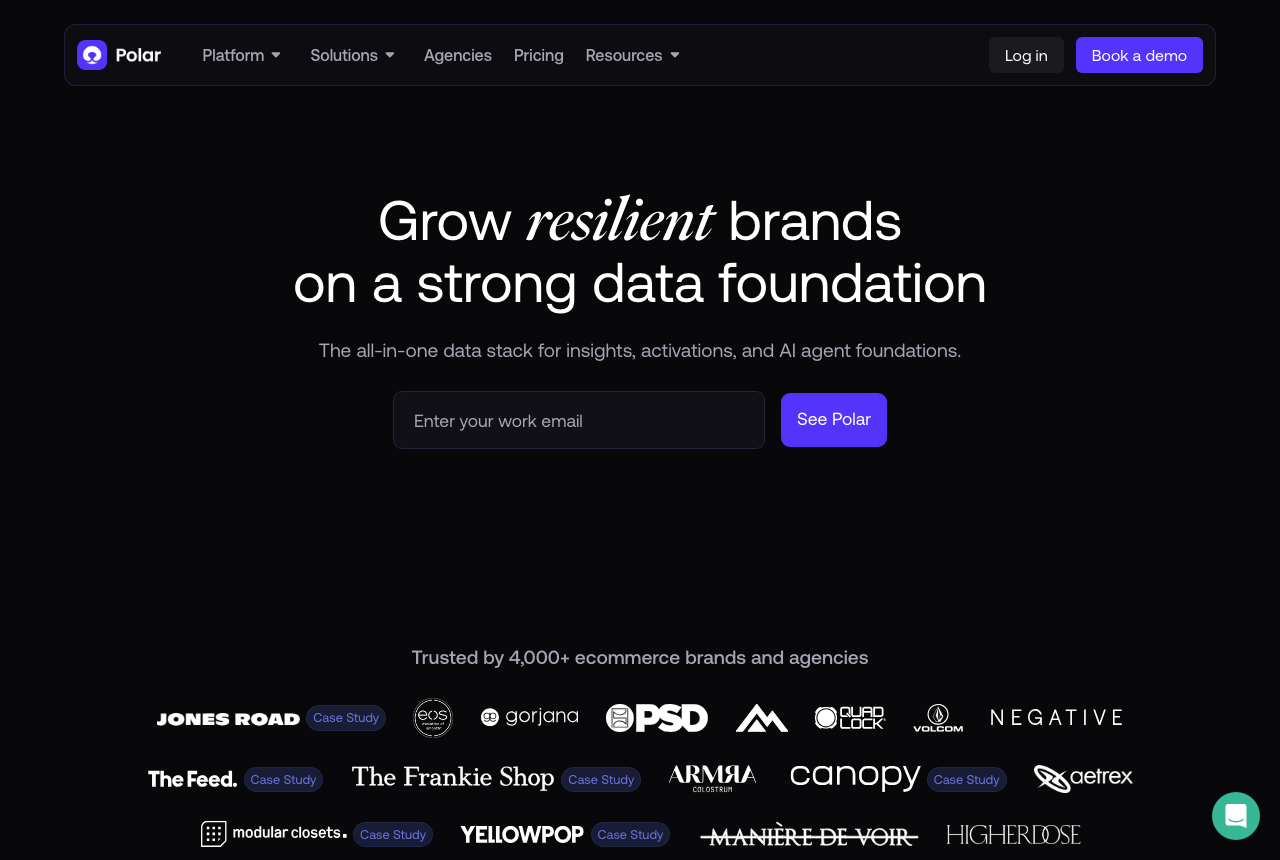
It is the pick if you run a Shopify store doing real revenue and want to build your own BI dashboards on first-party attribution, rather than live in a prebuilt operator screen. The catch is the bill. Core starts at $750 and is billed on your GMV, so a smaller shop pays more than the data is worth, and reviewers say it tightens up once your attribution needs get deep.
Polar is the pick for the brand that has outgrown a fixed dashboard and wants to build its own. It pulls Shopify, the ad platforms and your email or SMS data into one place and lets a data-literate operator assemble custom reports, closer to a business-intelligence layer than a single profit screen. Attribution runs off a first-party pixel, and Polar is honest that it is directional rather than exact. Buyers rate the setup and centralization highly, at 4.9 across 117 Shopify App Store ratings.
It ranks second because of price and depth. Its Core plan scales with your GMV, which buyers on Reddit call a revenue tax, so a smaller store overpays. And the recurring critique is that it is strong for visual reporting but gets restrictive once you need deep or custom attribution. Choose it over Triple Whale when reporting flexibility matters more than a fast out-of-the-box view.
What works
- Pulls Shopify, ad platform and email or SMS data into custom dashboards you build yourself, not a fixed template, with unlimited users and historical data on the Core plan
- First-party pixel and server-side tracking, so the numbers survive the browser better than a pixel-only setup
- Rated 4.9 out of 5 across 117 Shopify App Store ratings, with setup and data centralization the most-praised parts
What to watch
- Core opens at $750 a month and is priced on your GMV, so the bill climbs with revenue and a small store overpays
- Buyers report it gets restrictive when you need deep or custom attribution, where Triple Whale goes wider on ecommerce metrics and Northbeam goes deeper on modeling
- A dedicated success manager only arrives at a $10,000 annual contract, and some reviewers below that flag slow support and connector delays
Read the full Polar Analytics review, or see alternatives to Polar Analytics.
3. ElasticFunnels: best for sellers who host their own checkout
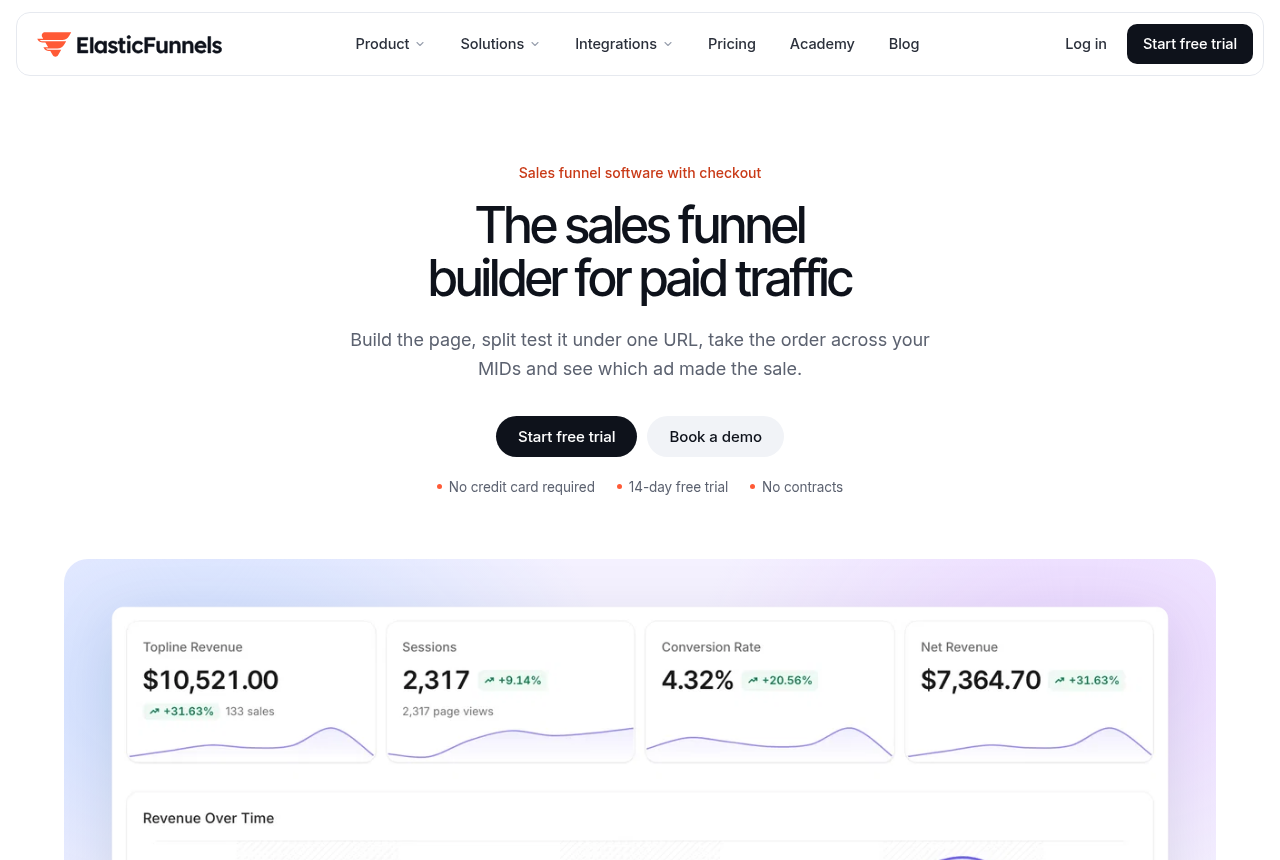
ElasticFunnels is a funnel platform built for teams that run paid traffic: it builds the pages, splits them behind one URL so your ads never reset, hosts the checkout, and keeps the CRM and the reporting on the same data. Same-URL split testing is the reason most teams switch. Its checkout stands out for multi-MID routing, which splits sales across the NMI merchant accounts you connect and only pays off if you already run more than one. It is newer than the platforms it rivals, though, and third-party proof is thin so far.
ElasticFunnels is a funnel platform: pages, same-URL split testing, checkout, CRM and attribution on one data layer. It ranks this high for one specific buyer, the ecommerce seller who owns the sale instead of modelling it. Because it hosts your checkout, every sale is a deterministic first-party event it records directly, and it fires server-side postbacks on purchase, refund, chargeback and rebill. For a brand whose orders all close in a checkout it hosts, that first-party record answers more of the attribution question than a modeled tool does, because there is no pixel gap to model around. That is why it sits ahead of the heavier, narrower tools below it for this reader.
The honest catch: ElasticFunnels is newer than the platforms it competes with, and there is very little independent third-party review coverage to check its claims against. Until you run real volume through it, you are largely taking the vendor's word for it. And because it records only what closes in its own checkout, it is blind to traffic that converts on someone else's page, so it does not replace Triple Whale or Northbeam when your sales close off-platform. For a seller whose orders all close in its checkout, that limit costs little.
What works
- Replaces the stack a growth team usually stitches together: a funnel builder, a checkout or CRM, a testing tool and an analytics tool, so a click, an order, a rebill and a refund are one record instead of four exports you reconcile on Monday
- Its standout is testing under one URL: variants rotate server-side on one campaign link, so Meta, Google and TikTok keep their learning and a test never sends the ad back for review
- The AI builder writes a page of any type from a prompt, and the cloner turns a competitor URL into a working copy in about a minute
- Its checkout takes Stripe, NMI, PayPal, Klarna or Authorize.net, splits sales across several NMI merchant accounts by weight, card brand, product and daily cap, and builds in order bumps, one-click upsells and subscription dunning
- Analytics put sessions, orders, rebills and refunds on one timeline, sliced by affiliate, geo, device or creative, and a built-in CRM and call center work off the same records
- A trial tests the whole tool because nothing is gated behind a higher tier: plans differ only by the traffic volume they allow
What to watch
- Newer than the platforms it competes with, with very little independent review coverage to check its claims against, so until you run real volume through it you are largely taking the vendor's word
- Multi-MID routing, the standout in its checkout, works across NMI merchant accounts only and pays off only if you already hold several to route between. A seller on a single Stripe account still gets the pages, the testing, the analytics and the CRM, but not that routing advantage
- It is not a merchant of record like Paddle: it will not file your sales tax or carry dispute liability, so that work stays with you and your processors
- The 0.5% checkout fee applies to revenue through its hosted checkout, on top of the monthly plan and your own processor fees, though sales on external networks like ClickBank or BuyGoods are not charged
Read the full ElasticFunnels review, or see alternatives to ElasticFunnels.
4. Northbeam: best for high-spend brands needing MMM
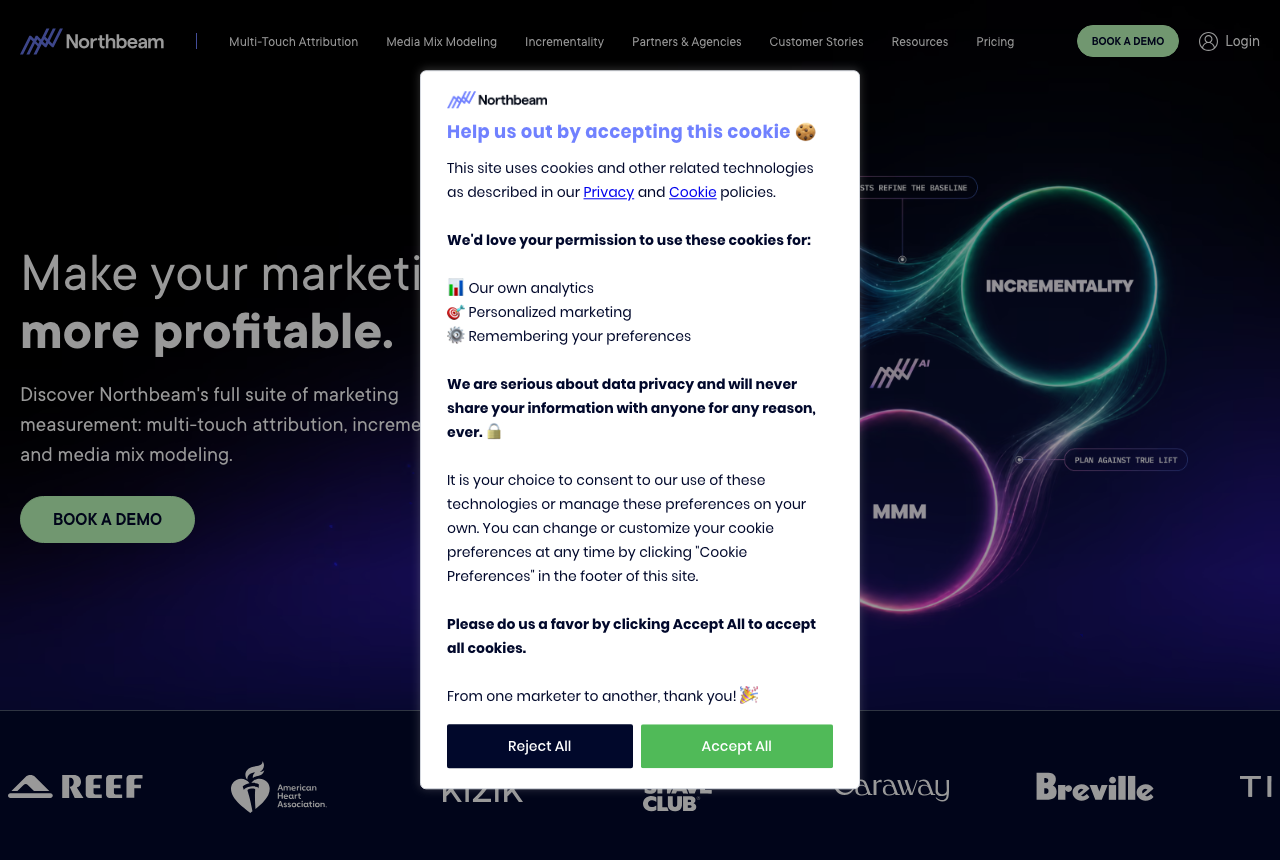
Northbeam is the pick if you spend heavily across channels and have an analyst to own multi-touch attribution, media-mix modeling and incrementality.
Northbeam is the tool you graduate to when a percentage point of attribution accuracy is worth thousands in reallocated spend. It blends click data with modeled and deterministic view-through data and layers multi-touch attribution, media-mix modeling and incrementality on top. For a brand spending across Meta, Google, TikTok and more, that is a fuller picture than a Shopify-first dashboard gives you, and Reddit's verdict is blunt: it is the premium option for brands spending six figures a month.
It ranks fourth because the fit is narrow. Pricing starts at $1,500 a month, and the real risk is adoption: without an analyst or data owner to run the models and act on them, it becomes expensive shelfware. Buy it once you have both the spend and the person.
What works
- Combines clicks with modeled and deterministic view data for fuller paid-media attribution
- MTA, MMM and incrementality testing in one platform
- Built for the scale where measurement decisions move real budget
What to watch
- Starts at $1,500/mo, a price only a large ad budget justifies
- Onboarding is hard, and one reviewer paid but could not get the product live
- Becomes expensive shelfware without someone dedicated to run the model
Read the full Northbeam review, or see alternatives to Northbeam.
5. Hyros: best for long, high-ticket funnels
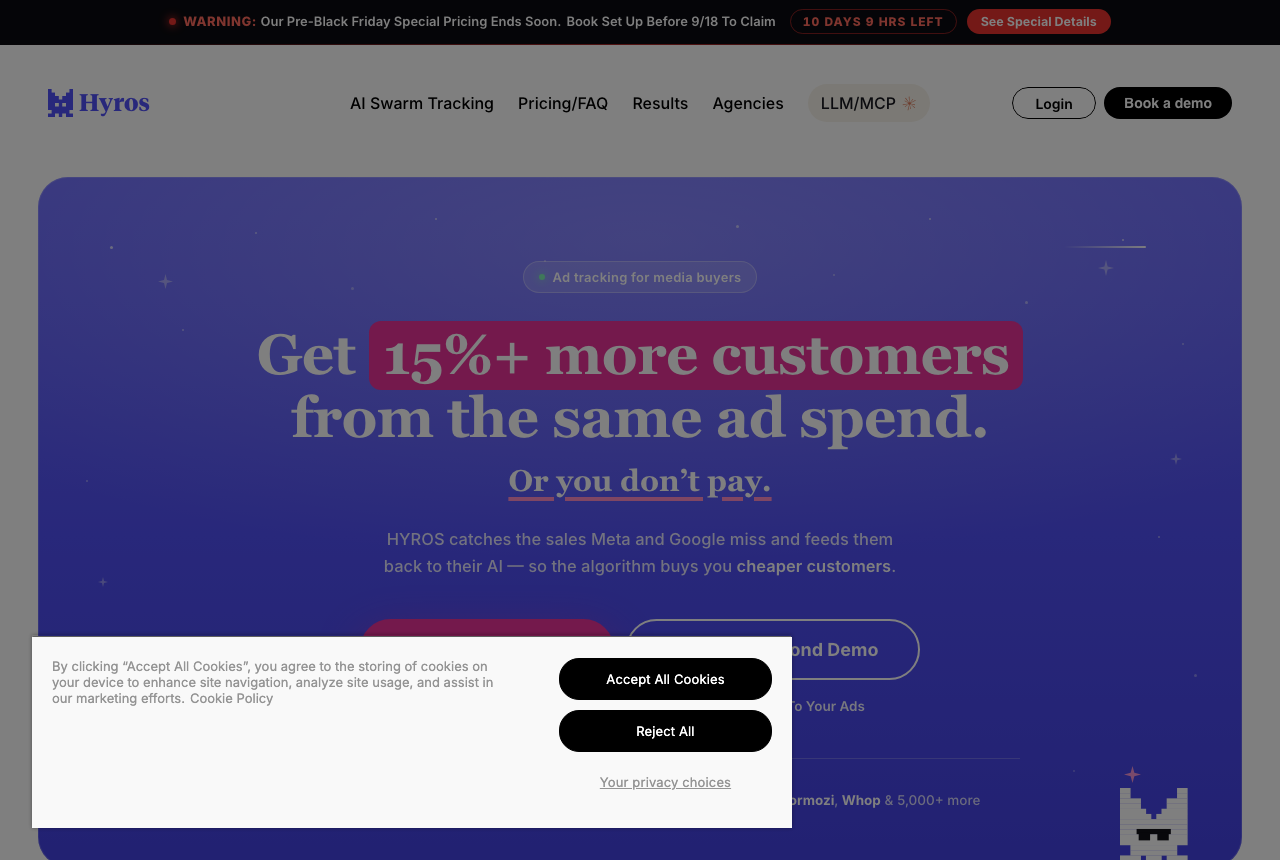
Hyros is the pick if you sell high-ticket or info products whose sales close over calls, webinars and CRM follow-ups. A low-AOV store with a short buying cycle gets little from it.
Hyros is built for the funnel that does not end at a checkout. If your sale happens after a lead opt-in, an email sequence, a sales call or a webinar, standard pixels lose the thread. Hyros tracks server-side and stitches the journey across payment processors and CRMs, which is why high-ticket and info-adjacent sellers credit it with finding revenue Meta and Google never attributed.
For a simple low-AOV Shopify store with a short buying cycle, that machinery is wasted, and buyers put the honest threshold around $50k a month in spend with genuinely complex funnels. Pricing is quote-driven and opaque, and like every tool here its figures are modelled, so they will not match what Meta reports. Its job is sharper allocation calls on a long funnel.
What works
- Server-side tracking that follows long journeys through calls, webinars and CRMs
- Finds sales that Meta and Google miss on multi-step funnels
- Pulls sales data from payment processors and CRMs alongside site analytics
What to watch
- Overkill below roughly $50k/mo in ad spend
- Pricing is opaque and quote-driven on the main site
- Its revenue figures are modelled, so expect them to diverge from what the ad platforms report
Read the full Hyros review, or see alternatives to Hyros.
Winners by segment
Shopify DTC brand that wants one dashboard for the team. Winner: Triple Whale, for attribution and profit together in a view an operator opens daily. Runner-up: Polar Analytics if you would rather design your own reports.
Data team that designs its own BI reports. Winner: Polar Analytics, for flexible dashboards on top of first-party attribution. Runner-up: Triple Whale if you want the faster out-of-the-box view.
High-spend brand across many channels. Winner: Northbeam, for multi-touch attribution, media-mix modeling and incrementality, if you have an analyst to run it. Runner-up: Triple Whale as the operator layer alongside it.
High-ticket or long funnel closing on a call. Winner: Hyros, for server-side tracking across calls, webinars and CRMs. Runner-up: Northbeam if the spend is high and the channel mix is wide.
Seller who runs their own checkout. Winner on that narrow need: ElasticFunnels, because a sale that closes in a checkout you host is recorded directly, with nothing left to model. It is newer, with little outside proof yet, so the proven platforms stay ahead of it for cross-channel attribution. Runner-up: Triple Whale if you still want to know which channel drove the click.
What to avoid
- Buying any of these before your spend justifies it. On a small ad budget, GA4 with clean UTMs, your platform reporting and a post-purchase survey do the job. Shopify controls the tracking in the cart, so the free baseline is better than most buyers think.
- Treating the tool's number as the truth. Add up what Meta, Google and your attribution tool each claim and you will over-count, because each one credits the same sale. Reconcile against your Shopify backend and your bank, and use MER and blended CAC as the north star.
- Feeding it dirty UTMs. Attribution is only as clean as the parameters you send. A messy or missing tag is the usual reason the first dashboard is wrong, and no amount of modeling fixes tracking you never set up.
- Ignoring the pricing model. Triple Whale, Polar and Northbeam all scale with your GMV or spend, so a tool that looks affordable today becomes a revenue tax at scale. Price the bracket you expect to reach next year.
- Buying a heavy tool with no one to run it. Northbeam and a full Hyros setup only pay off with an analyst or data owner. Without that person the dashboards go unopened, which is the most common regret buyers report.
How we researched this
We judged each tool against the job an ecommerce brand actually hires it for: assign credit for a sale across the touchpoints that led to it, survive the post-iOS tracking loss that broke browser pixels, and produce a number a buyer trusts enough to shift spend. We read what long-term users report in public threads and on review sites, and checked each vendor's own documentation, because a demo hides the ceilings you only hit in month three, like GMV-based bills climbing or support slowing after onboarding.
We weighted five things: fit for a store that pays for its traffic, how well users report the first-party and server-side tracking holding up, whether the vendor is honest that the output is directional rather than exact, how the pricing model behaves as revenue grows, and whether a normal team can run it without a dedicated analyst. The ranking is a numbered order with no score out of ten, and where a tool wins only for a specific buyer we say so. The full rubric is on our how we research page.
How to choose
Start with your spend and your stage. At low spend, I would not buy any of these yet, because the free reporting covers it. From there up to six figures a month, Triple Whale is the default, and Polar is the pick instead if you have a data person who wants to build custom reports. Past that, across several channels, add Northbeam for incrementality and media-mix modeling, provided you have someone to own it. If your funnel closes on a call or a webinar rather than a cart, Hyros is the specialist.
Then look at where the sale actually happens. If every order closes in a checkout you host yourself, a large part of your attribution is already deterministic, and a checkout that records and posts back its own conversions can cover more of the job than a buyer expects. That is the narrow case where ElasticFunnels fits, and it is the wrong answer the moment your sales close on a page you do not control.
Finally, price the billing model as well as the entry plan. A tool billed on GMV or spend gets more expensive exactly as you grow, so forecast the bracket you will sit in next year. And weigh who runs it: the most expensive attribution tool in the world returns nothing if no one opens it on a Monday.
What is ecommerce attribution software?
Ecommerce attribution software connects your store, your ad platforms and your email or SMS tools, then assigns credit for each sale across the touchpoints that led to it. The point is to judge spend against profit rather than trusting platform-reported ROAS, which over-counts because every platform claims the conversions it touched. Most of these tools report blended metrics like MER, marketing efficiency ratio, and blended CAC, which treat all spend and all revenue together instead of channel by channel.
Two things are true of the whole category in 2026. First, attribution is now first-party and server-side, because Apple's tracking changes broke the browser pixel and a server-side feed recovers conversions a pixel drops. Second, the output is modelled and directional: useful for deciding which campaign to scale this week, and certain to diverge from Shopify, Meta, Google and your bank. Read it as a guide to this week's budget moves.
Frequently asked questions
What is the best attribution software for ecommerce in 2026?
Do I need attribution software on a small ad budget?
Is ecommerce attribution software accurate?
Triple Whale vs Northbeam, which should I pick?
How much does ecommerce attribution software cost?
Changelog
- 13 September 2026. First published. Verified pricing for all five tools against vendor listings, added Polar Analytics to the catalog, and ranked them for stores that buy paid traffic.
Sources
Other sources
14 discussions and reviews read for this page. Quotes are excerpts; open a link to read the original in context.
- [reddit-must-4yr] Is triple whale a must?
- [reddit-must-50k] Is triple whale a must?
- [reddit-must-overlap] Is triple whale a must?
- [reddit-vsmeta-unprofitable] Triple Whale vs Meta Reporting?
- [reddit-vsmeta-confused] Triple Whale vs Meta Reporting?
- [reddit-ecom-convoluted] Triple Whale?
- [reddit-ecom-repeats] Triple Whale?
- [reddit-ecom-amazing] Triple Whale?
- [reddit-ecom-sonar-100k] Triple Whale?
- [fb-juggernaut] TripleWhale vs. Polar Analytics
- [fb-marknine] TripleWhale vs. Polar Analytics
- [fb-founder] TripleWhale vs. Polar Analytics
- [shop-nomastacos] Is it just me, or is the price for some apps getting obscene?
- [shop-nomastacos-gmv] Is it just me, or is the price for some apps getting obscene?

Written by
Dana Rourke
Lead reviewer
Dana Rourke is the lead reviewer at Campaign Buyer. She owns the tracker and attribution coverage: reading what long-term users report about each tool, checking its documentation and pricing, and verifying prices with the vendor before writing the verdict. Keeping the rankings honest mostly means writing down what the top pick gets wrong, so she does that first.
Last checked 2026-09-13