Tool reviewmedia buyer software
ElasticFunnels review
Funnel platform for teams running paid traffic: pages, same-URL split testing, checkout, CRM and attribution on one data layer.
By Dana Rourke, Lead reviewer. Reviewed by Campaign Buyer Editorial. Updated 8 September 2026.
Our verdict
ElasticFunnels is a funnel platform built for teams that run paid traffic: it builds the pages, splits them behind one URL so your ads never reset, hosts the checkout, and keeps the CRM and the reporting on the same data. Same-URL split testing is the reason most teams switch. Its checkout stands out for multi-MID routing, which splits sales across the NMI merchant accounts you connect and only pays off if you already run more than one. It is newer than the platforms it rivals, though, and third-party proof is thin so far.
ElasticFunnels runs the whole path between the ad click and the customer on one platform. You build the page, take the order, recover the decline and see what happened after the click, without duct-taping five tools together. It is aimed at the people who make money with funnels: affiliates, product vendors, agencies and ecommerce brands running their own campaigns.
The reason most teams switch is testing without resetting ad learning. Unlimited weighted variants run under one campaign link while the platform rotates traffic server-side, so Meta, Google and TikTok keep seeing the same live URL and never reset their optimization. The AI page builder generates an editable page of any type from a prompt, and the cloner turns a competitor URL into a clean, editable replica in about a minute. The analytics then put sessions, orders, rebills, refunds and recovery touches on one timeline, sliced by affiliate, geo, device or creative, so you can see which angles only looked profitable before the refunds landed.
The hosted checkout is where a direct-response seller makes or loses the margin. You build it in the page builder on your own domain, add order bumps and one-click upsells, and charge through Stripe, NMI, PayPal, Klarna or Authorize.net. On NMI it splits each first sale across several merchant accounts by weight, product, card brand or amount, with a daily cap per account and a report of sales, revenue and refunds per account. Upsells and rebills stay on the account that took the sale. Subscriptions get dunning and save offers, and a built-in CRM and call center let an agent work a failed rebill or a phone order off the same customer record. Sellers in high-risk categories use that routing to run offers on the merchant accounts they already hold, and it sits beside the pages, the testing and the attribution as one part of the platform.
Choosing it over a stitched-together stack
The pitch is that its shared data replaces the tools a growth team usually wires together. That stack tends to hold a funnel builder like ClickFunnels, Kartra or Systeme.io, a direct-response CRM and checkout like Konnektive, a standalone cart like SamCart, a landing-page tool like Unbounce, Instapage or Leadpages, and a separate analytics tool. Because a click, an order, a rebill and a refund are one record, nobody reconciles four exports to see which creative actually made money. The vendor's own comparison pages put its flat, per-traffic pricing against the stack it displaces. Treat that as the vendor's math and price it against the specific tools you run today.
How it stacks up against its rivals
Against ClickFunnels, the gap buyers name is one-URL testing and multi-MID checkout: ClickFunnels typically spins up a separate URL per variant and runs one processor per funnel, where ElasticFunnels keeps one URL and routes across several accounts. Against GoHighLevel, the trade is focus for breadth: GoHighLevel is built for agencies that white-label and resell software to local businesses, so if that is your model it fits better, while ElasticFunnels aims squarely at conversion for people running their own campaigns. Konnektive covers the same direct-response CRM, checkout and MID-routing ground and is the closest on the payment side, but it is a heavier, pricier system to run. SamCart and Shopify are simpler carts that stop at the checkout, without the pages, the testing and the attribution around it, and Kajabi and Systeme.io lean toward courses and creators.
Two limits are worth stating plainly. It is newer than most of those names, and little has been written about it by anyone but the vendor, which is what you would expect of a platform this young. Early on your own numbers are the main proof, and the 14-day trial needs no card, so that test costs nothing to run. Sales tax filing and dispute liability also stay with you, because it does not act as merchant of record the way Paddle does. It earns its place for a performance marketer, vendor, agency or ecommerce brand that wants the page, the test, the checkout and the reporting in one platform. A first-time seller who only needs a single page and one Stripe account can start simpler and add this later.
ElasticFunnels in the interface
Pros and cons
What works
- Replaces the stack a growth team usually stitches together: a funnel builder, a checkout or CRM, a testing tool and an analytics tool, so a click, an order, a rebill and a refund are one record instead of four exports you reconcile on Monday
- Its standout is testing under one URL: variants rotate server-side on one campaign link, so Meta, Google and TikTok keep their learning and a test never sends the ad back for review
- The AI builder writes a page of any type from a prompt, and the cloner turns a competitor URL into a working copy in about a minute
- Its checkout takes Stripe, NMI, PayPal, Klarna or Authorize.net, splits sales across several NMI merchant accounts by weight, card brand, product and daily cap, and builds in order bumps, one-click upsells and subscription dunning
- Analytics put sessions, orders, rebills and refunds on one timeline, sliced by affiliate, geo, device or creative, and a built-in CRM and call center work off the same records
- A trial tests the whole tool because nothing is gated behind a higher tier: plans differ only by the traffic volume they allow
What to watch
- Newer than the platforms it competes with, with very little independent review coverage to check its claims against, so until you run real volume through it you are largely taking the vendor's word
- Multi-MID routing, the standout in its checkout, works across NMI merchant accounts only and pays off only if you already hold several to route between. A seller on a single Stripe account still gets the pages, the testing, the analytics and the CRM, but not that routing advantage
- It is not a merchant of record like Paddle: it will not file your sales tax or carry dispute liability, so that work stays with you and your processors
- The 0.5% checkout fee applies to revenue through its hosted checkout, on top of the monthly plan and your own processor fees, though sales on external networks like ClickBank or BuyGoods are not charged
Pricing
Plans from $97/mo, with a 14-day trial.
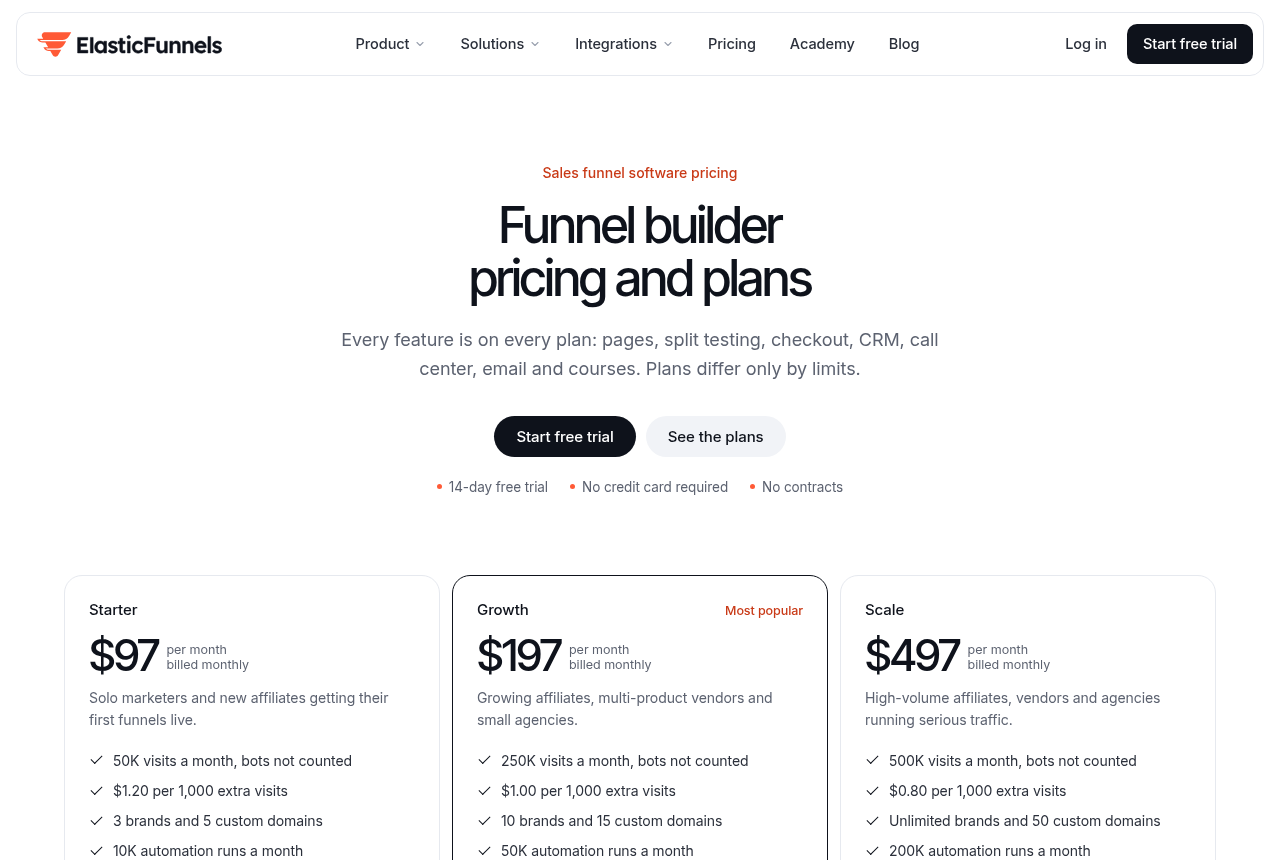
Starter costs $97 a month, Growth $197 and Scale $497 ($937, $1,891 and $4,771 billed yearly). Every feature is on every plan. The plans differ only in usage limits: page views included (50,000, 250,000 and 500,000 a month), brands, custom domains, team seats and automation runs. Extra page views bill at $1.20, $1.00 or $0.80 per 1,000 by plan, so going over does not force an upgrade. Bot and datacenter traffic is not billed. A 0.5% fee applies to revenue through ElasticFunnels' own checkout gateways (Stripe, NMI, PayPal, Klarna, Authorize.net). Sales through external checkouts such as ClickBank or Shopify Checkout carry no fee.
Prices as of 11 October 2026
See the full ElasticFunnels pricing breakdown, tier by tier.
Changelog
- 8 September 2026. First published. Verified pricing and features against the vendor and ranked ElasticFunnels in its category.
Frequently asked questions
How much does ElasticFunnels cost?
Does ElasticFunnels have a free trial?
Ready to try ElasticFunnels?
ElasticFunnels is a funnel platform built for teams that run paid traffic: it builds the pages, splits them behind one URL so your ads never reset, hosts the checkout, and keeps the CRM and the reporting on the same data. Same-URL split testing is the reason most teams switch. Its checkout stands out for multi-MID routing, which splits sales across the NMI merchant accounts you connect and only pays off if you already run more than one. It is newer than the platforms it rivals, though, and third-party proof is thin so far.
Related reading
- Not sold? Read ElasticFunnels alternatives.
- Head-to-head: ElasticFunnels vs ClickFunnels
- Head-to-head: ElasticFunnels vs GoHighLevel
- Head-to-head: ElasticFunnels vs Kartra
- Head-to-head: ElasticFunnels vs Systeme.io
- Head-to-head: Checkout Champ vs ElasticFunnels
- Head-to-head: ElasticFunnels vs SamCart
- Head-to-head: ElasticFunnels vs ThriveCart
- Head-to-head: ElasticFunnels vs Gumroad
- Head-to-head: ElasticFunnels vs Kajabi
- Head-to-head: ElasticFunnels vs Leadpages
- Head-to-head: Unbounce vs ElasticFunnels
- Head-to-head: ElasticFunnels vs Instapage
- Head-to-head: ElasticFunnels vs Landingi
- Which kind of tool: Click tracker vs attribution platform
- Which kind of tool: Multi-Touch Attribution vs Media Mix Modeling
- Which kind of tool: Order Bump vs One-Click Upsell
- Browse all head-to-heads and every review.

Written by
Dana Rourke
Lead reviewer
Dana Rourke is the lead reviewer at Campaign Buyer. She owns the tracker and attribution coverage: reading what long-term users report about each tool, checking its documentation and pricing, and verifying prices with the vendor before writing the verdict. Keeping the rankings honest mostly means writing down what the top pick gets wrong, so she does that first.
Last checked 2026-09-08