Skip to content

Best ad tracker for media buyers

The trackers that record conversions server-side so you stop trusting each ad platform to grade its own homework.

14 trackers ranked, updated 11 October 2026

By Dana Rourke, Lead reviewer. Reviewed by Campaign Buyer Editorial. Updated 11 October 2026. We revisit this page every 90 days.

We ranked these trackers from what long-term buyers report in public threads and review sites, cross-read against each vendor's own documentation and pricing, with every price verified against the vendor page. There are no star scores here. Each tool gets one job it is the best at, and every pick names what it is bad at, including the one we rank first.

Quick answer

Triple Whale is the pick if you buy paid social or run ecommerce and want CAPI without stitching tools together. If that is not you, jump to the tool matching your traffic:

  • 1. Triple Whale is best for Shopify DTC brands wanting attribution and AI insights in one app.
  • 2. Voluum is best for affiliate and native buyers who want a proven, low-friction cloud tracker.
  • 2. Northbeam is best for high-spend DTC brands with a data owner to run the models.
  • 3. Binom is best for high-volume pop, push and native buyers who will self-host.
  • 3. Polar Analytics is best for DTC teams that want their own custom BI dashboards.
  • 4. ClickFlare is best for buyers who want Voluum-class tracking with cost sync and CAPI at a lower flat price.
  • 4. AdsBridge is best for Affiliates and media buyers that want click tracking and hosted landing pages in one low-cost cloud tool.
  • 5. CPV Lab Pro is best for paid-traffic advertisers and CPA affiliates who want to own their data and skip per-event pricing.
  • 6. FunnelFlux is best for buyers running multi-step funnels with lander and offer rotations.
  • 6. Keitaro is best for high-volume affiliate and paid-traffic buyers who will self-host and skip event-based pricing.
  • 7. ClickMagick is best for solo advertisers, affiliates and info-product sellers who want a flat, predictable bill and a morning email that flags what to grow or cut.
  • 8. AnyTrack is best for ecommerce and affiliate marketers who need conversions fed back to the ad networks without a developer.
  • 9. Cometly is best for B2B SaaS teams tying paid ad spend to Stripe or CRM revenue, from first click to closed-won.
  • 10. Rockerbox is best for mid-market and enterprise brands measuring offline and digital together.

Compare the trackers

Feature comparison across 14 tools
Tool CAPI S2S postbacks Cost sync Self hosted Free tier From
1. Triple Whale –Unknown –Unknown –Unknown –Unknown –Unknown Free tier
2. Voluum –Unknown –Unknown –Unknown –Unknown –Unknown $119/mo
2. Northbeam –Unknown –Unknown –Unknown –Unknown –Unknown $1,500/mo
3. Binom –Unknown –Unknown –Unknown –Unknown –Unknown $149/mo
3. Polar Analytics –Unknown –Unknown –Unknown –Unknown –Unknown Not listed
4. ClickFlare –Unknown –Unknown –Unknown –Unknown –Unknown $69/mo
4. AdsBridge ×No ✓Yes Manual ×No ×No $29/mo
5. CPV Lab Pro Pro plan and up ✓Yes Pro plan and up ✓Yes –Unknown $57/mo
6. FunnelFlux S2S to Meta, Google, TikTok, Microsoft ✓Yes via Argosync add-on ×No –Unknown $99/mo
6. Keitaro ✓Yes ✓Yes ✓Yes ✓Yes –Unknown €40/mo
7. ClickMagick –Unknown –Unknown –Unknown –Unknown –Unknown $79/mo
8. AnyTrack –Unknown –Unknown –Unknown –Unknown –Unknown Free tier
9. Cometly –Unknown –Unknown –Unknown –Unknown –Unknown Not listed
10. Rockerbox –Unknown –Unknown –Unknown ×No ×No Not listed

The ranking

1. Triple Whale

Know what's actually working. Act on it instantly.

Triple Whale, captured from the vendor's own site

Our take: It is the pick if you run a Shopify or DTC brand and want attribution and profit dashboards in one place, and you will keep your UTMs clean.

What works

  • Built for Shopify: first-party pixel, MER, blended CAC and profit in one dashboard
  • Lower entry cost than the other serious attribution tools here
  • Fast, operator-friendly dashboards the whole team will actually open

What to watch

  • The first dashboard is rarely right until your UTMs are clean and consistent
  • Paid plans are 12-month commitments priced by GMV
  • Users report data quirks such as VAT counted in revenue, so reconcile against the backend

Read the full Triple Whale review, or see alternatives to Triple Whale.

2. Voluum

Cloud ad tracker for affiliate and media-buying campaigns.

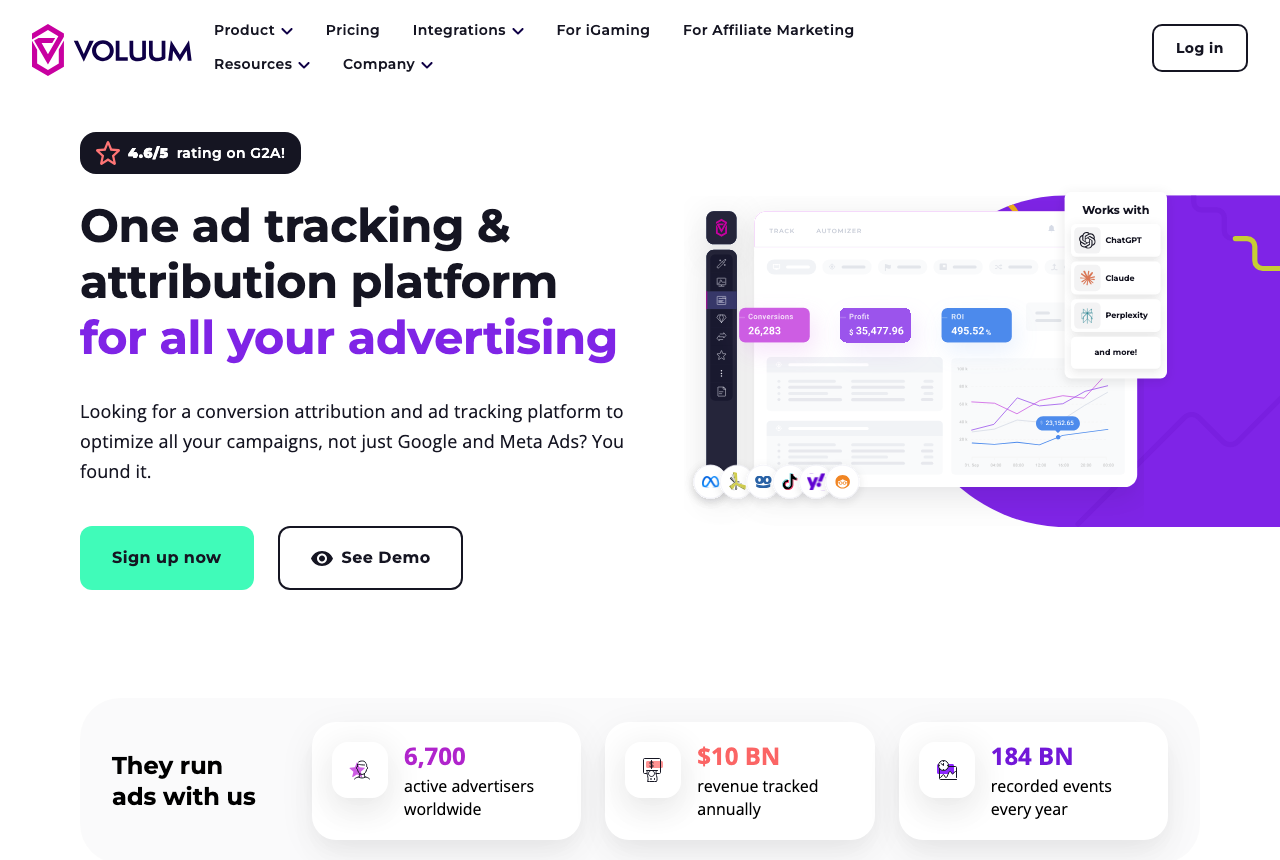
Voluum, captured from the vendor's own site

Our take: Voluum is the pick if you run affiliate or native campaigns and want the proven, low-friction tracker other buyers already use, provided you can absorb the price.

What works

  • The default recommendation for Meta and native affiliate traffic, so setups and integrations are well documented
  • Fast redirect and reporting infrastructure that holds up at volume
  • Anti-fraud and traffic-distribution rules come standard

What to watch

  • The most expensive mainstream tracker: $119/mo billed annually to start, $299 to reach 5M events
  • Event overages are billed on top, so costs are hard to predict as traffic grows
  • You pay for polish you may not need if your funnels are simple

Read the full Voluum review, or see alternatives to Voluum.

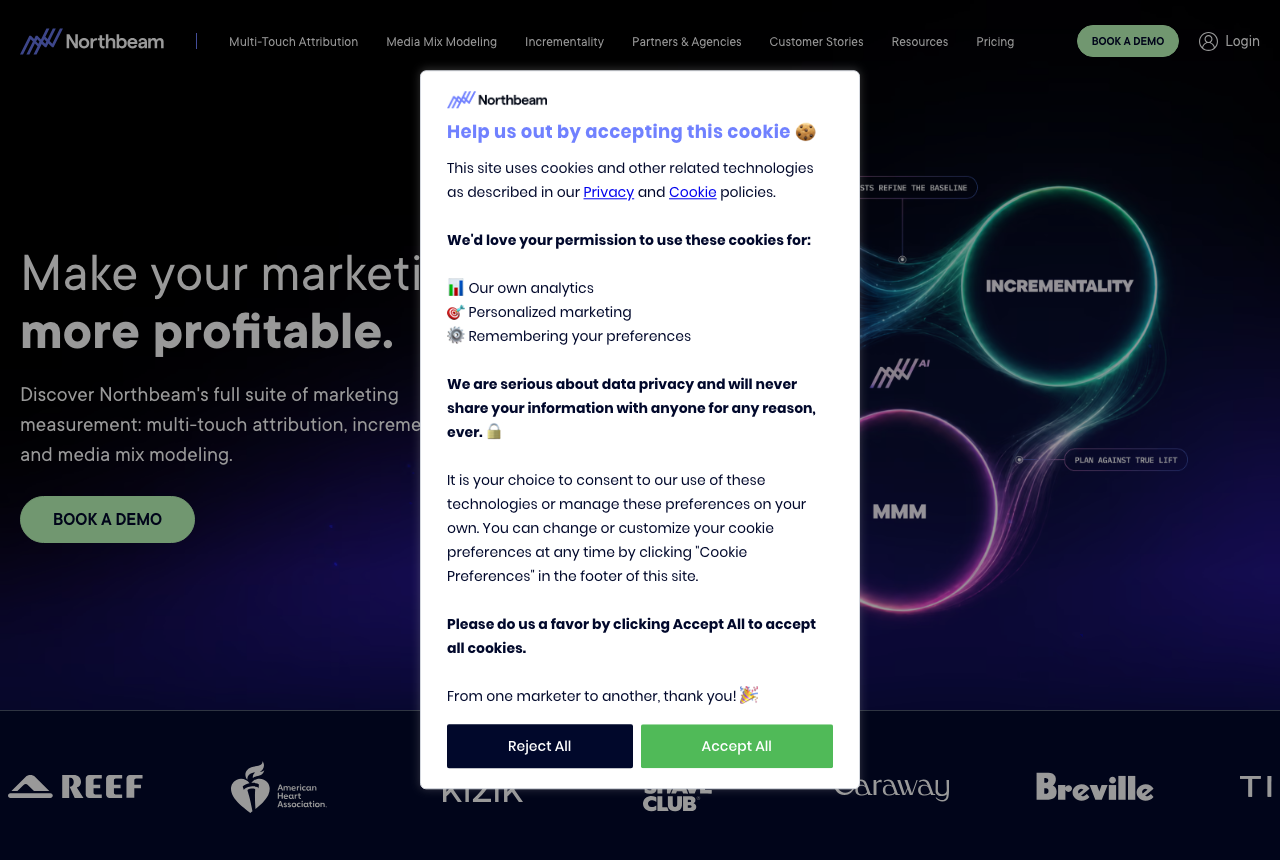
2. Northbeam

The marketing intelligence platform for profitable growth.

Northbeam, captured from the vendor's own site

Our take: Northbeam is the pick if you spend heavily across channels and have an analyst to own multi-touch attribution, media-mix modeling and incrementality.

What works

  • Combines clicks with modeled and deterministic view data for fuller paid-media attribution
  • MTA, MMM and incrementality testing in one platform
  • Built for the scale where measurement decisions move real budget

What to watch

  • Starts at $1,500/mo, a price only a large ad budget justifies
  • Onboarding is hard, and one reviewer paid but could not get the product live
  • Becomes expensive shelfware without someone dedicated to run the model
Price
$1,500/mo
Best for
high-spend DTC brands with a data owner to run the models

Read the full Northbeam review, or see alternatives to Northbeam.

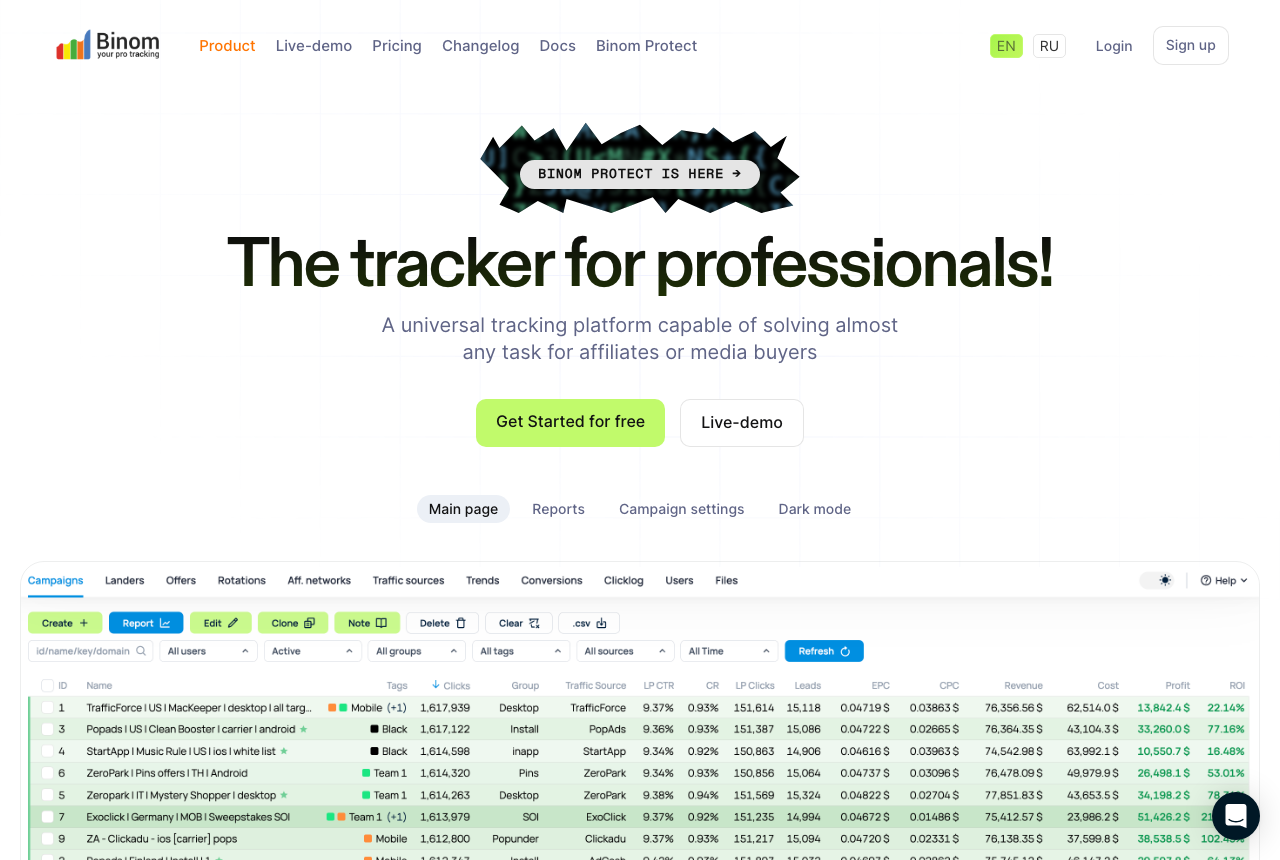
3. Binom

A self-hosted performance-marketing tracker with flat pricing, built for affiliates and media buyers at high click volume.

Binom, captured from the vendor's own site

Our take: Binom is the pick if you push high volume, want to own your data, and have someone who can run a server.

What works

  • Self-hosted, so your data stays on your own infrastructure and there is no per-event tax
  • Flat $149/mo, or $104 billed yearly, with no traffic-volume cap, so cost does not scale with clicks
  • Built for speed at pop, push and native volumes where cloud trackers get expensive

What to watch

  • You run the server, including updates, uptime and scaling
  • The setup is the most technical of any tracker here
  • Support and onboarding assume you already know postbacks and tokens
Price
$149/mo
Best for
high-volume pop, push and native buyers who will self-host

Read the full Binom review, or see alternatives to Binom.

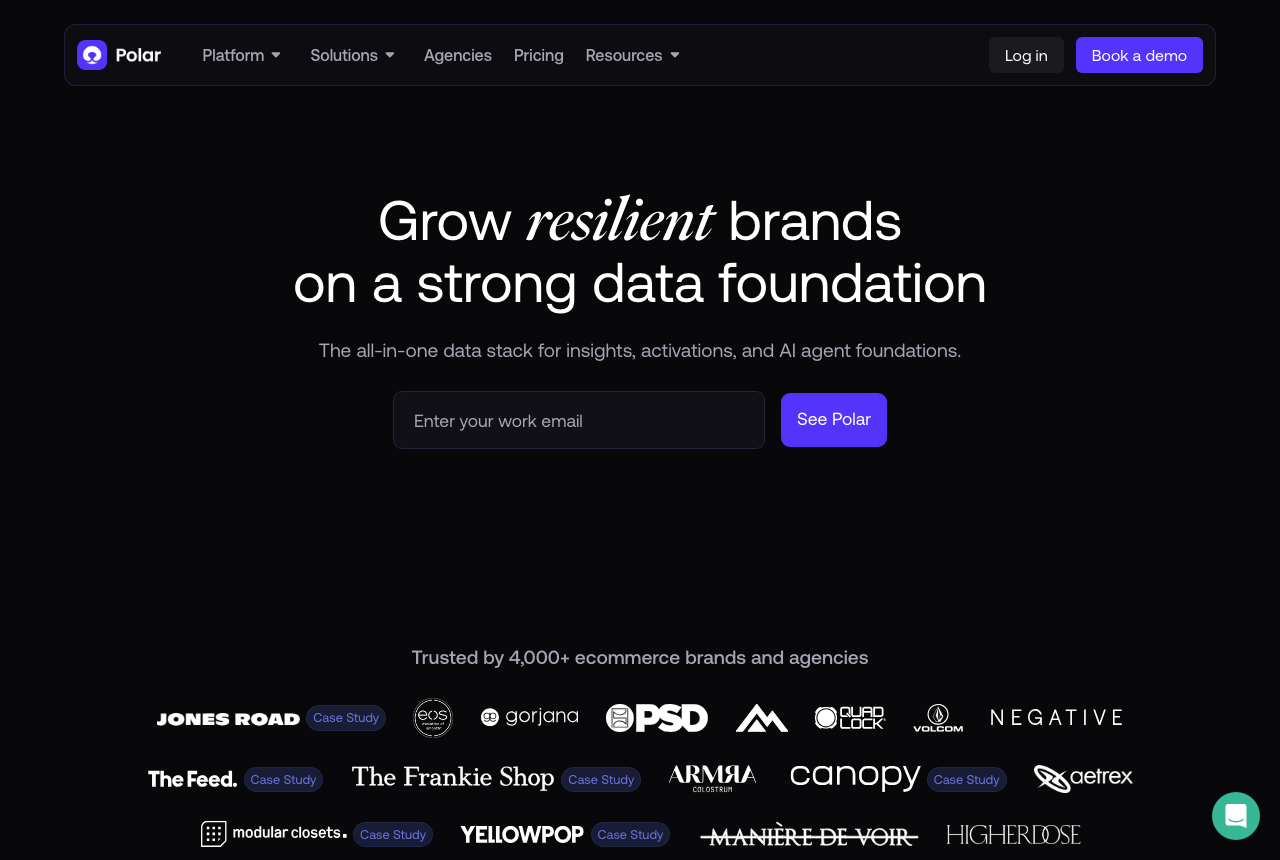
3. Polar Analytics

The unified data platform powering omnichannel growth for modern consumer brands.

Polar Analytics, captured from the vendor's own site

Our take: It is the pick if you run a Shopify store doing real revenue and want to build your own BI dashboards on first-party attribution, rather than live in a prebuilt operator screen. The catch is the bill. Core starts at $750 and is billed on your GMV, so a smaller shop pays more than the data is worth, and reviewers say it tightens up once your attribution needs get deep.

What works

  • Pulls Shopify, ad platform and email or SMS data into custom dashboards you build yourself, not a fixed template, with unlimited users and historical data on the Core plan
  • First-party pixel and server-side tracking, so the numbers survive the browser better than a pixel-only setup
  • Rated 4.9 out of 5 across 117 Shopify App Store ratings, with setup and data centralization the most-praised parts

What to watch

  • Core opens at $750 a month and is priced on your GMV, so the bill climbs with revenue and a small store overpays
  • Buyers report it gets restrictive when you need deep or custom attribution, where Triple Whale goes wider on ecommerce metrics and Northbeam goes deeper on modeling
  • A dedicated success manager only arrives at a $10,000 annual contract, and some reviewers below that flag slow support and connector delays
Price
Not listed
Best for
DTC teams that want their own custom BI dashboards

Read the full Polar Analytics review, or see alternatives to Polar Analytics.

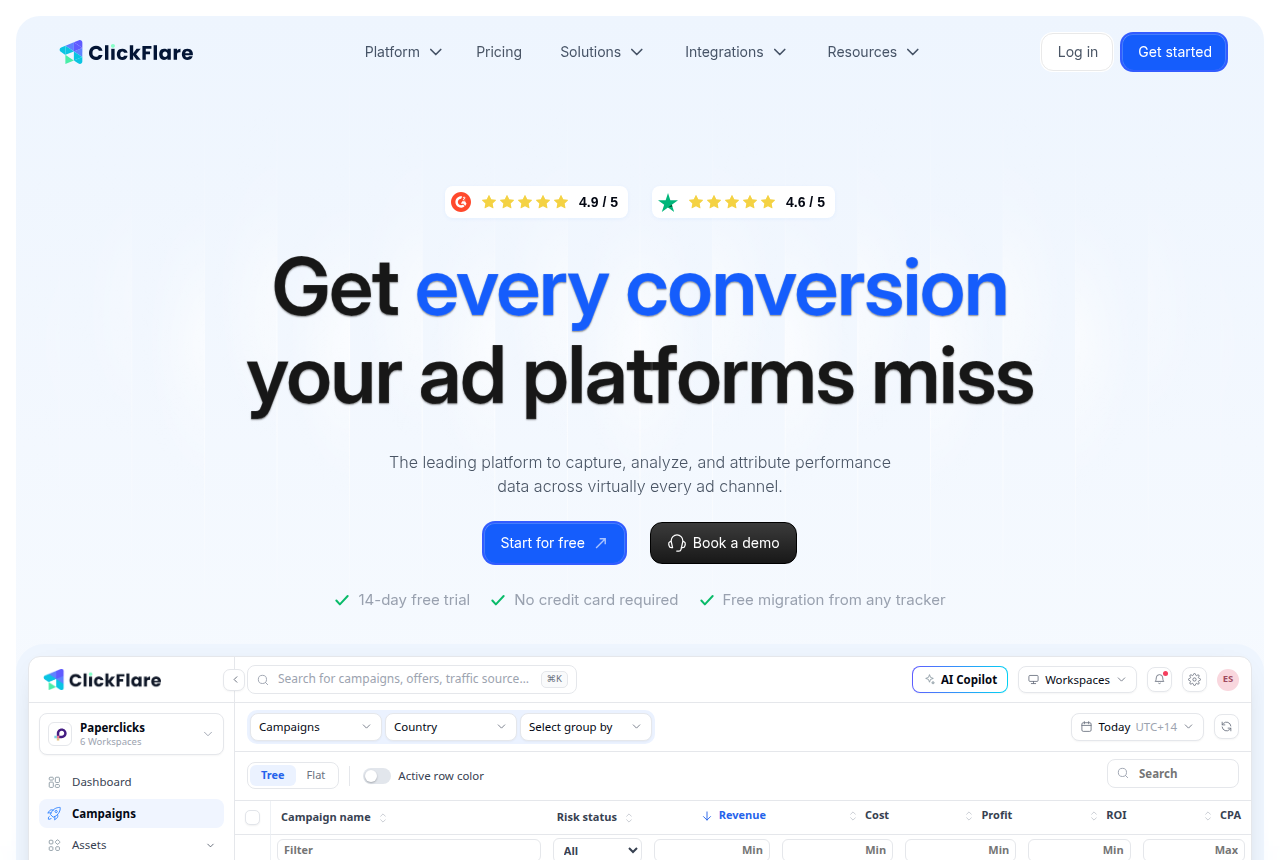
4. ClickFlare

Cloud ad tracker and attribution for performance media buyers, priced flat by events.

ClickFlare homepage on a white background reading 'Get every conversion your ad platforms miss', with a 'Start for free' button, a 14-day free trial note and a sample campaign dashboard.

Our take: ClickFlare is real. It is an established cloud tracker, running since 2021 and used by 3,500-plus media buyers, that does what Voluum and RedTrack do: server-side capture, CAPI to Meta, Google and TikTok, and spend pulled in for you to compute ROI, all on one flat price. You are unlikely to regret it if you run the 14-day no-card trial against your ad platform's own numbers first. The one real caveat is thin public proof, so the trial will tell you more than the review scores can.

What works

  • Cost sync and CAPI are on every tier, including the $69 Starter. You pull your spend in, compute ROI and send conversions to Meta, Google and TikTok server-side, without a paid upgrade and without handing over a cut of your budget.
  • Flat pricing that undercuts Voluum on the same event model. The vendor says the price has not risen since it launched in 2021, and there is no percentage of your budget layered on top.
  • Server-side capture with both redirect and direct tracking, so a blocked pixel or an iOS restriction does not silently drop the form fill or the sale.
  • Free done-for-you migration and fast human support are the two things public reviewers single out most, alongside a setup that is smoother than trackers usually are.
  • A real 14-day trial with no card, plus a 99.99% uptime record since January 2021, so you can prove the tracking on your own traffic before you pay.

What to watch

  • Thin independent proof. A couple of dozen Trustpilot reviews, all five-star, and little organic Reddit discussion. Trustpilot itself flags that the sample may not be representative, so the trial is your real due diligence.
  • Everything counts as an event. Every visit, click, conversion and postback draws down one limit, so high-volume pop or push traffic burns the cap faster than the plan names suggest. Estimate your real event count before you pick a tier.
  • Spend data lags on the lower tiers. Starter and Pro refresh hourly and Master every 30 minutes, with near-real-time updates a paid add-on. On fast-moving campaigns an hour-old ROAS can mislead you.
  • Less battle-tested at extreme scale than Voluum. For the heaviest automation rules and deepest anti-fraud, the older incumbents still have the longer public track record.
  • Billing is charged in advance and is generally non-refundable, and you cancel inside the account rather than by asking support. Export your data before you leave.
Price
$69/mo
Best for
buyers who want Voluum-class tracking with cost sync and CAPI at a lower flat price

Read the full ClickFlare review, or see alternatives to ClickFlare.

4. AdsBridge

A cloud ad tracker with a built-in landing page builder.

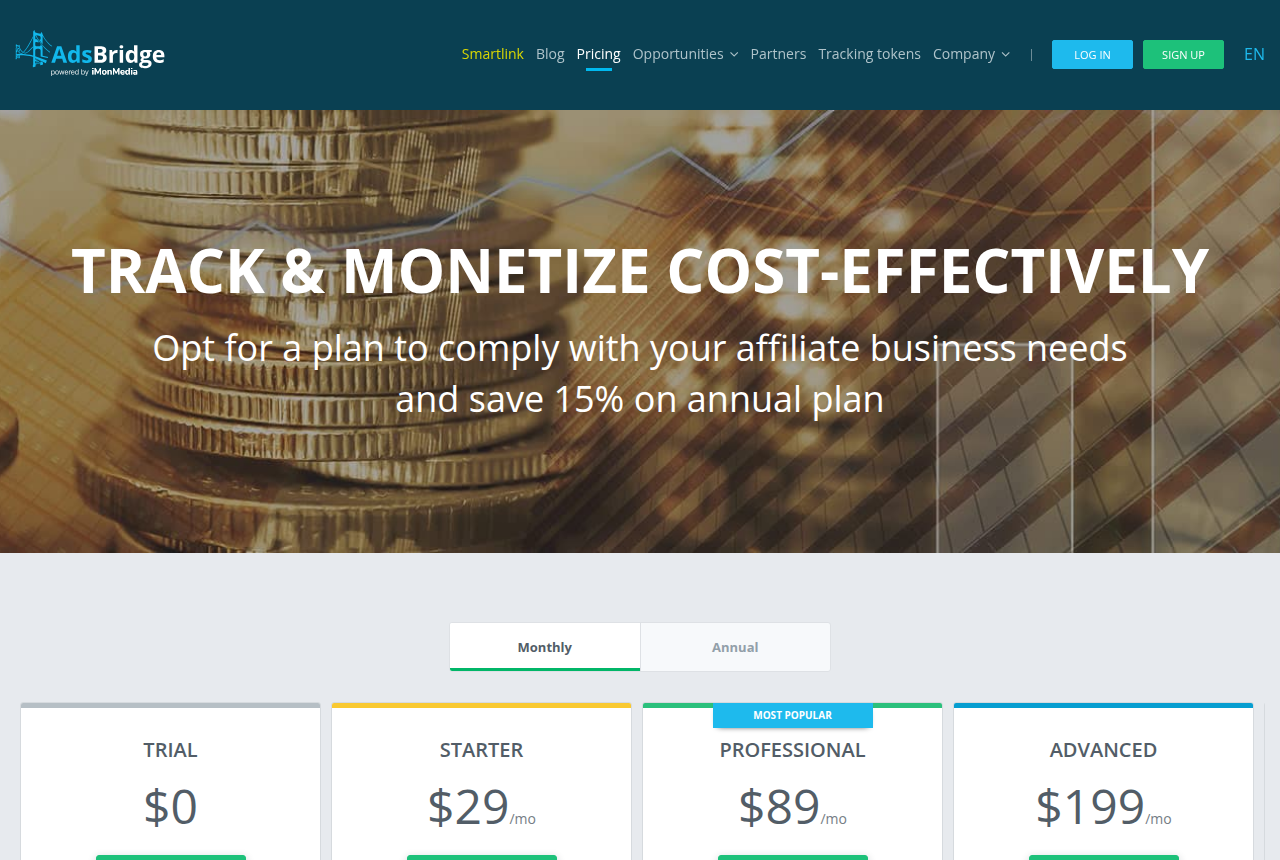
The AdsBridge pricing page, captured from the vendor's own site, showing its Trial, Starter $29, Professional $89 (marked most popular) and Advanced $199 monthly plans.

Our take: AdsBridge is a real, long-running cloud tracker that bundles a landing page builder and split testing for less than Voluum or RedTrack, so it fits an affiliate who wants tracking and pages in one low-cost tool. Skip it if fast redirects at high volume or a native Meta conversion API are what you are paying for, because that is where buyers report it trailing the leaders.

What works

  • Tracking, a drag-and-drop landing page builder and split testing come in one subscription, so a beginner does not pay for a separate page tool.
  • Cheaper entry than Voluum or RedTrack: $29/mo for 100,000 visits, and every plan carries the full feature set with no features gated to higher tiers.
  • Prices by monthly visits rather than events, which is easier to predict than event-based billing when a campaign scales.
  • Established since 2013 on AWS infrastructure, with 100-plus one-click network integrations, an anti-fraud filter and a redirectless tracking mode.

What to watch

  • Redirect speed is the recurring complaint. A community speed test clocked its redirects slower than several rivals, which matters most on mobile traffic.
  • Reviewers report stability flaws once daily volume gets extreme, and the dashboard can feel slow at times.
  • No native Meta or Google conversion API. It leans on server-to-server postbacks, so paid-social buyers who want CAPI are better served elsewhere.
  • Thin independent proof. Its G2 profile has too few reviews to be useful, so most write-ups are affiliate blogs rather than heavy buyer feedback.
  • No permanent free tier, only a 14-day trial, and AdsBridge states it issues no refund on cancellation.
Price
$29/mo
Best for
Affiliates and media buyers that want click tracking and hosted landing pages in one low-cost cloud tool

Read the full AdsBridge review, or see alternatives to AdsBridge.

5. CPV Lab Pro

The self-hosted performance marketing tracker for media buyers, agencies and ecommerce.

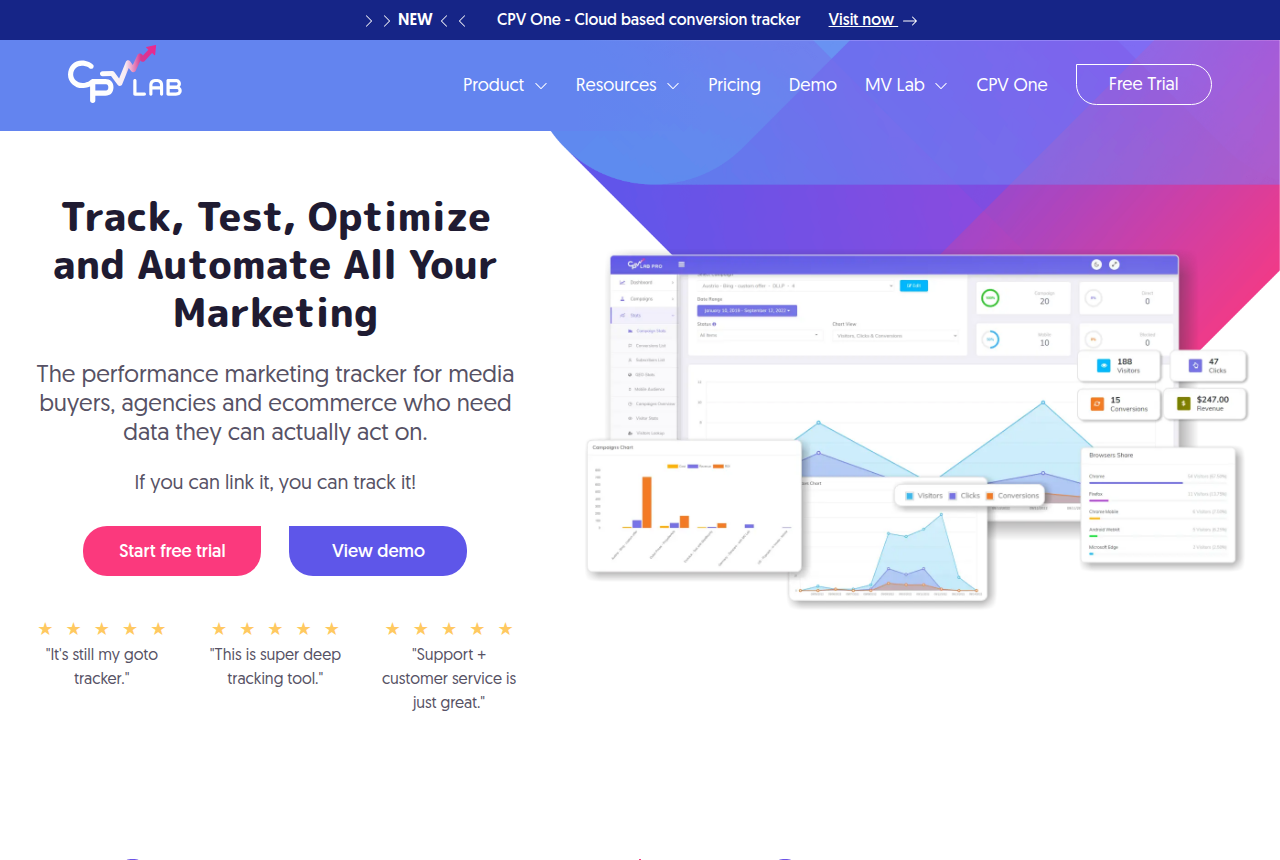
The CPV Lab Pro home page on a white ground, headline 'Track, Test, Optimize and Automate All Your Marketing', with 'Start free trial' and 'View demo' buttons and rows of five-star user testimonials.

Our take: CPV Lab Pro is real, and it is one of the longer-running trackers in the category: a self-hosted performance marketing tracker media buyers have run for a decade. If you buy paid traffic, want unlimited events with no click limits or overage fees, and are comfortable running your own server, you are unlikely to regret it. The catch is the deployment. You supply and maintain a VPS, the features you probably came for (CAPI and automatic cost sync) start on the $97 Pro plan, and its independent review footprint is thin, so lean on the 14-day trial to prove it on one real campaign before you commit.

What works

  • Unlimited events, no click limits, no overage fees, on every plan. You can pour traffic at a winning campaign without watching a meter, while the bill at event-metered Voluum and RedTrack climbs with volume.
  • You own the data. It is self-hosted on your own Linux server, so your click logs and campaign data sit on hardware you control rather than a vendor's cloud. For many long-term affiliates that is the whole reason they run it.
  • Cookieless server-to-server postback tracking that keeps firing on iOS and in privacy browsers, with 30-plus data points per click, bot and proxy filtering, A/B testing of landers and offers inside the tracker, and multivariate testing on the top plan.
  • Support is the part users praise most. Across the affiliate forum afflift and Trustpilot the repeated note is fast, knowledgeable help that walks you through postback and CAPI setup by name, and the vendor helps with the initial install at no cost.
  • Predictable cost, and a lifetime option. Starter is $57/mo and Pro $97/mo, and one-time lifetime licences let you own the software outright instead of subscribing. No per-event bill to model.

What to watch

  • Self-hosting is the real cost and the real risk. It runs on your own Linux VPS (PHP 8.1 to 8.4, MySQL or MariaDB, ionCube), a separate bill and your job to keep fast, patched and online. The cheap unlimited tracking is only as good as the machine under it. If server administration is not your thing, the cloud sibling CPV One or a managed tracker like RedTrack fits better.
  • Expect a learning curve. Reviewers who like the tool still say the number of campaign types, settings and reports can overwhelm a beginner, so budget setup time.
  • The features you probably came for start on Pro. CAPI, automatic ad-spend cost sync and API access are not on the $57 Starter plan, so the real entry price for a modern paid-media setup is $97/mo.
  • Thin independent proof. Trustpilot sits at 3.8 from only 16 reviews, and most public praise lives on affiliate forums rather than the large review sites, a smaller footprint than Voluum or RedTrack. The 14-day trial is the due diligence the review count cannot give you.
  • Overkill for a content-site affiliate. If all you need is which blog link got clicked, a link cloaker or your network's sub-ID report is simpler. This is far more tracker than that job wants.
Price
$57/mo
Best for
paid-traffic advertisers and CPA affiliates who want to own their data and skip per-event pricing

Read the full CPV Lab Pro review, or see alternatives to CPV Lab Pro.

6. FunnelFlux

Visual funnel tracker for performance marketers

FunnelFlux, captured from the vendor's own site

Our take: FunnelFlux Pro is the pick if you run multi-step funnels and want to see the whole journey as a map instead of a table of clicks.

What works

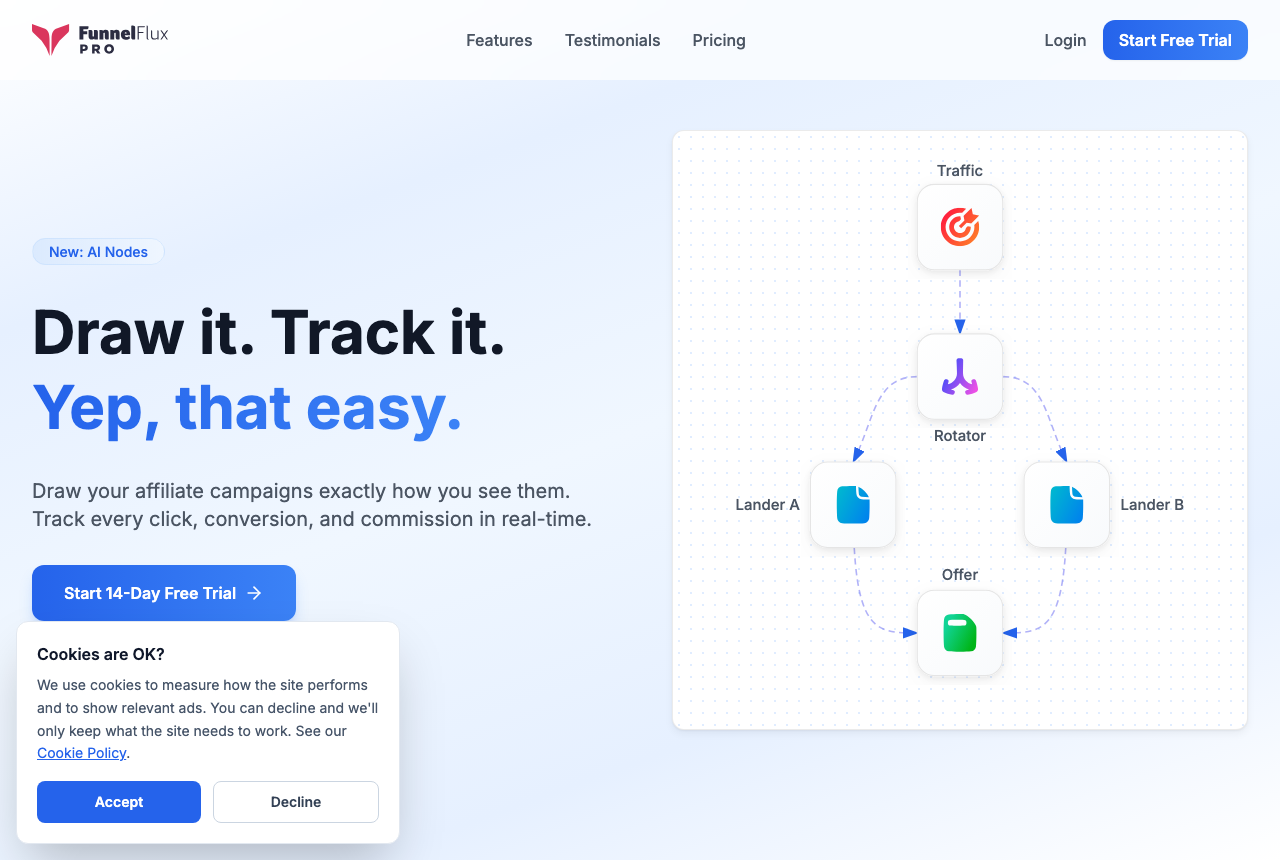
  • A visual funnel canvas: landers, offers, rotators and conditional routing wired together on one screen
  • Node-level reporting shows exactly where a funnel leaks
  • Predictable pricing: a $99/mo base plus $10 per extra million events

What to watch

  • Expect a learning curve: the routing options take real setup time to master
  • Automatic cost sync needs a separate product, Argosync
  • A smaller community than Voluum or RedTrack, so fewer guides when you get stuck

Read the full FunnelFlux review, or see alternatives to FunnelFlux.

6. Keitaro

Self-hosted attribution and ad performance tracker for media buyers

The Keitaro home page on a white ground, headline 'Attribution and Ad Performance Tracker', with 'Start tracking' and 'Live demo' buttons.

Our take: Keitaro is real, and it is one of the most established self-hosted trackers media buyers run: its maker Apliteni has shipped it for years and says more than 4,000 businesses use it. If you buy paid traffic at volume, want to own your data, and are comfortable running a Linux server, you are unlikely to regret it. The catch is the model. It is self-hosted only, so you rent and maintain your own VPS. There is no free trial, so trying it means buying a license. And when server-side tracking breaks, the loudest complaint is that support can be slow to resolve it. Use the live demo and one small campaign to prove it before you commit.

What works

  • Self-hosted, so your click data lives on hardware you control and nothing meters your events. The license costs the same whatever your click count, which is the main reason high-volume pop, push and native buyers pick it over event-priced cloud trackers like Voluum and RedTrack.
  • Deep traffic routing and filtering. It splits visitors to different landing pages and offers by GEO, device, OS, browser, connection and source ID, across 35+ tracking parameters, so one tool handles the tracker, the routing and lander rotation.
  • Server-side postbacks and conversion sync on every individual plan. It fires S2S postbacks and sends conversions back to Meta, Google and TikTok through their APIs, and pulls ad spend in so reports show real cost and ROI.
  • Support and price are what long-term users praise most. Across Trustpilot the repeated note from people running it for one to several years is fast, knowledgeable help and a low price relative to cloud trackers.
  • A built-in landing page editor, custom domains with SSL, and bot filtering, so there are fewer separate tools sitting between your tracker, your lander and your offer.

What to watch

  • Self-hosted only, and that is the real cost and the real risk. You rent a clean Linux VPS (CentOS 9 or 10 Stream, 4GB RAM minimum), and keeping it fast, patched and online is your job. There is no cloud version, so if server operations are not your thing, a managed tracker like RedTrack or Voluum fits better.
  • No free trial. To try it properly you buy a license, though there is a public live demo and a refund policy. That is more commitment up front than the card-free trials most cloud trackers offer.
  • When tracking breaks, resolution can be slow. The sharpest critical review reports 502 errors on server-side conversion tracking and inaccurate cost attribution, with support acknowledging the problem but giving no timeline for a fix, which for a media buyer means daily lost optimization while it is open.
  • A real learning curve. DNS, SSL, Cloudflare settings, server load, PHP-FPM tuning and postback debugging are all on you, and reviewers who like the tool still say the number of settings and reports can overwhelm a beginner.
  • Live chat keeps business hours. Support is online roughly 06:00 to 16:00 GMT on weekdays, so a launch that breaks overnight in your timezone waits until the next window.
Price
€40/mo
Best for
high-volume affiliate and paid-traffic buyers who will self-host and skip event-based pricing

Read the full Keitaro review, or see alternatives to Keitaro.

7. ClickMagick

First-party ad tracking and conversion attribution for paid traffic.

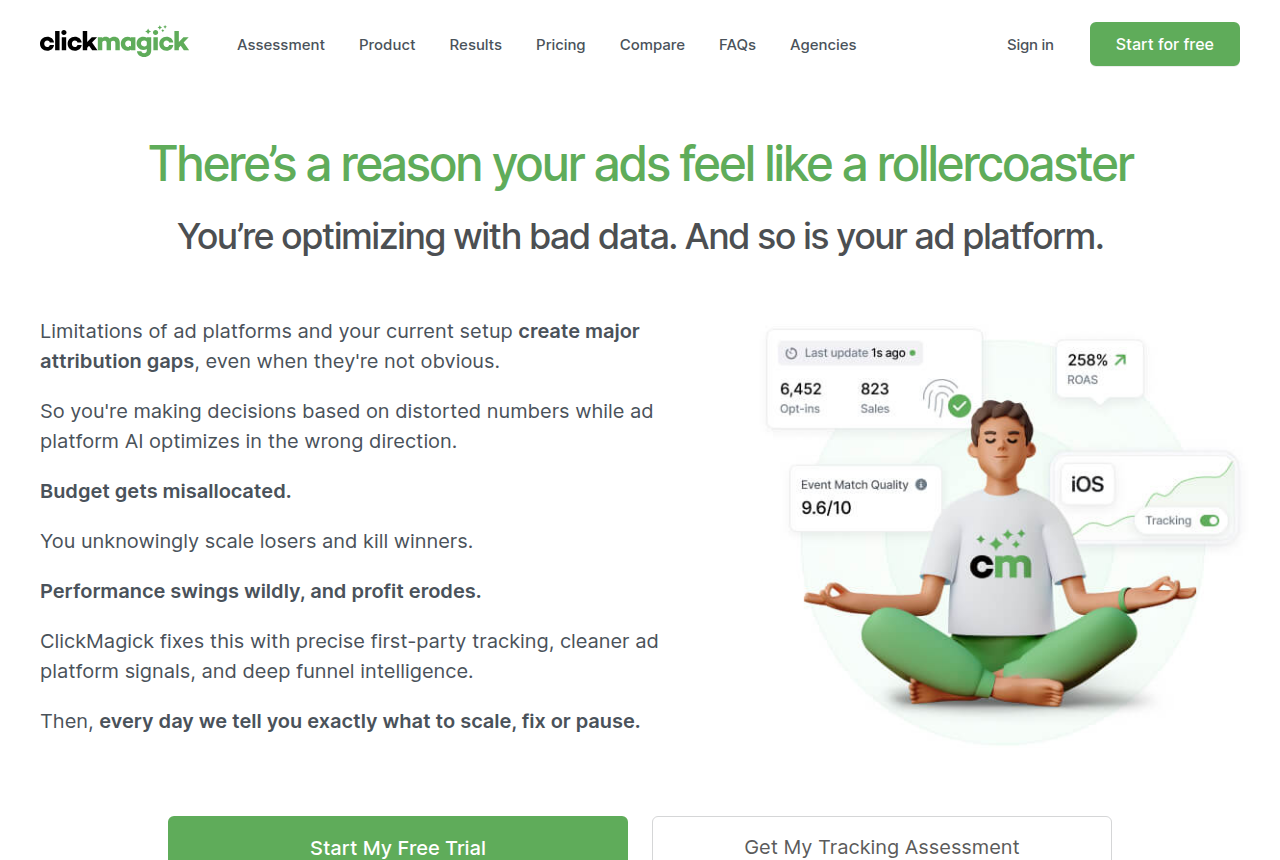
The ClickMagick home page, headlined "There's a reason your ads feel like a rollercoaster", with a meditating figure and floating cards showing ROAS, event match quality and iOS tracking

Our take: ClickMagick is the pick if you are an affiliate, a solo advertiser or an info-product seller who wants a flat monthly bill and a morning email telling you what to scale or cut, and you can live with an entry plan that tracks only 10,000 visitors.

What works

  • Flat monthly price based on the visitors you track, not a cut of your revenue, so the bill does not climb every time a campaign wins.
  • First-party TrueTracking with a custom domain and CAPI feeds cleaner conversion data back to Meta, Google and YouTube, which users credit for better ad optimization.
  • The Morning Magick email reads your stats each morning and names what to scale, pause or fix, which suits a solo buyer with no analyst.
  • Support is the most-praised part in public reviews: fast replies, often the same day, sometimes with screen recordings.

What to watch

  • The Starter plan tracks just 10,000 visitors for $79, so anyone buying real volume is pushed to the $199 Standard tier fast.
  • Independent proof is thin. There is no meaningful G2 or Capterra presence, and ClickMagick stopped maintaining its Trustpilot page after disputing fake reviews, so you lean on the vendor's own case studies more than you would like.
  • Its numbers will differ from what the ad network reports, so reconcile them against GA4 and your backend before you move budget.
  • Setup rewards patience. Postbacks, cross-domain tracking and CAPI all need wiring, and a botched setup is behind most of the accuracy complaints.
Price
$79/mo
Best for
solo advertisers, affiliates and info-product sellers who want a flat, predictable bill and a morning email that flags what to grow or cut

Read the full ClickMagick review, or see alternatives to ClickMagick.

8. AnyTrack

No-code conversion tracking that feeds server-side data back to Meta, Google and TikTok.

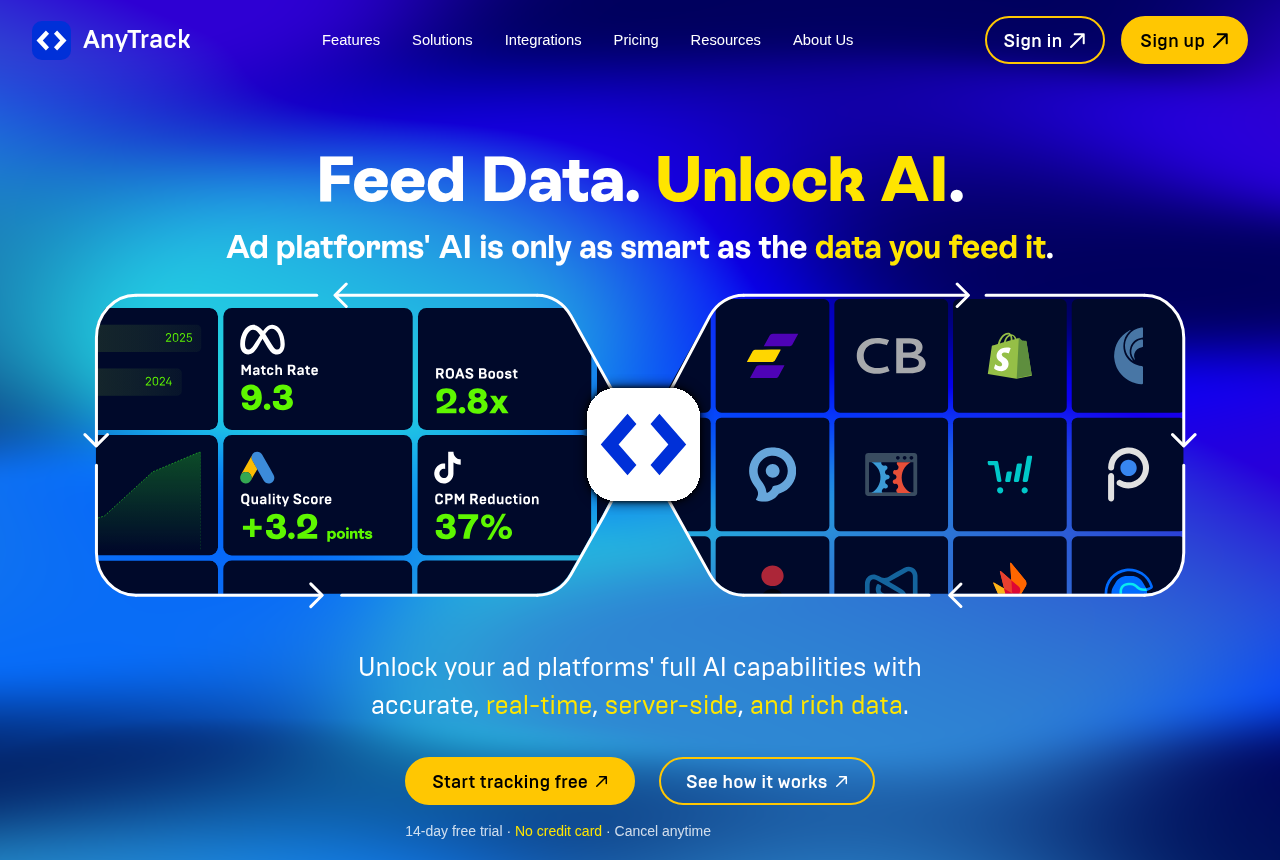
AnyTrack homepage hero on a deep blue background reading 'Feed Data', with a 'Start tracking free' button and a line noting it feeds cleaner data to ad platforms for more than 1,000 brands.

Our take: AnyTrack is the pick if you run paid traffic to a Shopify store or affiliate offers and want conversions fed back to Meta, Google and TikTok without wiring server-side tracking yourself. Test the support and watch the session-based bill before you commit.

What works

  • No-code setup. You connect the tag and your ad accounts from a dashboard instead of standing up a server-side Google Tag Manager container.
  • Server-side and client-side tracking run together, so a blocked pixel or an iOS restriction does not silently drop the conversion.
  • Feeds conversions back to seven ad platforms through the Conversion API, and covers 90+ affiliate networks, ecommerce platforms and CRMs out of the box.
  • A real free plan and a 14-day trial with no credit card, so you can prove the tracking before you pay.

What to watch

  • Support and billing draw the most complaints. Unanswered tickets and trial-cancellation disputes recur across Trustpilot and PPC threads, so test support inside the trial.
  • Thin independent proof. Two reviews on G2 and 3.4 out of 5 from eleven reviews on Trustpilot make it hard to sanity-check against the crowd.
  • Session-based pricing with automatic overage. A traffic spike pushes you past your cap and bills $0.40 to $0.20 per 1,000 sessions, and you cannot switch it off on a paid plan.
  • No automatic ad-spend sync. Unlike RedTrack or Voluum it does not pull your cost in, so ROI across sources has to be computed somewhere else.
Price
Free tier
Best for
ecommerce and affiliate marketers who need conversions fed back to the ad networks without a developer

Read the full AnyTrack review, or see alternatives to AnyTrack.

9. Cometly

AI marketing attribution for B2B SaaS: tie ad spend to pipeline and closed-won revenue.

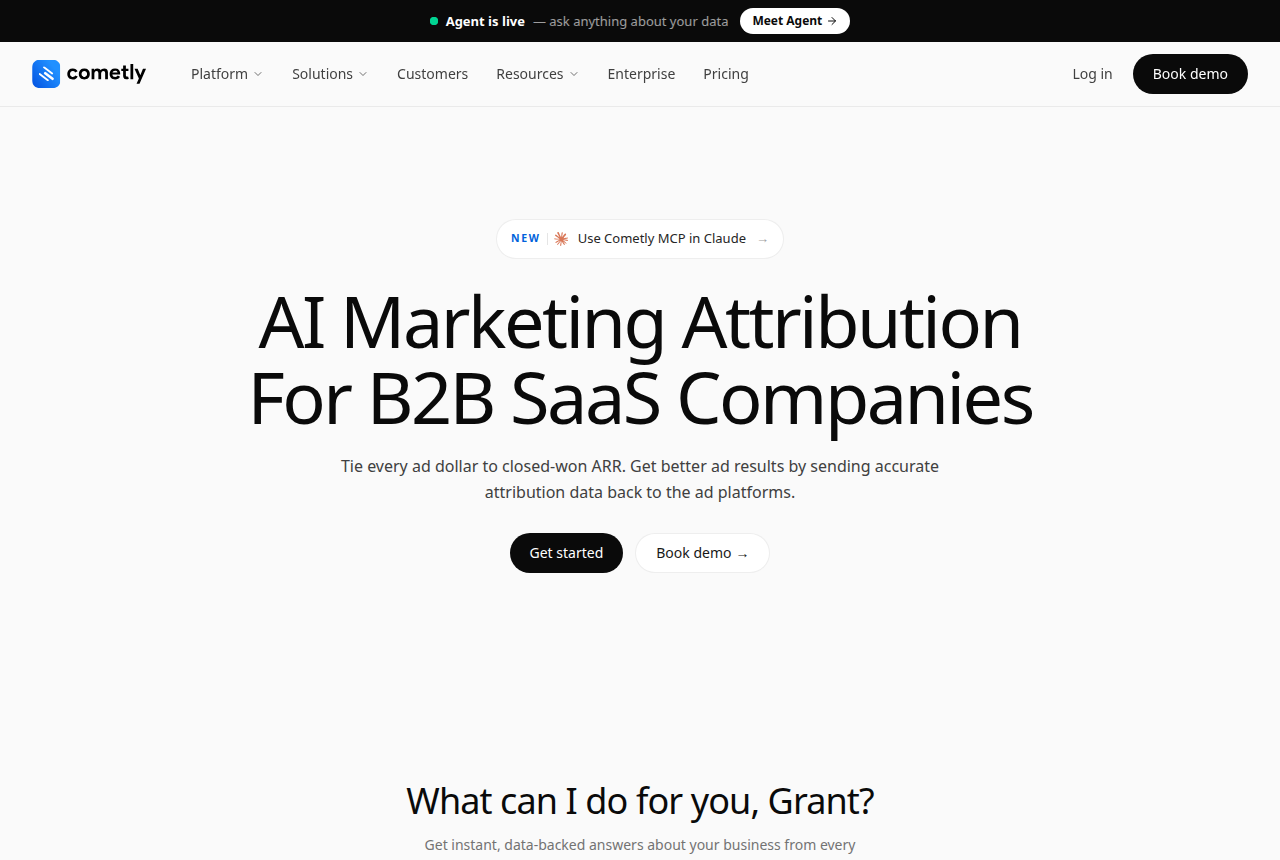
The Cometly home page on a dark ground, reading 'AI Marketing Attribution for B2B SaaS Companies' with a sample sales-by-source table and 'Get started' and 'Book demo' buttons.

Our take: Cometly is a working B2B SaaS marketing attribution platform with named customers and a 4.8 G2 record, built to tie paid ad spend to Stripe revenue and CRM pipeline, from first click to closed-won. You are unlikely to regret it if that is your job and the live demo proves the tracking on your own data first. It publishes no price and offers no free trial, so that demo is the proof you get before you commit.

What works

  • Ad spend is matched to revenue that reached Stripe. The Comet Pixel and server-side events feed Stripe revenue and CRM deal stages into the attribution, so you see which campaign produced pipeline and closed-won revenue, with MRR and LTV attached.
  • Server-side Conversion API to seven ad platforms, on both plans. It sends deal-stage-aware events to Meta, Google, LinkedIn, TikTok, Microsoft, Reddit and Snapchat, so the bidding optimizes toward paying customers. The vendor claims Meta event match quality up to 9.3 out of 10.
  • Multi-touch models built for long B2B journeys. First, last, linear, U-shaped and data-driven attribution, with the full pre- and post-form touch history written onto each deal in HubSpot or Salesforce, which is the part a CRM's own tracking usually cannot see across a weeks-long sale.
  • A strong, consistent G2 record. 4.8 out of 5 from 36 reviews, 34 of them five-star, with praise clustering on attribution accuracy, custom-event tracking and fast, human support. One reviewer reported accurate tracking on over $100,000 a month in ad spend.
  • 70-plus native integrations and done-for-you onboarding. Stripe, HubSpot, Salesforce, Close, HighLevel and the major ad platforms connect in minutes, and a specialist wires your stack up, which matters because attribution is only ever as good as its setup.

What to watch

  • No public pricing. The two plans, Core and Enterprise, carry no numbers. Pricing is usage-based on your monthly pageviews and quoted on a sales call, so you cannot line its cost up against a competitor before you talk to sales. Some buyers report the quote feels high, one G2 review titled bluntly "Not worth of it's price."
  • Cometly offers no free trial, arguing that attribution needs your CRM and ad platforms wired up first, and sells a paid onboarding instead. You commit, or at least pay to get set up, before you see it run on your own traffic, which makes the live demo the one look at your real numbers you get up front.
  • Thin proof outside G2. Trustpilot sits at 3.6 from 92 reviews and flags that only a handful are recent and the sample may not be representative, and there is no clear Capterra listing. The G2 record is good but small, so the trial you cannot take is exactly the due diligence you would most want.
  • Its models will not perfectly match Meta, Google, GA4 and your bank at once, and its accuracy depends on your UTMs and CRM hygiene. Use its numbers to choose where the next dollar goes, and reconcile them against a second source.
  • Some rough edges reviewers name. A couple report documentation that lags the actual app, one flags pricing changing after they signed, and a Trustpilot reviewer found it "just another tool with a bunch of complicated options." None is disqualifying, but budget setup time and expect to lean on support early.
Price
Not listed
Best for
B2B SaaS teams tying paid ad spend to Stripe or CRM revenue, from first click to closed-won

Read the full Cometly review, or see alternatives to Cometly.

10. Rockerbox

Unified marketing measurement that combines attribution, media-mix modeling and incrementality testing.

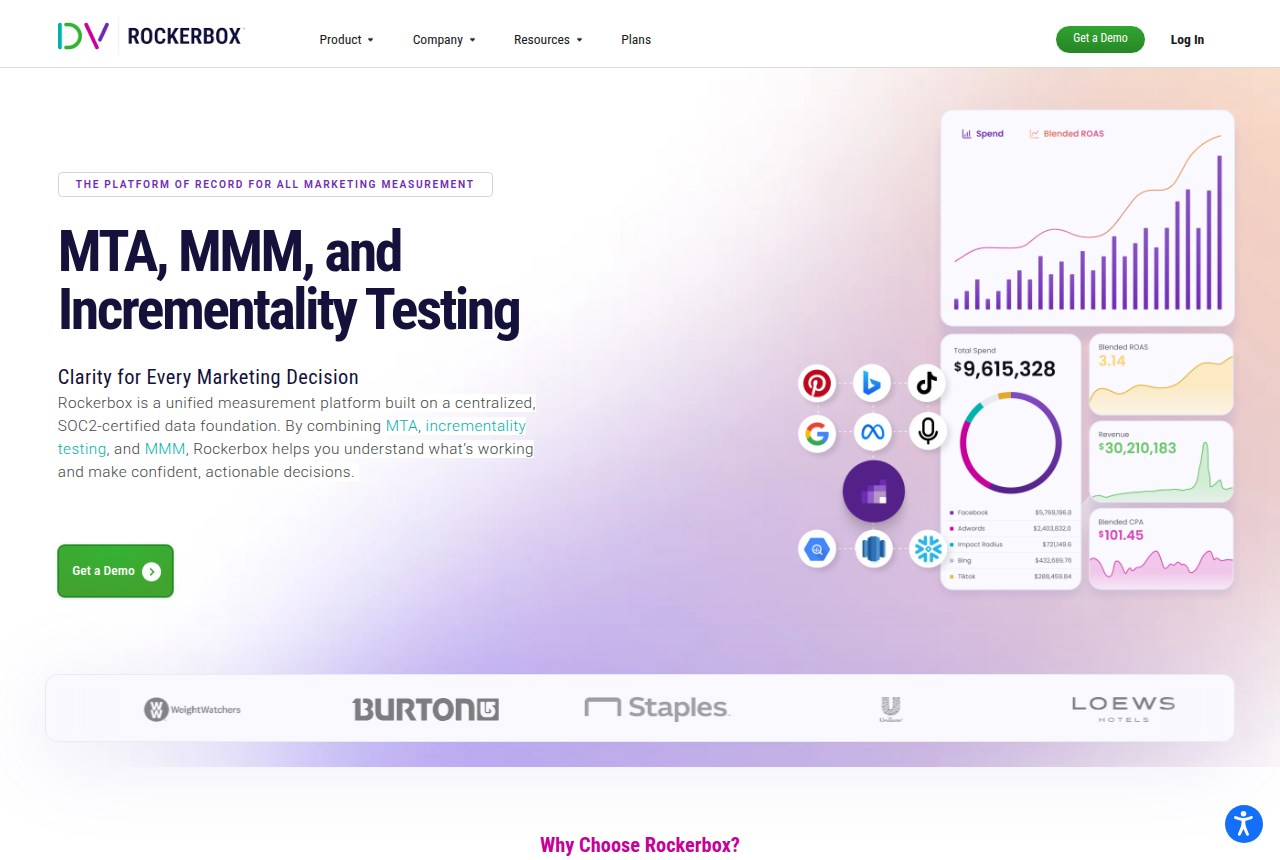
The Rockerbox home page, headlined The Platform of Record for All Marketing Measurement, captured from the vendor's site

Our take: Rockerbox is real, well-established and now owned by DoubleVerify, so the risk is not whether it works. It is a question of fit and cost. Buy it if you are a mid-market or enterprise brand spending across many channels, including offline like connected TV, direct mail and podcasts, and you have a data owner to run it. Skip it if you are a small Shopify store on Meta and Google, where the price, the demo-gated quote and the six to eight week setup will cost more than the payoff.

What works

  • Runs multi-touch attribution, marketing mix modeling and incrementality testing on one data foundation, so you cross-check three methods instead of trusting a single number
  • Measures the offline and view-through channels most tools ignore: connected TV, linear TV, direct mail, podcasts and billboards, reconciled next to digital
  • Exports its cleaned first-party dataset to your own warehouse (BigQuery, Redshift, Snowflake), so the numbers feed your BI stack rather than locking you into its dashboards
  • SOC2-certified data foundation, and since March 2025 the backing of a public parent in DoubleVerify

What to watch

  • No public pricing and no self-serve. You book a demo and get a custom quote pitched at mid-market and enterprise budgets, so a small store cannot price it before a sales call
  • Setup is heavy: MTA or MMM take about six to eight weeks and need developer time plus Rockerbox's own team, and it becomes shelfware without a data owner to run it
  • Reviewers report reporting bugs and dashboards that break, especially on view-through channels like TikTok and YouTube where platforms share less data
  • Every figure is a modelled estimate, so it needs a reader who can act on ranges, even with incrementality tests calibrating the models
Price
Not listed
Best for
mid-market and enterprise brands measuring offline and digital together

Read the full Rockerbox review, or see alternatives to Rockerbox.

Other rankings we publish

This page ranks ad trackers. The rest of the paid-traffic stack has its own rankings, judged the same way.

Winners by segment

Paid social and ecommerce. Winner: RedTrack, for CAPI at $69/mo billed annually. Runner-up: Triple Whale if you are Shopify-first and want profit dashboards alongside attribution.

Affiliate and native. Winner: Voluum, the documented default. Runner-up: FunnelFlux Pro if your profit comes from optimizing multi-step funnels.

High-volume pop, push and native. Winner: Binom, flat-priced and self-hosted. Runner-up: Voluum if you will not run a server.

Beginners and light spend. Winner: BeMob, for a real free tier. Runner-up: RedTrack once your spend justifies CAPI.

Selling your own offer, where the funnel does the tracking. Not everyone in affiliate marketing needs a standalone tracker. If you sell your own product and recruit affiliates to push it, and the sale closes in a funnel you run, the conversion tracking can live inside that funnel instead of in a separate tool. Winner: ElasticFunnels, a funnel platform that builds the pages and hosts the checkout. Its affiliate postbacks fire server-side straight from that checkout on a purchase, refund or chargeback, so your network or your partners get credited without a second tool in the click-to-sale path. That reporting covers sales that close in a funnel it hosts, so if you also send traffic to offers that close on someone else's page, you still need a dedicated tracker for those. The catch, said plainly: it is newer than every tracker on this page, and there is very little independent review coverage to check its claims against, so until you run real volume through it you are largely taking the vendor's word for it. Runner-up: RedTrack if you also buy paid traffic to that offer and would rather keep click-to-sale tracking in one dedicated tool.

What to avoid

  • A free tier as your permanent setup. BeMob's 100K free events vanish once you log impressions. A free plan is for learning, not for running a real budget through.
  • Redirect links straight off Google, Microsoft or Meta traffic. Buyers report accounts flagged for it. Use a landing page and a pixel or CAPI, not a bare third-party redirect.
  • Self-hosting without the skills. Binom's economics only pay off if you can keep a server patched and up. If you cannot, the flat price is a false saving.
  • Trusting one number. No tracker is truth. Reconcile it against the platform, GA4 and your backend before you move budget.

How we researched this

We read what long-term users report about each tracker in public threads and on review sites, worked through each vendor's own documentation on postbacks, CAPI and event handling, and verified every price against the vendor's pricing page. Where users report a number that only the vendor states, we say so rather than repeat it as fact.

We weighted four things: does the conversion data survive iOS and ad blockers, how far users report the tracked profit drifting from platform ROAS, how much setup the tool demands before it is trustworthy, and whether the pricing model punishes you as traffic grows. We rank by order, not by a score out of ten. The full rubric is on our how we research page.

How to choose

Start with your traffic source, because it decides more than any feature list. Meta and native affiliate traffic points you at Voluum. Everything else, especially paid social and ecommerce that needs conversions sent back through CAPI, points at RedTrack.

Then check your volume against the pricing model. Cloud trackers bill by events, so a traffic spike moves your bill. If your monthly event cost starts to approach what a server would cost, and you can run one, Binom's flat, uncapped price wins. If you are still learning, start free on BeMob and graduate later. If your funnels are genuinely multi-step, FunnelFlux Pro's visual canvas will show you leaks a campaign table hides.

Whatever you pick, budget setup time. Every tracker here rewards a careful configuration, and none of the reported numbers should be trusted until they reconcile against a second source.

How to set one up and run it, step by step

The words on the buttons change from tool to tool, but the setup is the same shape across every tracker here. The word "simple" describes the starting mode, not a shortcut: you still wire four things together, test that they talk, and reconcile the numbers before you act on them. Here is the order that avoids the mistakes buyers report, with the one step that changes by tool called out.

  1. 1. Connect your traffic source first. Add each ad platform (Meta, Google, a native network) inside the tracker so it can pull spend automatically and match it to clicks. Without cost sync you see conversions but not profit, and profit is the only number worth the subscription. RedTrack and Voluum both pull spend from the major platforms on a schedule; BeMob and the self-hosted tools can import it too, with more manual setup on the cheaper tiers.
  2. 2. Add the offer and find its conversion hook. Whether you promote a network offer or your own product, the offer side needs a way to tell the tracker a sale happened. In an affiliate network, paste the tracker's postback URL into the network's postback field and map the click-id token it expects (often {clickid} or subid). If the sale closes on your own checkout, you point that checkout's conversion webhook at the same tracker URL instead.
  3. 3. Build the campaign and take the tracking link. Create a campaign, attach the traffic source and the offer, and the tracker hands you a tracking link carrying a unique click id. That click id is the thread the whole system follows, so every link, redirect and pixel after it has to pass it along untouched.
  4. 4. Place the link and carry the click id through your page. Put the tracking link in the ad, or send the ad to a landing page and pass the click id into the offer link on that page. If the click id gets dropped between the ad and the offer, the conversion comes back with nothing to attach to, and you are back to guessing.
  5. 5. Wire the conversion back server-side. This is the step that separates a tracker from a spreadsheet. Set the postback so the offer or checkout fires the conversion server to server using the click id, with no browser pixel in the path. For Meta and ecommerce, send the event through CAPI as well. Server-side events survive the iOS restrictions and ad blockers that quietly break pixel-only setups, which is the main reason platform-reported numbers drift from reality. If the sale closes in a funnel you run rather than on a network's page, the postback can come straight from that funnel's checkout. ElasticFunnels, for one, fires server-side affiliate postbacks on a purchase, refund or chargeback, so the conversion and its reversal reach your tracker or network without a second tool in the click-to-sale path. It belongs in this step for that job and nothing wider: it is a funnel platform that reports its own sales, not a standalone tracker, so it does not replace the tool you log into to read campaigns across offers you do not host. The catch, stated plainly: ElasticFunnels is newer than the platforms on this page, and there is very little independent third-party review coverage to check its claims against, so until you run real volume through it you are largely taking the vendor's word for it.
  6. 6. Fire a test conversion before you spend a cent. Click your own tracking link, complete a test conversion, and confirm it lands with the right click id, offer and payout, and that it is counted once rather than twice. A tracker you have not tested end to end is a tracker you are trusting blind.
  7. 7. Reconcile against a second source on day one. Compare the tracker's conversions and revenue against the ad platform, GA4 and your network or backend before you move any budget. No tracker is the truth on its own; the number worth acting on is the one that roughly agrees across sources.
  8. 8. Read the report to move budget, not to admire it. Sort by blended CAC or MER, not by platform ROAS. Pause the placements and creatives losing money, scale the ones in profit, and keep an eye on your event count against your plan as you grow, because cloud trackers bill by events and a winning campaign is also a rising bill.

The whole thing takes an afternoon the first time and about twenty minutes once you have done it once. The mistake is almost never the configuration. It is skipping the test conversion and the day-one reconciliation, then moving budget on a number nobody checked.

What is an ad tracker?

An ad tracker is the layer between your ad click and your conversion that records what actually happened, independently of the ad platform. It assigns each click an id, follows that id through your landing page and offer, and records the conversion server-side using a postback so it survives pixels being blocked.

Because it sits outside the platforms, it can pull spend from each of them and show blended cost per acquisition and marketing efficiency ratio across channels, which is the profit picture a media buyer optimizes to. Media buyers say "tracker" for what some vendors market as "attribution software" or "ad tracking software"; they are the same job seen from different sides.

What is affiliate tracking software?

Affiliate tracking software is the tool that records which click led to which sale, so the right partner gets paid and you can see which ad, link or campaign actually made money. It ties a sale back to the click that caused it, usually by carrying a click id from the link through to the checkout and confirming the sale with a server-side postback.

The phrase is ambiguous, and buying the wrong kind is the most common regret in the category. It names two different products, depending on which side of the deal you are on:

  • An affiliate management platform, for the person who runs an affiliate program. It tracks which partner drove each sale, works out commissions, handles partner signups and payouts, and flags fraud. Everflow, Tapfiliate and Refersion sit here, priced for a business. If you recruit affiliates to sell your own product, this is your camp. We do not review these; they are outside the media-buyer stack.
  • A standalone campaign tracker, for the person who buys the media. It records the clicks and conversions on ads you run yourself, across any offer, any domain and any traffic source, server to server. Voluum, RedTrack, BeMob and Binom sit here. This is the camp this page ranks.

The rule buyers use: if you own the program and pay partners, you want a management platform; if you buy ads and send them to offers you promote, you want a tracker. A media buyer is nearly always in the second camp, which is why every tool ranked above is a tracker, not a management platform.

For the longer version of this split, and the two regrets that follow from getting it wrong, read our take on what affiliate tracking software really is.

What is attribution software?

Attribution software, marketing attribution software in full, works out which marketing touchpoints get credit for a sale, across every channel a buyer saw before converting, so you can decide where the next dollar of budget goes. It pulls spend and conversions from each channel, ties them to a first-party pixel and server-side events, and reports blended numbers like marketing efficiency ratio and blended cost per acquisition in one dashboard.

It sounds like the tracker above, and buyers use the word "attribution" for both, but the job is wider. An ad tracker is deterministic: it follows one click id from one ad through to one conversion, and it is honest about the clicks it can actually see. Marketing attribution software works across many channels and many touches, and where the click id runs out (a view instead of a click, a second device, a channel with no link to tag) it models the credit rather than measuring it.

That modeling comes in a few shapes, and the platforms differ mostly in which one they lean on:

  • Single-touch gives all the credit to the first or the last click. It is what the ad platforms and GA4 do by default. It is the cheapest to run and the easiest to mislead.
  • Multi-touch attribution (MTA) splits the credit across the touches on the path to a sale, usually from a first-party pixel. It is the working default for most direct-to-consumer brands.
  • Media mix modeling (MMM) works top-down from spend and results over time, so it survives lost cookies and covers channels that never carried a click. It needs scale and patience to be reliable.
  • Incrementality tests hold out a region or an audience to measure the sales you would have made anyway. They are the closest thing to truth here, and the most work to run.

The honest caveat every buyer learns: no attribution tool is the truth. Each one is directional, and the totals from two of them rarely match. Under roughly $30,000 a month in ad spend you do not need one of these platforms. GA4 with clean UTMs, the platform reports, and a "how did you hear about us" question at checkout is the honest baseline. Above that they earn their place, and they split by spend and stage: Triple Whale for most Shopify and DTC brands, Northbeam for high spenders who have an analyst to run it, Hyros for long, high-ticket funnels, and Polar Analytics when you want to build the dashboards yourself.

This is a different tool from any tracker ranked above. For the full ranking, and what each attribution platform is bad at, read our best attribution software for ecommerce.

What is a landing page builder?

A landing page builder is a tool for making the single page a paid click lands on, without a developer. You drag blocks onto a template, publish the page on its own URL, and swap the headline, image and offer between campaigns from an editor rather than a code editor. Most also run A/B tests and wire the form to your email tool or CRM.

It is not the same as a general website builder. A landing page has one job, one offer and one call to action, with the site navigation stripped out so the only choice a visitor has is to convert or leave. That focus, plus the speed of shipping and testing variants, is what you pay for. Drawing the page itself is a commodity every tool in the category does.

Where a media buyer runs into it, the category splits into two kinds, and buyers conflate them:

  • Standalone hosted builders host the page on their own servers and link back to your site. Unbounce, Leadpages and Instapage sit here. These are the tools built for paid search: dynamic text replacement to match the page headline to the term someone searched, built-in A/B testing, and editing without a developer. The cost is a second subscription just to host the page.
  • On-platform builders render the page on a site you already run. WordPress plugins such as SeedProd, Elementor and Thrive Architect, and Shopify apps such as Replo, PageFly and Shogun, build the page on your own domain, so it inherits your analytics, pixels and checkout with no extra subscription. The cost is the front-end weight they add, which shows up in mobile load time.

The rule buyers use: if the page belongs to a site you already run, build it with a plugin or app on that site; reach for a standalone builder when you want a purpose-built pay-per-click page with message match the plugins do not have. And if you are not running paid traffic yet, you may need neither. One simple page can be hand-built or made with a free single-page tool. Google scores the match between your ad and your page, and the page experience, not which builder drew it.

For the two kinds in full, the three regrets buyers report, and which tool fits which case, read our take on what a landing page builder is worth. If you already run a store or a WordPress site, see our rankings of the best landing page builder for Shopify and for WordPress.

What is a sales funnel builder, and do you need one?

A sales funnel builder is software for chaining the pages and checkout steps between an ad click and a paid conversion, usually with templates, hosting, payments and follow-up email in one tool. The funnel is the journey. The builder is the editor, hosting and wiring that move someone through it.

In plain English, sales funnel builder meaning comes down to a connected sequence. A typical path is an opt-in page, an offer, a checkout, then a thank-you page or upsell. The builder carries the visitor and their details from one step to the next. It can trigger an email, take payment and deliver access after the purchase. That is different from a CRM pipeline board, which tracks sales conversations and deal stages rather than hosting the pages a buyer sees.

Systeme.io describes a sales funnel as a sequence of pages from first contact to purchase. Its builder joins those pages to email, payments and course delivery. ClickFunnels uses the same funnel-first idea, with a drag-and-drop editor, checkout and A/B testing in the same platform. Those are product examples, not a ranking. The useful definition is the work the software owns between the click and the completed order.

Sales funnel builder vs landing page builder

A landing page builder makes one focused page for one conversion. A funnel builder controls the multi-step path after that page, including the offer, checkout, upsell and follow-up. Many funnel suites include a landing page editor, but page specialists such as Unbounce and Leadpages stop before the native cart. A buyer may add a checkout tool such as SamCart when the page is fine and the next gain has to come from order bumps, upsells or subscriptions.

The boundary matters because the tools solve different bottlenecks. If your ad needs tighter message match, faster page production or a cleaner A/B test, start with the landing page builder definition above and our landing page builder guide. If the page converts but the handoff to payment, email and delivery keeps breaking, the wider funnel category is the better fit. Our landing page vs checkout comparison shows that fork. ClickFunnels vs Leadpages shows it through two products buyers often compare.

The three shapes buyers confuse

  • Integrated creator suites combine pages, checkout, email and customer delivery. ClickFunnels, Kartra, Systeme.io, GoHighLevel and Kajabi are common examples. Their advantage is fewer handoffs. Their trade-off is that one module may be less capable than a specialist tool you already use.
  • Checkout-first carts start with the order form, then add sales pages, bumps, upsells and subscription tools around it. SamCart and ThriveCart sit here. They fit a seller whose page already works and whose next problem is order value or payment recovery.
  • A page-plus-cart stack keeps a specialist landing page builder and connects it to a separate checkout, email service and CRM. It is not one funnel builder, but it may be the better system when each specialist already earns its subscription.

Do you need a sales funnel builder?

You probably need one when you sell through a multi-step offer and spend too much time keeping the steps connected. Lead magnet to sales call, low-priced first offer to upsell, and webinar to checkout are all funnel jobs. The case gets stronger when a page tool, cart, email service and analytics layer each hold part of the same customer path.

You often do not need one for a single product on Shopify or WordPress. The store checkout and an on-platform page builder may already cover the job. A small business can also run a complete funnel with a storefront and a simple email follow-up. If your real problem is click-level return on ad spend, fix the tracker before buying page software. A funnel builder hosts and connects the offer. An ad tracker follows the click id and reports which traffic made money. Attribution software answers a wider cross-channel question again.

Use a simple decision rule. Count the paid subscriptions between the click and the rebill. At two or more, price a funnel builder against the stack and the hours spent repairing handoffs. At zero paid traffic, start cheaper and prove the offer first. Systeme.io says its free plan includes up to three funnels. ClickFunnels starts at $97 per month, so that larger bill makes more sense after the funnel has something to sell.

Consolidation fits a solo creator launching a first offer because there are fewer accounts, integrations and failure points to manage. A serious paid-traffic team may keep specialist page, email, CRM and checkout tools when better testing or deeper checkout control is worth the extra wiring. Convenience is useful. It is not a reason to replace software that already performs the job well.

Where to go next

Start with the ClickFunnels review, Systeme.io review, GoHighLevel review or Kartra review once you know which shape fits. For direct comparisons, see ClickFunnels vs GoHighLevel and ClickFunnels vs Systeme.io. We have not linked the planned funnel-builder roundup or category comparison because those pages are not live yet.

Sources for this definition

Vendor documentation checked 12 October 2026: ClickFunnels product page, ClickFunnels pricing, and Systeme.io sales funnels. Other sources: public discussions about when a simple funnel is enough, CRM pipelines versus page funnels, and the trade-offs in consolidated marketing suites. These reports informed the judgment above. Product features and prices come from the vendor pages.

Frequently asked questions

What is the best ad tracker for media buyers in 2026?
RedTrack is our overall pick for paid-social and ecommerce buyers because it includes CAPI and ad-spend sync from $69/mo billed annually. Voluum is the affiliate and native default, Binom wins for high-volume self-hosting, BeMob is the best free starting point, and FunnelFlux Pro is best for multi-step visual funnels.
Do I really need a tracker if the ad platform reports conversions?
Platform-reported ROAS is unreliable and usually optimistic. A third-party tracker records conversions server-side, deduplicates them, and lets you calculate blended CAC and MER across channels, so you are optimizing to profit rather than to the platform marking its own homework.
What does affiliate tracking software mean?
Affiliate tracking software records which click led to which sale, so the right partner is paid and you can see which ad or campaign made money. The phrase covers two different products: an affiliate management platform for the person who runs a program (Everflow, Tapfiliate, Refersion), and a standalone campaign tracker for the person who buys the media (Voluum, RedTrack, BeMob, Binom). A media buyer wants the tracker.
What does attribution software mean?
Attribution software, or marketing attribution software in full, works out which marketing touchpoints get credit for a sale across every channel a buyer saw before converting, so you can decide where budget goes next. It is broader than an ad tracker: a tracker follows one click id from one ad to one conversion, while attribution software spreads credit across many channels and many touches, and models the credit where the click id runs out. Common tools are Triple Whale, Northbeam, Hyros and Polar Analytics. No attribution tool is the truth; they are directional, and under about $30,000 a month in spend, GA4 with clean UTMs and a post-purchase survey does the job.
What is a landing page builder?
A landing page builder is a tool for making the single page a paid click lands on, without a developer: you edit a template, publish it on its own URL, run A/B tests, and connect the form to your email tool or CRM. It splits into two kinds. Standalone hosted builders (Unbounce, Leadpages, Instapage) host the page on their own servers and are built for paid search, with dynamic text replacement and A/B testing. On-platform builders (WordPress plugins like SeedProd and Elementor, Shopify apps like Replo and PageFly) render the page on a site you already run, so it inherits your analytics and checkout with no extra subscription.
What is a sales funnel builder?
A sales funnel builder is software for chaining the pages and checkout steps between an ad click and a paid conversion. It usually combines an editor, hosting, payments and follow-up email, then passes a buyer from an opt-in page to an offer, checkout, thank-you page or upsell. You need one when several paid tools are holding that path together. A landing page builder or store checkout is often enough for one page and one product.
What is S2S or postback tracking?
Server-to-server (S2S) tracking, also called postback tracking, fires a conversion from the offer or checkout server back to the tracker using a click id, with no browser pixel involved. It survives ad blockers and iOS restrictions that break pixel-only setups.
Cloud tracker or self-hosted?
Cloud trackers like RedTrack, Voluum and BeMob are hands-off but price by events, so cost scales with traffic. Self-hosted Binom is flat-priced and uncapped but you run the server. Cross the line to self-hosted when your event bill passes what a server costs and you can maintain one.

Changelog

  • 11 October 2026. Added the sales funnel builder definition, the split from landing page builders and CRM pipelines, a direct test for whether you need one, and links to the relevant reviews and comparisons.
  • 14 September 2026. Added a definition of "landing page builder", how it differs from a general website builder, and the split between standalone hosted builders and on-platform plugins and apps.
  • 14 September 2026. Reworked the affiliate tracking software section to answer "what is affiliate tracking software" head-on, with a one-sentence definition first and the two-camps split under it.
  • 14 September 2026. Reframed the attribution definition to answer "what is attribution software" and "attribution software meaning" head-on, keeping the fuller "marketing attribution software" name and the split from a deterministic ad tracker.
  • 14 September 2026. Added a definition of "marketing attribution software", how it differs from an ad tracker, its four modeling approaches, and the spend threshold below which you do not need it.
  • 14 September 2026. Added a definition of "affiliate tracking software" and the split between an affiliate management platform and a standalone campaign tracker, so the term resolves to the right tool.
  • 14 September 2026. Added a step-by-step walkthrough of setting up and running a tracker, from connecting the traffic source to the test conversion and day-one reconciliation.
  • 14 September 2026. Added a segment for affiliate sellers who run their own checkout, where conversion tracking lives in the checkout rather than a standalone tracker.
  • 8 September 2026. First published. Verified pricing for every ranked tracker against vendor pages and ranked them from long-term user reports and vendor documentation.

Sources

Other sources

9 discussions and reviews read for this page. Quotes are excerpts; open a link to read the original in context.

  1. [reddit-must-4yr] Is triple whale a must? Reddit,
  2. [reddit-must-50k] Is triple whale a must? Reddit,
  3. [reddit-must-overlap] Is triple whale a must? Reddit,
  4. [reddit-vsmeta-unprofitable] Triple Whale vs Meta Reporting? Reddit,
  5. [reddit-vsmeta-confused] Triple Whale vs Meta Reporting? Reddit,
  6. [reddit-ecom-convoluted] Triple Whale? Reddit,
  7. [reddit-ecom-repeats] Triple Whale? Reddit,
  8. [reddit-ecom-amazing] Triple Whale? Reddit,
  9. [reddit-ecom-sonar-100k] Triple Whale? Reddit,
Dana Rourke

Written by

Dana Rourke

Lead reviewer

Dana Rourke is the lead reviewer at Campaign Buyer. She owns the tracker and attribution coverage: reading what long-term users report about each tool, checking its documentation and pricing, and verifying prices with the vendor before writing the verdict. Keeping the rankings honest mostly means writing down what the top pick gets wrong, so she does that first.

danar@campaignbuyer.com

Last checked 2026-10-11