Rockerbox is real, well-established and now owned by DoubleVerify, so the risk is not whether it works. It is a question of fit and cost. Buy it if you are a mid-market or enterprise brand spending across many channels, including offline like connected TV, direct mail and podcasts, and you have a data owner to run it. Skip it if you are a small Shopify store on Meta and Google, where the price, the demo-gated quote and the six to eight week setup will cost more than the payoff.
You have heard Rockerbox named in a measurement conversation, probably next to Triple Whale, Northbeam or a media-mix consultant, and you want to know two things before you take a sales call: is it a real platform, and will you regret the contract. The short version is that it is real and serious, and the regret risk sits in fit: whether you are the kind of brand it was built for.
What Rockerbox actually is
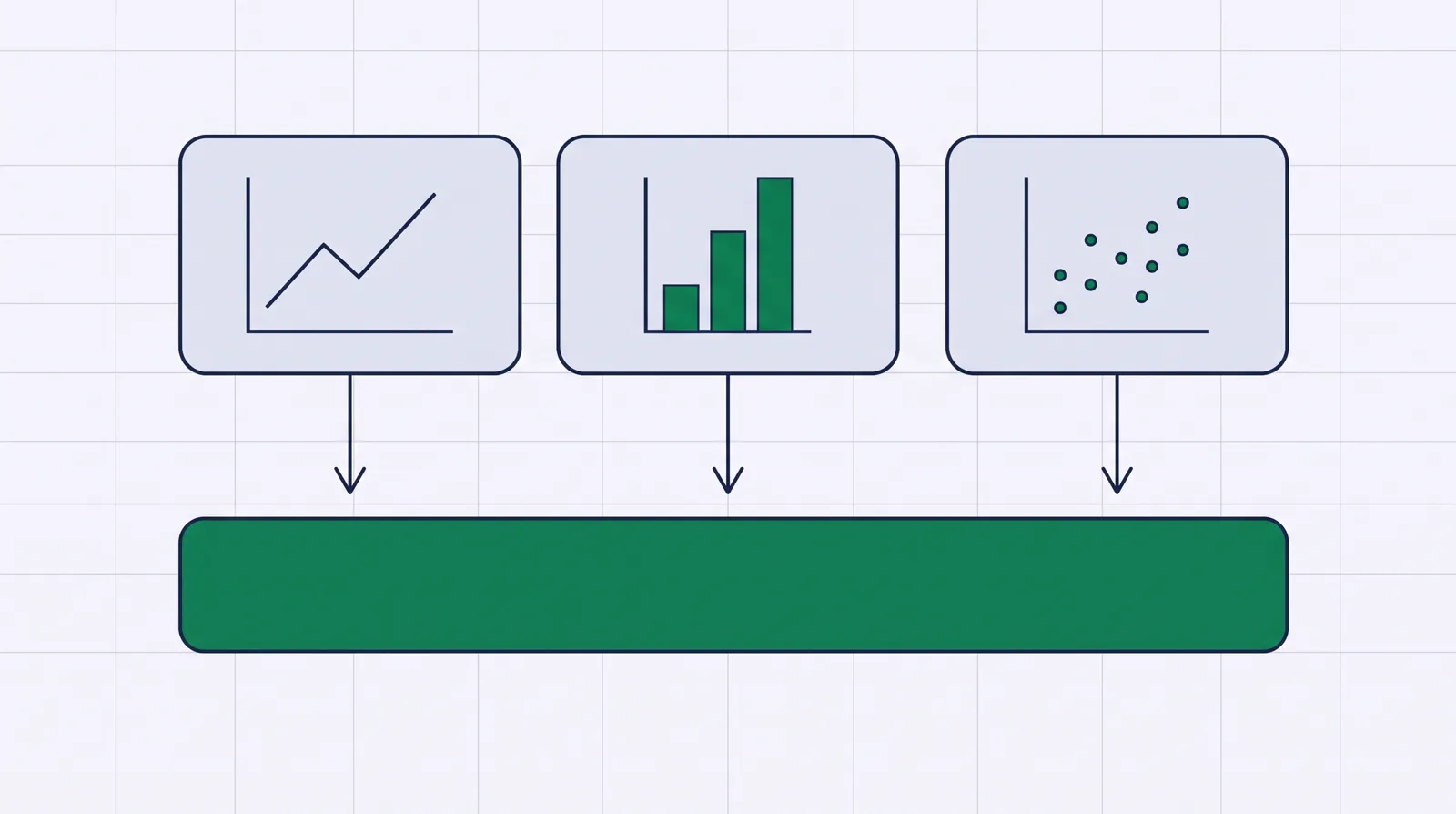
Rockerbox is a unified marketing measurement platform. Instead of picking one method, it runs three on the same data: multi-touch attribution (MTA) for daily, campaign-level decisions, marketing mix modeling (MMM) for budget planning and hard-to-track channels, and incrementality testing to prove causal lift. All three sit on a single SOC2-certified data foundation that centralizes spend, impressions, clicks and conversions across your channels into one deduplicated dataset.
The pitch is triangulation. MTA and MMM surface hypotheses, testing validates them, and the test results calibrate the models. Agreement between the three gives a team grounds to move budget, and a gap between them is the cue to dig in. That cross-check is why a brand with a complex media mix reaches for it over a lighter, single-number dashboard.
The shaded centre marks where all three methods point the same way.
It is established. The vendor says it tracks more than $9.8 billion in marketing spend across its customers, offers over 100 integrations, and counts brands like Away Travel, TULA and American Giant as customers. In March 2025 it was acquired by DoubleVerify, the public ad-verification company, which folds its outcome measurement into DV's performance suite. For a measurement vendor, a public parent is a stability signal. It is also a reason to ask, on your call, what has changed in the roadmap and packaging since.
Where it is strong: the channels other tools cannot see
The praise that comes up again and again is breadth. It measures the offline and upper-funnel channels a pixel-only tool ignores: connected TV, linear TV, direct mail, podcasts, influencers and billboards, reconciled next to your digital spend. If your growth plan involves anything beyond Meta, Google and TikTok, that is the capability you are paying for. One buyer on Reddit, no fan of the category's hype, put it plainly: "Rockerbox is solid for mid market but expensive. Their offline attribution for billboards and traditional media is actually decent though." A five-star G2 reviewer said the same from the inside: "Its ability to track multiple channels, both online and offline, is impressive."
The other quiet strength is data ownership. The platform exports its cleaned, first-party dataset to your own warehouse in BigQuery, Redshift or Snowflake, so the numbers feed the BI stack your analysts already use. For a team with a warehouse in place, that export is worth more than another dashboard.
Where the regret comes from
Three things: the cost, the setup and the rough edges in reporting.
First, cost and gating. It publishes no price and has no self-serve plan. You book a demo, and you get a quote built around your channels, sized for mid-market and enterprise budgets. G2 lists its perceived cost at the top of its scale. If you are a small Shopify store running Meta and Google, you cannot even see a number before a sales call, and the number you would get is more than the payoff at your spend.
Second, implementation. Testing can be live in a week or two, but MTA and MMM take roughly six to eight weeks and need developer time plus Rockerbox's own team to stand up. That is normal for a platform at this level, but it means the tool becomes expensive shelfware without a data owner to run the models and act on them.
Third, the rough edges. Reviewers report reporting bugs and dashboards that break, particularly on view-through channels like TikTok and YouTube, where some platforms hand over click data but not view data and the picture goes inconsistent. Support is generally described as responsive when problems surface, so plan on regular contact with it in the first months.
Every attribution figure is an estimate
This is true of the whole category, and Rockerbox is more honest about it than most. Every attribution tool is making educated guesses under iOS and privacy limits. As the same Reddit commenter warned, "the brutal truth about attribution tools is that they're all making educated guesses, especially with iOS tracking limitations." Their advice was to run incrementality tests alongside any attribution tool to validate what you are seeing. The platform's own answer is to build that validation in, with its testing and MMM. The output stays directional all the same. It will not perfectly reconcile with Meta, Google and your finance team at once, and someone on your side has to read its figures as a guide to budget decisions.
What it costs, and what to ask
There are no published tiers to compare. Pricing is modular: you choose your mix of the data collection layer and the analysis products (MTA, MMM, testing), and the vendor quotes it. Because the bill is custom and enterprise-sized, treat the sales call as due diligence. Ask for the exact annual cost and any renewal increase, which channels support click, view, modeled-view and offline data, how often the models refresh, what setup will need from your dev and data people, and whether the contract has any out if the tool has not proved its worth in the first quarter. Our full breakdown of how Rockerbox pricing works lays out those questions in detail.
So, will you regret it?
If you are a mid-market or enterprise brand spending across many channels, including offline, and you have someone to own the data, it is a credible, well-supported choice, and the acquisition removes most of the vendor-risk worry. If you are a solo media buyer or a small store whose spend lives in two ad platforms, the honest read is that it is more platform, more setup and more money than your question needs. Start with your ad platforms, clean UTMs and a post-purchase survey, and read our best ecommerce attribution software ranking for tools that fit a smaller stack. If you have outgrown those, weigh it against Northbeam, the other MTA-plus-MMM-plus-incrementality platform on this site, and see Rockerbox alternatives for the full field.
Pros and cons
What works
Runs multi-touch attribution, marketing mix modeling and incrementality testing on one data foundation, so you cross-check three methods instead of trusting a single number
Measures the offline and view-through channels most tools ignore: connected TV, linear TV, direct mail, podcasts and billboards, reconciled next to digital
Exports its cleaned first-party dataset to your own warehouse (BigQuery, Redshift, Snowflake), so the numbers feed your BI stack rather than locking you into its dashboards
SOC2-certified data foundation, and since March 2025 the backing of a public parent in DoubleVerify
What to watch
No public pricing and no self-serve. You book a demo and get a custom quote pitched at mid-market and enterprise budgets, so a small store cannot price it before a sales call
Setup is heavy: MTA or MMM take about six to eight weeks and need developer time plus Rockerbox's own team, and it becomes shelfware without a data owner to run it
Reviewers report reporting bugs and dashboards that break, especially on view-through channels like TikTok and YouTube where platforms share less data
Every figure is a modelled estimate, so it needs a reader who can act on ranges, even with incrementality tests calibrating the models
What buyers keep saying
Research: unverified
Cross channel and offline coverage↑ frequently praised
Buyers credit Rockerbox with measuring channels pixel-only tools miss: connected TV, linear TV, direct mail, podcasts and billboards, reconciled next to digital in one place. That breadth, more than raw accuracy, is why mid-market brands keep it.
“Rockerbox is solid for mid market but expensive. Their offline attribution for billboards and traditional media is actually decent though. They use statistical modeling that's more sophisticated than most tools.”
The recurring complaint is implementation. Initial setup is tedious and needs developer time plus Rockerbox's own team, and reviewers report reporting bugs and dashboards that break, especially on view-through channels like TikTok and YouTube. Support is described as responsive when problems hit.
Rockerbox publishes no price and sells through a demo. Buyers describe it as expensive and aimed at mid-market and enterprise budgets, so a small Shopify-plus-Meta brand is likely paying for capability it will not use.
“Rockerbox is solid for mid market but expensive. Their offline attribution for billboards and traditional media is actually decent though. They use statistical modeling that's more sophisticated than most tools.”
Even a category advocate warns every attribution tool is an educated guess under iOS limits. Rockerbox's own answer is to pair attribution with incrementality testing and MMM, which is the argument for buying the three together rather than trusting one number.
“The brutal truth about attribution tools is that they're all making educated guesses, especially with iOS tracking limitations. We typically recommend running incrementality tests alongside any attribution tool to validate what you're seeing.”
DoubleVerify acquired Rockerbox in March 2025. That is a stability signal for a measurement vendor, but it also means a buyer should ask what has changed in roadmap, packaging and pricing since the acquisition.
“DoubleVerify To Acquire Rockerbox, Adding Outcome Measurement and Attribution Capabilities to Its Suite of Performance Measurement and Optimization Solutions”
We read the threads before we ranked. Here is where the sentiment above comes from, at links you can open.
“Rockerbox is solid for mid market but expensive. Their offline attribution for billboards and traditional media is actually decent though. They use statistical modeling that's more sophisticated than most tools.”
“The brutal truth about attribution tools is that they're all making educated guesses, especially with iOS tracking limitations. We typically recommend running incrementality tests alongside any attribution tool to validate what you're seeing.”
“DoubleVerify To Acquire Rockerbox, Adding Outcome Measurement and Attribution Capabilities to Its Suite of Performance Measurement and Optimization Solutions”
Rockerbox does not publish a public price. Pricing is quote-based.
Rockerbox does not publish pricing. It is sold through a demo and quoted per company based on your channel mix and measurement needs, and is pitched at mid-market and enterprise budgets. You choose which products you take (Data Foundation, MTA, MMM, Testing). Implementation runs about 1 to 2 weeks for testing and 6 to 8 weeks for MTA or MMM, depending on data readiness.
Dana Rourke is the lead reviewer at Campaign Buyer. She owns the tracker and attribution coverage: reading what long-term users report about each tool, checking its documentation and pricing, and verifying prices with the vendor before writing the verdict. Keeping the rankings honest mostly means writing down what the top pick gets wrong, so she does that first.