A first-party ad tracker for long, call-driven funnels against an enterprise measurement platformmedia buyer software
Hyros vs Rockerbox
By Dana Rourke, Lead reviewer. Reviewed by Campaign Buyer Editorial. Updated 24 September 2026.
Quick answer
Pick Hyros if you sell high-ticket or info products through calls, webinars and long email and CRM funnels, and you want first-party, server-side tracking that follows the individual buyer to the sale and feeds cleaner conversions back to Meta and Google; pick Rockerbox if you are a mid-market or enterprise brand spending across many channels, including offline like connected TV, direct mail and podcasts, and you have a data owner to run a modeled measurement platform. Hyros is the tracking layer for a long, call-driven funnel. Rockerbox is the enterprise platform that models where a large, mixed budget actually worked. Neither replaces the other, and most people choosing between them only need one.
Side by side
| Hyros | Rockerbox | |
|---|---|---|
| What it is | First-party ad tracker | Unified measurement |
| Built for | High-ticket, info funnels | Mid-market, enterprise |
| Tracks | The individual buyer | The whole mix |
| Offline channels | No | TV, mail, podcasts |
| Feeds ad platforms | Yes | No, models only |
| Methods | Server-side tracking | MTA, MMM, lift |
| Data export | Dashboards first | Your own warehouse |
| Setup | Guided onboarding | 6-8 week build |
| Pricing | Custom quote | Custom quote |
If you are down to Hyros and Rockerbox, you are choosing between two ways of connecting ad spend to revenue, both built for advertisers spending enough that a few points of attribution accuracy move real budget. They split on who they were built for and on how they answer the question. Hyros is first-party ad tracking for a long, call-driven funnel that ends in a CRM. Rockerbox is enterprise measurement for a brand whose budget is spread across many channels, including offline ones. The choice comes down to what your sale looks like, and what you plan to do with the numbers.
The one question that decides it
Answer this before you compare a single feature: how does your sale close, and how do you want to act on the data? If you sell high-ticket coaching, info products or anything where a paid click becomes an opt-in, then an email sequence, then a webinar or a sales call, then a payment weeks later, Hyros is built to follow that whole path buyer by buyer and Rockerbox is not. If a real share of your budget goes to offline and upper-funnel channels like connected TV, linear TV, direct mail and podcasts, and you need all of it reconciled next to your digital spend, Rockerbox is built for that and Hyros cannot see it.
The second half of the question matters as much as the first. Both platforms hand you estimates, and an estimate that never moves budget is an expensive dashboard. Hyros is only as good as your CRM and processor hookups, and it sells a guided onboarding because the setup is the hard part. Rockerbox needs a data owner and a six to eight week build. Buy either only once someone on the team owns the output and acts on it.
Hyros: tracking built for long, call-driven funnels
Hyros is the tool an info-product seller, a coach or a high-ticket advertiser reaches for when Meta and Google are grading their own homework and the pixel loses the thread the moment a lead leaves the page. Its edge is server-side, first-party tracking that stitches the journey across the steps a normal pixel never sees: the opt-in, the email sequence, the webinar, the sales call, the payment processor and the CRM. That is why sellers with long funnels credit it with finding revenue Meta and Google never attributed, and why it can tie a sale that closed on a call weeks later back to the ad that started it.
It does not stop at reporting. Hyros sends cleaner, deduplicated conversions back to the ad platforms through their conversion APIs, so the bidding optimizes toward buyers who actually pay rather than raw leads. Its honest limits are scale and cost. On Reddit, buyers put the threshold where it earns its keep near $50,000 a month in spend on a genuinely complex funnel. Below that, the machinery is more than the job needs, and its modelled figures will still differ from what Meta and Google report. For a simple, low-AOV store with a short buying cycle, it is overkill. For a long, call-and-CRM funnel doing real spend, it is the one of these two built for the job.
Rockerbox: measurement across the whole mix
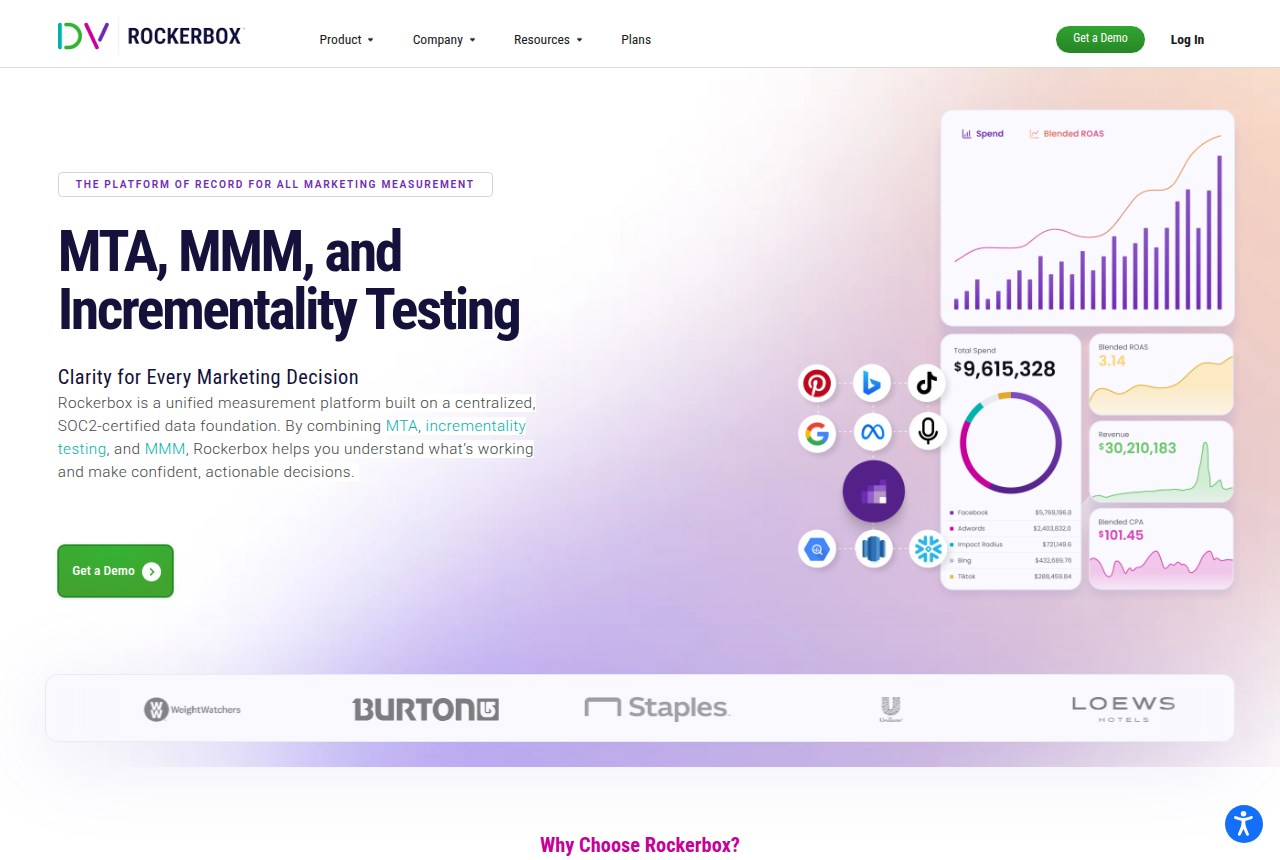
Rockerbox answers a broader question than Hyros, for a bigger company. It runs multi-touch attribution, marketing mix modeling and incrementality testing on one first-party data foundation, so you cross-check three readings instead of trusting one. Its real edge is breadth, including offline: connected TV, linear TV, direct mail, podcasts, influencers and billboards, reconciled next to your paid social and search. It exports its cleaned dataset to your own warehouse in BigQuery, Redshift or Snowflake, it holds SOC2 certification, and since March 2025 it has the backing of a public parent in DoubleVerify, which bought it for around $82 million.
The cost of that breadth is friction. There is no public pricing and no self-serve: you book a demo and get a quote scoped to your channels and the modules you enable. Setup is heavy, roughly six to eight weeks for MTA or MMM, and it needs developer time plus Rockerbox's own team. A brand with the mix and the team it is built for absorbs that. For a high-ticket seller who just needs their call funnel tracked and fed back to the ad accounts, all of it is more platform than the job requires.
The individual buyer versus the whole mix
Strip away the marketing and three differences decide this. The first is grain: Hyros tracks an individual buyer click by click through the funnel to a payment and a CRM deal, so it shines when the sale is a considered, multi-step purchase you can follow one person at a time. Rockerbox models a channel's contribution to total revenue, so it shines when spend is spread across many channels you cannot observe click by click. The second is offline coverage: Hyros is digital-first and leaves out television, mail and podcasts, which Rockerbox reconciles into one model. The third is the feedback loop: Hyros pushes cleaner conversions back into the ad platforms so bidding improves, and Rockerbox keeps its findings in its dashboards and your warehouse.
What they share is that both produce estimates, both are only worth the money if someone owns them, and both make you talk to sales before you see a number. If your business is a high-ticket or info-product funnel, the overlap is thin and Hyros is the one built for you. If your business is a mid-market brand with an offline mix, the overlap is thin the other way and Rockerbox is the one built for you. The genuine tie happens in a narrow middle: a larger direct-response brand big enough for Rockerbox's price but whose sales still run through calls and a CRM, where you weigh per-buyer tracking that feeds the ad platforms against a broader modeled view of the whole budget.
Pricing: two quotes, neither published
Neither tool shows you a price. Hyros sells a single all-inclusive plan priced by the revenue it tracks for you, quoted on a setup call, and backs it with a guarantee that you pay only if your ads grow. Rockerbox publishes nothing either: you request a demo and receive a contract scoped to your channels, your data volume and the modules you enable, pitched at large media budgets. So you cannot line these two up on a sticker price. What you can compare is the basis: Hyros scales with the revenue your funnel produces, and Rockerbox with the size of the media mix it models.
What neither tool builds
Both of these platforms tell you what your spend produced. Neither builds the funnel that spend runs through. Hyros tracks and Rockerbox models. The pages, the checkout and the offers are a separate job on a separate bill. ElasticFunnels is a funnel platform for teams running paid traffic that covers that part: it builds and hosts the pages, splits variants under one URL so the ad platforms keep their learning, hosts the checkout with order bumps and one-click upsells, and keeps sessions, orders, rebills and refunds on one timeline with ad-spend and conversion reporting and affiliate postbacks attached. Its reporting layer is lighter than Hyros's per-buyer, server-side tracking across calls and a CRM, and it does not run marketing mix modeling or incrementality across offline channels the way Rockerbox does, so it replaces neither for that job. It fits a paid-traffic team that wants the funnel and its own spend-to-sale reporting in one place, and it runs a 14-day trial with no card. The honest limit is that it is newer than both tools on this page, and there is very little independent third-party review coverage to check its claims against, which is what you would expect of a platform this new, so until you run real volume through it you are largely taking the vendor's word for how the reporting holds up. If your webinar pages and order forms already convert, leave it out of this choice.
Which one for you
You sell high-ticket or info products through calls and long funnels: Hyros. The server-side tracking across calls, webinars and the CRM, and the cleaner conversions fed back to Meta and Google, are exactly what a long-funnel advertiser is paying for, and Rockerbox's offline modeling is capability you would pay for and not use. Make the demo prove the tracking on your own funnel before you sign, because there is no trial to fall back on, and check that you clear roughly $50k of monthly ad spend, the level where buyers say it starts to pay.
Your mix includes offline and you have a data team: Rockerbox. Weighing TV, mailers and podcast sponsorships against digital, cross-checked three ways and piped into your own warehouse, is a job Hyros cannot do. Budget for the quote and the six to eight week build, and name the data owner before the first demo.
You are earlier than either, on Meta and Google with a short funnel and no data person: neither, yet. Both are quote-gated, both skip the free trial, and both assume someone will act on the output. A lighter, cheaper tracker will serve you until your spend, your funnel and your team grow into a platform at this level. Revisit these two when a point of accuracy is worth thousands in reallocated budget.
Hyros is our default pick because most of this site's readers run paid traffic to their own high-ticket and direct-response funnels and need spend tied to the sale that actually closed. Enterprise brands with an offline mix and a data team are the minority here. For a brand with real offline spend and a data owner, Rockerbox is plainly the better fit, and Hyros is not in the running.
Hyros
What works
- Server-side tracking that follows long journeys through calls, webinars and CRMs
- Finds sales that Meta and Google miss on multi-step funnels
- Pulls sales data from payment processors and CRMs alongside site analytics
What to watch
- Overkill below roughly $50k/mo in ad spend
- Pricing is opaque and quote-driven on the main site
- Its revenue figures are modelled, so expect them to diverge from what the ad platforms report
Rockerbox
What works
- Runs multi-touch attribution, marketing mix modeling and incrementality testing on one data foundation, so you cross-check three methods instead of trusting a single number
- Measures the offline and view-through channels most tools ignore: connected TV, linear TV, direct mail, podcasts and billboards, reconciled next to digital
- Exports its cleaned first-party dataset to your own warehouse (BigQuery, Redshift, Snowflake), so the numbers feed your BI stack rather than locking you into its dashboards
- SOC2-certified data foundation, and since March 2025 the backing of a public parent in DoubleVerify
What to watch
- No public pricing and no self-serve. You book a demo and get a custom quote pitched at mid-market and enterprise budgets, so a small store cannot price it before a sales call
- Setup is heavy: MTA or MMM take about six to eight weeks and need developer time plus Rockerbox's own team, and it becomes shelfware without a data owner to run it
- Reviewers report reporting bugs and dashboards that break, especially on view-through channels like TikTok and YouTube where platforms share less data
- Every figure is a modelled estimate, so it needs a reader who can act on ranges, even with incrementality tests calibrating the models
Pricing
Hyros: from a custom quote. Hyros publishes no plan prices. It sells one plan with everything included, and the price follows the revenue Hyros tracks for you. The figure is quoted on a setup call and is aimed at higher-spend accounts.
Rockerbox: from a custom quote. Rockerbox does not publish pricing. It is sold through a demo and quoted per company based on your channel mix and measurement needs, and is pitched at mid-market and enterprise budgets. You choose which products you take (Data Foundation, MTA, MMM, Testing). Implementation runs about 1 to 2 weeks for testing and 6 to 8 weeks for MTA or MMM, depending on data readiness.
Prices as of 14 September 2026
Our pick
Hyros
Hyros is the pick if you sell high-ticket or info products whose sales close over calls, webinars and CRM follow-ups. A low-AOV store with a short buying cycle gets little from it.
Frequently asked questions
Which is cheaper, Hyros or Rockerbox?
Do Hyros and Rockerbox do the same thing?
Can Hyros measure offline channels like TV and direct mail?
Which fits a high-ticket or info-product funnel that closes on a sales call?
Does either offer a free trial?
Sources
Other sources
2 discussions and reviews read for this page. Quotes are excerpts; open a link to read the original in context.
- [h1] Hyros or TripleWhale?
- [h2] Hyros vs Triple Whale

Written by
Dana Rourke
Lead reviewer
Dana Rourke is the lead reviewer at Campaign Buyer. She owns the tracker and attribution coverage: reading what long-term users report about each tool, checking its documentation and pricing, and verifying prices with the vendor before writing the verdict. Keeping the rankings honest mostly means writing down what the top pick gets wrong, so she does that first.
Last checked 2026-09-24