Self-serve tracker vs enterprise MMMmedia buyer software
AdsBridge vs Rockerbox
By Dana Rourke, Lead reviewer. Reviewed by Campaign Buyer Editorial. Updated 27 September 2026.
Quick answer
Pick AdsBridge if you run affiliate or network offers across several traffic sources and want one cheap, self-serve cloud tool that tracks your clicks, syncs ad cost into profit by source, and builds and split-tests your landing pages; pick Rockerbox if you are a mid-market or enterprise brand spending across many channels including offline media, and you have a data owner to run a modeled measurement platform. Most readers who reach this page run offers, so AdsBridge is the default, and Rockerbox becomes the better tool the moment your budget includes channels no click tracker can see.
Side by side
| AdsBridge | Rockerbox | |
|---|---|---|
| What it is | Cloud ad tracker | Enterprise measurement platform |
| Built for | Affiliates and media buyers | Mid-market and enterprise brands |
| What it measures | Click to conversion, profit by source | MTA, marketing mix modeling and incrementality |
| How it tracks | S2S postbacks, redirect and redirectless | First-party data foundation, modeled |
| Channels it sees | Paid traffic to offers on any domain | Digital plus offline: CTV, TV, direct mail, podcasts |
| Ad-platform feedback | Postbacks to 100+ networks; no native CAPI | Modeled measurement, not campaign feeds |
| Landing pages | Drag-and-drop builder and split testing | None; it measures, it does not build |
| Setup | Self-serve, live in minutes | About 6-8 weeks, dev time and its own team |
| Pricing | From $29/mo by visits | Custom quote after a demo, no public price |
| Data ownership | Its own dashboards | Exports cleaned data to your warehouse |
| Outside proof | Thin G2 | Reporting bugs reported; DoubleVerify-owned since 2025 |
These two land on the same shortlist because both promise to tell you what your marketing is actually doing, in a world where the browser pixel drops conversions and the ad platforms grade their own homework. They answer that for two completely different companies, at two completely different prices. AdsBridge is a cloud ad tracker for affiliates and media buyers: it stamps every click, follows it through a lander to an offer, and works out which source and campaign turned a profit, from $29 a month. Rockerbox is an enterprise measurement platform, owned by DoubleVerify since March 2025: it models the contribution of your whole marketing mix, including offline channels a click-based tool cannot see, on a custom quote you only get after a demo. The reader stuck between them is really working out which of two very different businesses they are running.
The one question that settles it
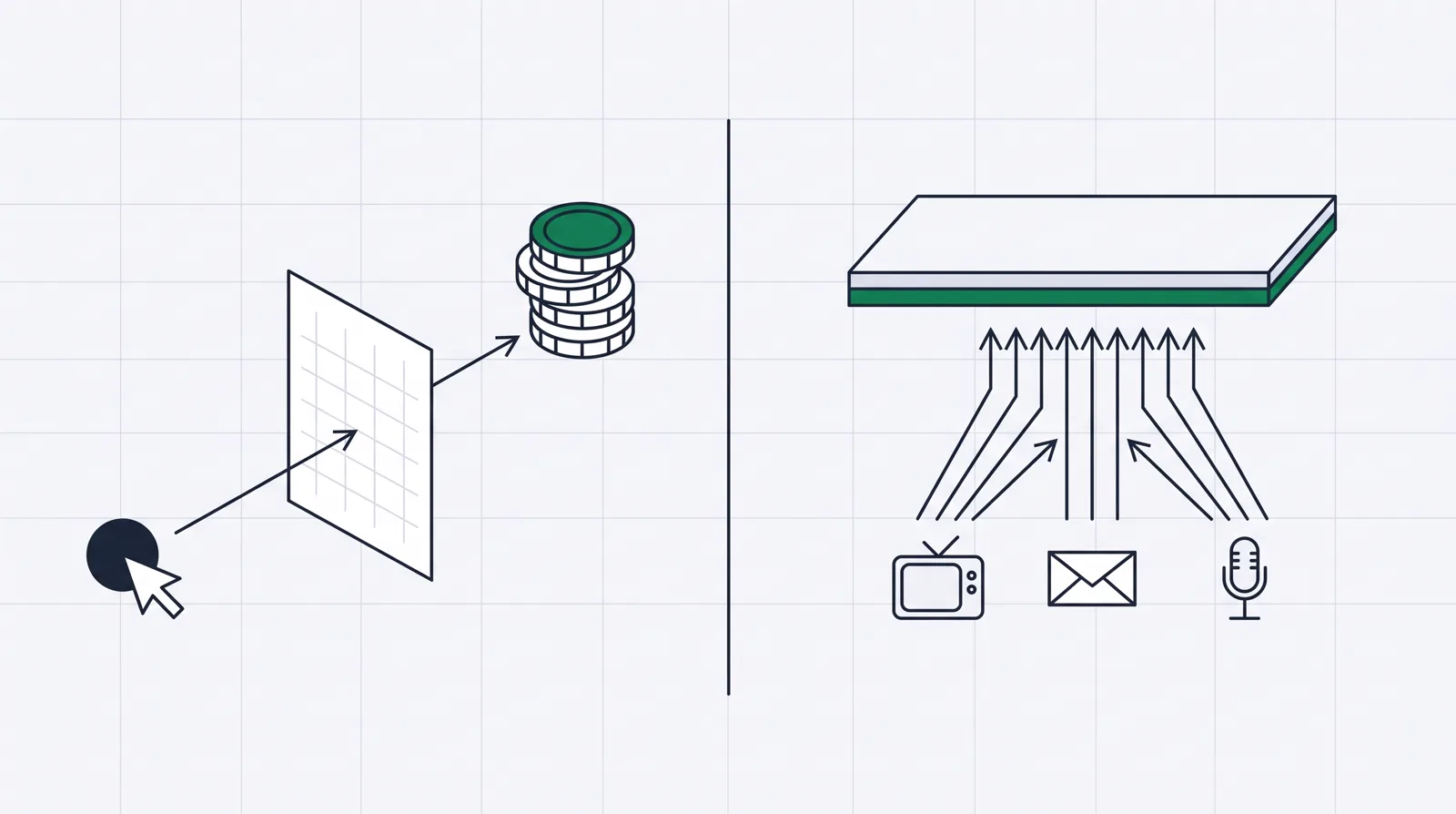
Answer this before you compare a single feature. Is your problem seeing which source, lander and offer produced a profit at click-level, on traffic you buy across a few paid sources, some of it to offers on domains you do not own? Or is your problem measuring the contribution of a whole marketing mix that spans channels with no click at all, connected TV, linear TV, direct mail, podcasts and billboards, alongside your digital spend? If it is the first, that is AdsBridge's job and it does it cheaply and today. If it is the second, no tracker can help you, because there is no click to track, and modeling that contribution is the entire reason Rockerbox exists. Point a scaling affiliate's pop or push volume at Rockerbox and you are paying an enterprise measurement contract for a job AdsBridge does at click-level for a small monthly fee. Ask AdsBridge which of your podcast reads drove revenue and it has nothing to answer with.
AdsBridge: tracking and pages in one cheap subscription
AdsBridge has run since 2013 on AWS across 160-plus countries, and it does the media buyer's core job: it assigns every click an id, follows it through your page and offer, and records conversions server to server so a blocked pixel does not cost you the sale. Around that it folds in a drag-and-drop landing page builder, split testing, a URL rotator, an anti-fraud filter and a redirectless mode, all in one subscription that starts at 100,000 visits a month on its cheapest plan, with every plan carrying the full feature set. It connects to more than 100 affiliate networks with one-click postback setup, and you can bring your ad cost in to compute profit by source. That bundle, tracking plus pages plus split testing for less than Voluum or RedTrack, is why this site ranks it fourth among trackers. You sign up and you are live the same day, which is the opposite of what buying Rockerbox looks like.
Speed and proof are its weak spots. A community redirect-speed test clocked it slower than several rivals, which hurts most on mobile traffic, and reviewers report the dashboard slowing once daily volume gets extreme. Independent proof is thin: its G2 profile is too small to lean on, so most write-ups are affiliate blogs rather than heavy buyer feedback. It also has no native Meta or Google conversion API. It reports by server-to-server postback, which is the right method for affiliate networks but a weak fit for a paid-social buyer who specifically wants CAPI events pushed into Meta. There is a 14-day trial, with no refund on cancellation, so test it inside that window.
Rockerbox: three modeled methods across every channel
Rockerbox does a much larger and much more expensive thing, and it does it well for the brand it is built for. It runs multi-touch attribution, marketing mix modeling and incrementality testing on one first-party data foundation, so instead of trusting a single attribution number you cross-check three methods against each other. Its real edge is the channels most tools ignore: broadcast and streaming TV, printed mailers, audio and outdoor, reconciled next to your digital spend. It exports its cleaned first-party dataset to your own warehouse, BigQuery, Redshift or Snowflake, so the numbers feed your BI stack and you are not locked into its dashboards. It holds a SOC2-certified data foundation, and since March 2025 it has the backing of a public parent in DoubleVerify.
Fit and cost are where it gets hard. There is no public pricing and no self-serve: you book a demo and receive a quote scoped to your channels, so a small store cannot even price it before a sales call. Setup is heavy, about six to eight weeks for MTA or MMM, needing developer time plus Rockerbox's own team, and it becomes shelfware without a data owner to run it. Reviewers also describe bugs in its reports and dashboards that break, especially on view-through channels like TikTok and YouTube where the platforms share less data. Its channel figures are modeled estimates, so even paired with incrementality they need someone who reads them as directional. For a brand with that person and that budget, the setup is the price of seeing its whole mix.
Where each genuinely pulls ahead
Set audience aside for a moment and the capability gap runs both ways. Rockerbox measures things AdsBridge structurally cannot: offline channels, view-through, and the modeled contribution of a mix where no single click explains the sale. If your budget spans broadcast and print, that measurement is the whole job, and AdsBridge has no answer for it. AdsBridge, in turn, does things Rockerbox does not attempt: it tracks individual clicks in real time to offers on any domain, fires postbacks into 100-plus affiliate networks, builds and split-tests the landing pages that traffic hits, and it starts today for a small monthly fee. Rockerbox serves a data team planning budgets across the year. AdsBridge serves an operator optimizing campaigns by the hour. The modeled platform is useless to an affiliate, and the cheap tracker is blind to a brand's TV spend.
The tool that sits between them
If your reason for weighing these two is that you are bolting measurement onto a funnel you already run, a third option changes where the data lives. ElasticFunnels is a funnel platform for teams running paid traffic that builds the pages and hosts the checkout itself, and keeps the click, the order, the rebill and the refund on one record, so nobody reconciles a tracker's export against a checkout's. Its lead feature for a paid-traffic team is same-URL split testing: variants rotate server-side under one campaign link, so Meta, Google and TikTok keep their learning and a test never sends the ad back through review. Because a sale closes in a checkout it hosts, that conversion is a first-party event it records directly, and it fires server-side postbacks to your affiliate networks on purchase, refund and renewal, the network-attribution job AdsBridge does for click traffic. It starts with a 14-day free trial that takes no card, on plans from $97 a month, plus 0.5% of revenue processed through its hosted checkout. Its drawback: ElasticFunnels is newer than either tool on this page, and there is very little independent third-party review coverage to check its claims against, so until you run real volume through it you are largely taking the vendor's word for how its reporting and postbacks hold up. That is what you would expect of a platform this recent, where AdsBridge has run since 2013 and Rockerbox has a decade and a public parent behind it, and it matters less if you use that no-card trial to prove it on your own campaigns first. It suits a direct-to-consumer seller whose spend is still mostly digital and who wants the sale and the click on one record long before a mix model makes sense. It does not model offline media the way Rockerbox does, and an affiliate tracking clicks across offers on other people's domains still needs a dedicated tracker like AdsBridge for that traffic.
Which one for you
You buy media for affiliate or network offers: AdsBridge. Click tracking, automatic ad-cost sync, a drag-and-drop landing page builder and split testing come in one subscription from $29 a month for 100,000 visits, with 100-plus affiliate-network integrations, live the same day. Test the redirect speed on your own mobile traffic during the 14-day trial, and remember there is no refund once you cancel.
You are a mid-market or enterprise brand spending across many channels, including offline: Rockerbox. Multi-touch attribution, marketing mix modeling and incrementality on one data foundation, with offline media reconciled next to digital and the cleaned dataset exported to your warehouse, is the right fit, as long as you have the budget for a custom enterprise quote, six to eight weeks to stand it up, and a data owner to run it.
AdsBridge is our default pick here because far more readers who reach this comparison run affiliate traffic than manage enterprise cross-channel budgets with offline spend. For a brand measuring broadcast, print and digital together, Rockerbox is plainly the better tool, and we would pick it every time over software that cannot see a channel without a click. If you are choosing between trackers instead, our AdsBridge vs AnyTrack and AdsBridge vs ClickMagick comparisons take the next step, and the ad tracker ranking puts AdsBridge in context. If you are weighing enterprise measurement platforms, Northbeam vs Rockerbox and Triple Whale vs Rockerbox are the ones to read next.
AdsBridge
What works
- Tracking, a drag-and-drop landing page builder and split testing come in one subscription, so a beginner does not pay for a separate page tool.
- Cheaper entry than Voluum or RedTrack: $29/mo for 100,000 visits, and every plan carries the full feature set with no features gated to higher tiers.
- Prices by monthly visits rather than events, which is easier to predict than event-based billing when a campaign scales.
- Established since 2013 on AWS infrastructure, with 100-plus one-click network integrations, an anti-fraud filter and a redirectless tracking mode.
What to watch
- Redirect speed is the recurring complaint. A community speed test clocked its redirects slower than several rivals, which matters most on mobile traffic.
- Reviewers report stability flaws once daily volume gets extreme, and the dashboard can feel slow at times.
- No native Meta or Google conversion API. It leans on server-to-server postbacks, so paid-social buyers who want CAPI are better served elsewhere.
- Thin independent proof. Its G2 profile has too few reviews to be useful, so most write-ups are affiliate blogs rather than heavy buyer feedback.
- No permanent free tier, only a 14-day trial, and AdsBridge states it issues no refund on cancellation.
Rockerbox
What works
- Runs multi-touch attribution, marketing mix modeling and incrementality testing on one data foundation, so you cross-check three methods instead of trusting a single number
- Measures the offline and view-through channels most tools ignore: connected TV, linear TV, direct mail, podcasts and billboards, reconciled next to digital
- Exports its cleaned first-party dataset to your own warehouse (BigQuery, Redshift, Snowflake), so the numbers feed your BI stack rather than locking you into its dashboards
- SOC2-certified data foundation, and since March 2025 the backing of a public parent in DoubleVerify
What to watch
- No public pricing and no self-serve. You book a demo and get a custom quote pitched at mid-market and enterprise budgets, so a small store cannot price it before a sales call
- Setup is heavy: MTA or MMM take about six to eight weeks and need developer time plus Rockerbox's own team, and it becomes shelfware without a data owner to run it
- Reviewers report reporting bugs and dashboards that break, especially on view-through channels like TikTok and YouTube where platforms share less data
- Every figure is a modelled estimate, so it needs a reader who can act on ranges, even with incrementality tests calibrating the models
Pricing
AdsBridge: from $29/mo. AdsBridge prices by monthly visits. Starter costs $29 a month for 100,000 visits. Professional is $89, Advanced $199, Business $379, Agency $499 and Enterprise $799, and Exclusive is quoted individually. Visits over the limit bill per 1,000, from $0.07 on Starter down to $0.029 on Enterprise. Annual billing saves up to 20%. Every plan starts with a 14-day free trial, and cancellations receive no refund.
Rockerbox: from a custom enterprise quote. Rockerbox does not publish pricing. It is sold through a demo and quoted per company based on your channel mix and measurement needs, and is pitched at mid-market and enterprise budgets. You choose which products you take (Data Foundation, MTA, MMM, Testing). Implementation runs about 1 to 2 weeks for testing and 6 to 8 weeks for MTA or MMM, depending on data readiness.
Prices as of 28 September 2026
Our pick
AdsBridge
AdsBridge is a real, long-running cloud tracker that bundles a landing page builder and split testing for less than Voluum or RedTrack, so it fits an affiliate who wants tracking and pages in one low-cost tool. Skip it if fast redirects at high volume or a native Meta conversion API are what you are paying for, because that is where buyers report it trailing the leaders.
Frequently asked questions
Which is cheaper, AdsBridge or Rockerbox?
Do AdsBridge and Rockerbox do the same thing?
Can AdsBridge measure offline channels like TV, direct mail or podcasts?
Is Rockerbox overkill for a small affiliate or Shopify store?
Sources
Other sources
6 discussions and reviews read for this page. Quotes are excerpts; open a link to read the original in context.
- [ab-statsdrone-speed] AdsBridge Review: Overview, Features, Pros & Cons, Pricing
- [ab-statsdrone-diff] AdsBridge Review: Overview, Features, Pros & Cons, Pricing
- [ab-affmaven-stability] Real AdsBridge Review 2026: Better Than Voluum?
- [ab-affmaven-opt] Real AdsBridge Review 2026: Better Than Voluum?
- [ab-affiliatefix-support] AdsBridge reviews
- [ab-g2-thin] AdsBridge Reviews

Written by
Dana Rourke
Lead reviewer
Dana Rourke is the lead reviewer at Campaign Buyer. She owns the tracker and attribution coverage: reading what long-term users report about each tool, checking its documentation and pricing, and verifying prices with the vendor before writing the verdict. Keeping the rankings honest mostly means writing down what the top pick gets wrong, so she does that first.
Last checked 2026-09-27