The premium funnel tool vs the free-to-start onemedia buyer software
ClickFunnels vs Systeme.io
By Dana Rourke, Lead reviewer. Reviewed by Campaign Buyer Editorial. Updated 24 September 2026.
Quick answer
Pick ClickFunnels if you already have traffic and sales, you sell coaching, courses or higher-ticket offers, and you want a proven checkout with order bumps and one-click upsells to lift the value of every order; pick Systeme.io if you are starting out or watching costs, and you want funnels, email, a course and your own affiliate program in one login you can run free until the sales justify paying.
Side by side
| ClickFunnels | Systeme.io | |
|---|---|---|
| What it is | Funnel-first builder | One-login suite |
| Best for | Selling your offers | Budget beginners |
| Entry price | $97/mo | Free, then $17 |
| Checkout | Bumps + upsells | Basic checkout |
| Page builder | Deep, big library | Basic templates |
| Courses | Included | Included, free plan |
| Sales fees | None | None |
| Track record | 10+ yrs, 4.6/5 | 500k+ users |
The question that actually decides it
If you are down to ClickFunnels and Systeme.io, you have already agreed on the shape of the tool. You want one account that builds the pages, takes the payment and follows up with the buyer, and both do that. Their feature lists overlap more than either vendor admits, so the choice comes down to two things: how much you can spend right now, and how hard you need the checkout to sell.
ClickFunnels is the premium option, built to raise the value of every order. Systeme.io is the budget option, built so a beginner can launch before spending a cent. Get those two facts straight and the rest of this page is detail.
ClickFunnels: the premium selling machine
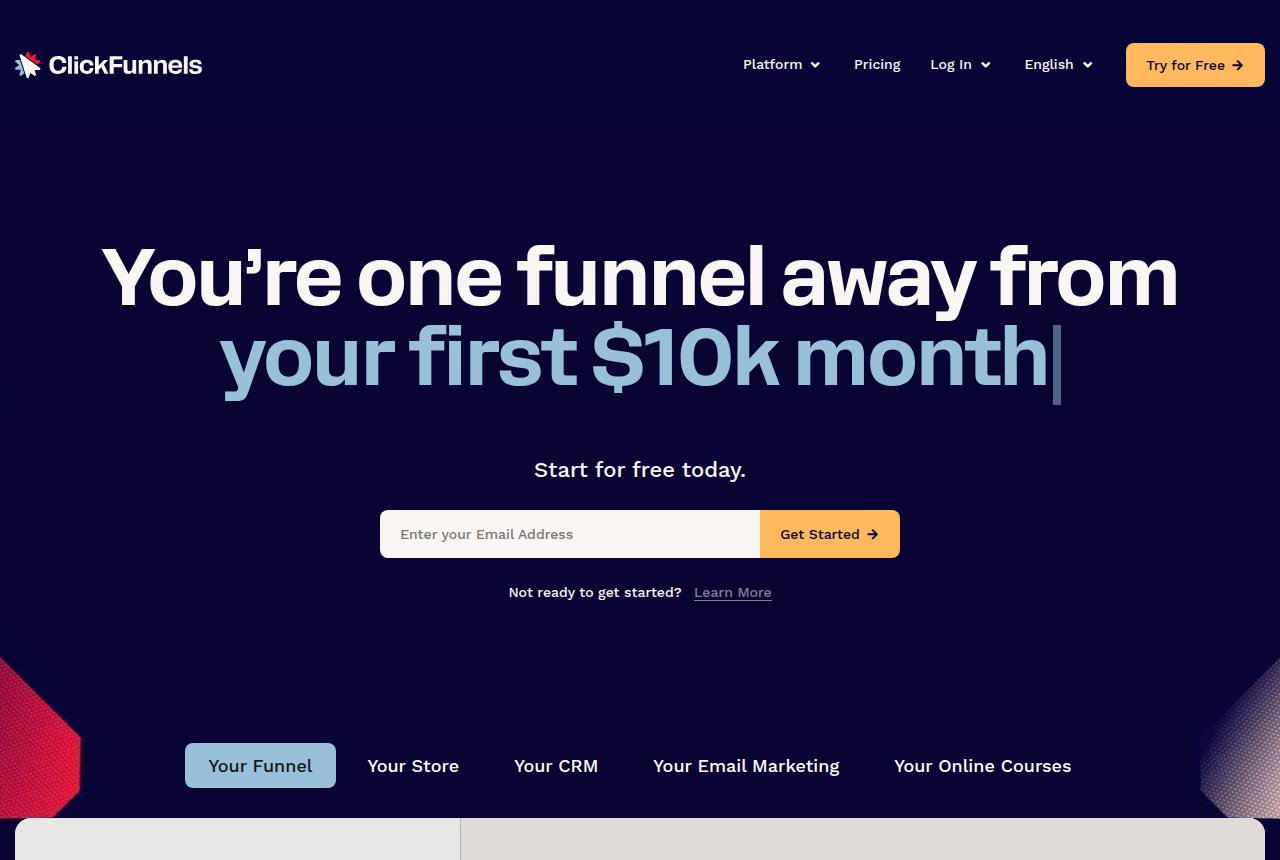
ClickFunnels is one of the names that turned "sales funnel" into a category, and after more than a decade it is still one of the most recognised funnel builders online. It runs the whole path from click to customer in one place: landing and sales pages, a checkout, email follow-up, a light CRM, courses and a community.
Two things justify the price. Sellers who do not want to touch code praise the drag-and-drop editor and the prebuilt funnel templates above everything else, and a full funnel can be live in an afternoon. Then there is Smart Checkout, built to sell, with order bumps and one-click upsells aimed squarely at lifting average order value. If you already have traffic and sales, that is where ClickFunnels earns its keep: it is tuned to make each buyer worth more.
The scores back it up. ClickFunnels sits around 4.6 out of 5 across more than 400 G2 reviews and thousands of Trustpilot ratings, it takes no cut of your sales, and it carries a 30-day money-back guarantee. Against that, plans run from $97 to $297 a month, and users say the bill climbs fast, especially if you only use part of it. Billing and cancellation draw the loudest complaints, and there is lingering confusion between the older Classic accounts and the newer 2.0 platform, which some long-time users feel was a step back.
Systeme.io: the one that costs nothing to start
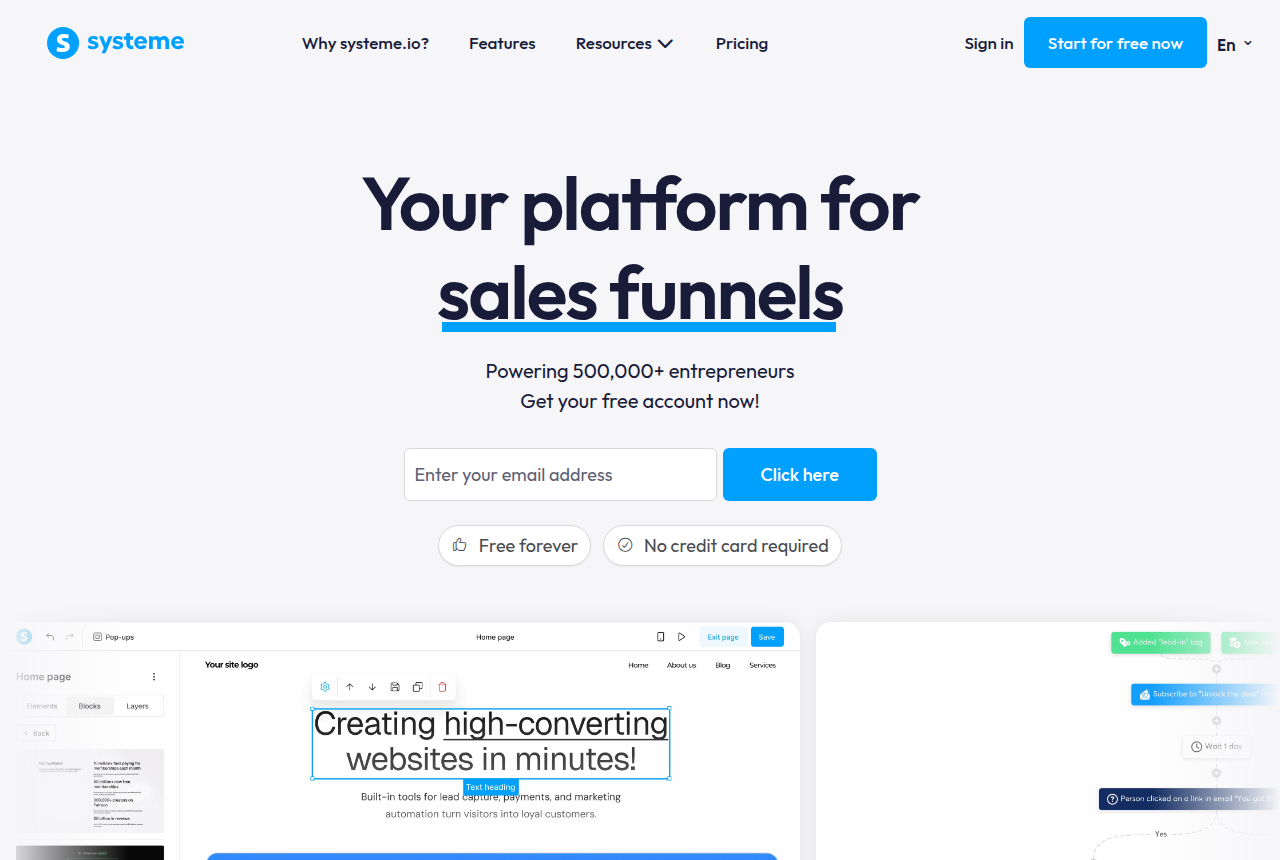
Systeme.io covers most of the same ground for a fraction of the money. Funnels, email, a website and blog, courses, communities and your own affiliate program all run from one login. The company says more than 500,000 entrepreneurs use it, which makes it an established platform.
Its real advantage is the free plan, which you can actually sell on. You get up to 2,000 contacts, three sales funnels, a course, a blog and an affiliate program, with no credit card and no expiry date. You can build a working funnel and make sales before you pay anything. When you do pay, plans start at $17 a month and top out at $97 for unlimited contacts, and every plan takes 0% on top of your Stripe or PayPal fees. Nothing about the bill balloons as your list grows.
Where it runs short is design and depth. The page builder and templates are basic. They are fine for a clean, simple funnel and restrictive if you want pixel-level control or a high-end brand look. One long-term user put it as "okay, but branding always felt slightly off for higher end offers". The same holds for automation and checkout: sellers who leave tend to hit a wall on conditional email logic, deeper checkout customization or heavier CRM work. The simplicity that makes Systeme.io easy is also where it stops.
The real bill, tier by tier
Price is where the two differ most. ClickFunnels has no free plan and no cheap plan. You start at $97 a month on Launch and move up to $197 on Scale or $297 on Optimize as you need more funnels, contacts and team seats, with a $5,997-a-year Dominate tier above that. There is no cut of your sales and hosting is included, but the floor is high, and a reader who only needs a couple of pages is paying for a whole platform.
Systeme.io starts at nothing, moves to $17 for the Startup plan, $47 for Webinar and $97 for unlimited contacts. Annual billing knocks off two months, and there are no transaction fees on any tier. Put plainly: Systeme.io's most expensive plan costs about what ClickFunnels charges to walk in the door.
So if budget is the pressure, Systeme.io wins on price outright, and it is the honest pick for anyone validating an offer or running lean. ClickFunnels is worth its floor only once the extra order value from its checkout, or the speed of its templates, is paying for itself.
If you buy your own traffic, look past both
One reader this comparison does not serve well is the media buyer running cold paid traffic to an offer. Neither ClickFunnels nor Systeme.io is built around the ad click. Both A/B test by splitting visitors across separate URLs, which resets the ad platform's optimization every time you start a test, and neither ties the click, the order, the rebill and the refund onto one record you can read without exporting from three tools.
A platform built for that job is worth a look here: ElasticFunnels. It is a funnel platform aimed at teams that run paid traffic. It builds the pages, including an AI builder that can clone a page from a URL, and it split-tests variants server-side under one URL, so Meta, Google or TikTok keep their learning and a test never sends the ad back through review. It hosts the checkout with order bumps, one-click upsells and routing across more than one merchant account, and it keeps sessions, orders and refunds on a single timeline with a CRM and attribution on the same data. The trial is 14 days with no card, and pricing starts at $97 a month, billed by traffic rather than by feature tier.
The honest caveat is proof. ElasticFunnels is newer than either tool on this page, and there is very little independent review coverage to check its claims against. Until you push real volume through it, you are largely taking the vendor's word for what it does, which is what you would expect of a platform this young. If your growth comes from bought media, trial it next to ClickFunnels. A seller with an owned audience is on safer ground with either established tool here.
Which one for you
Pick ClickFunnels if you already have traffic and sales, you sell coaching, courses or a higher-ticket offer, and you want a proven checkout that pushes order bumps and upsells to lift the value of every sale. You are paying a premium for speed and for a selling engine, and it only makes sense once the extra revenue covers the bill.
Pick Systeme.io if you are starting out, watching costs, or validating an offer before you commit money to it. You get funnels, email, a course and an affiliate program in one login, free until the sales justify paying, with no transaction fees when you do. Accept the design ceiling as the price of that, and plan your move the day your offers outgrow it.
ClickFunnels
What works
- Runs the whole funnel in one account: pages, checkout, email, a light CRM, courses and a community, so you are not stitching four tools together
- Fast to get live. The drag-and-drop editor and prebuilt funnel templates are the most-praised part, especially for non-technical sellers
- Smart Checkout is built for selling, with order bumps and one-click upsells aimed at raising average order value
- Strong aggregate scores: about 4.6 out of 5 across more than 400 G2 reviews and thousands of Trustpilot reviews
- Takes no cut of your sales, includes hosting, and carries a 30-day money-back guarantee
What to watch
- Priced at the top of the market. Plans run $97 to $297 a month, and users say the cost adds up fast, especially if you only need part of it
- Billing and cancellation are the loudest complaints, along with confusion between ClickFunnels Classic and the newer 2.0 accounts
- Some long-time users feel 2.0 was a step back from Classic, and marketers report occasional bugs and page speed that is hit or miss
- Less flexible than a custom stack, and course and membership delivery is weaker than a dedicated platform
Systeme.io
What works
- The free plan runs a working business: up to 2,000 contacts, 3 sales funnels, a course, a blog and your own affiliate program, with no credit card and no expiry date. You can launch a live funnel before paying a cent.
- One login replaces four subscriptions. Funnels, email, courses, a website and affiliate management run from the same account, so there is no glue code between a page builder, an email tool and a course host.
- Cheap even when you pay. Paid plans start at $17/mo and top out at $97/mo for unlimited contacts, well below funnel-first rivals that open near $97 and climb from there.
- No transaction fees, ever. Every plan takes 0% on top of your Stripe or PayPal fees, and email sends are unlimited, so the bill does not balloon as your sales and list grow.
- Fast to learn and launch. Long-term users keep it for the same reason they picked it: fewer moving parts and less setup, which is what a first funnel actually needs.
What to watch
- The page builder and templates are basic. Fine for simple funnels and landing pages, but restrictive if you want pixel-level control or a high-end brand look. One long-term user called the editor "okay, but branding always felt slightly off for higher end offers".
- You can outgrow the automation and checkout. Conditional email logic, deeper checkout customization like tax handling, and heavier CRM or multi-brand workflows are where sellers say they leave for a specialist. The simplicity that draws you in is also the limit.
- Courses and communities are good enough, but they trail dedicated tools like Skool, and some niche features, such as natively collecting testimonials, need a third-party workaround.
- Much of the online praise is affiliate-driven. Systeme.io runs a strong affiliate program, and a lot of its glowing coverage, including Reddit "honest review" posts, reads as promotional. Weight your own free-plan trial over the hype.
Pricing
ClickFunnels: from $97/mo. Launch is $97, Scale $197 and Optimize $297 a month on monthly billing, or about $81, $164 and $248 a month paid yearly. Dominate is $5,997 a year and sold annually only. The first three plans open with a free trial, refunds are honoured for 30 days, and ClickFunnels takes no percentage of sales.
Systeme.io: from $0 (free plan). Free: 2,000 contacts, 3 funnels, 1 course, no card. Startup $17/mo: 5,000 contacts, 10 funnels, 5 courses. Webinar $47/mo: 10,000 contacts, 50 funnels, 20 courses. Unlimited $97/mo: unlimited contacts, funnels, courses. All plans: unlimited email sends, 0% transaction fees.
Prices as of 12 October 2026
Our pick
ClickFunnels
ClickFunnels is the pick if you sell coaching, courses or info products and want the pages, checkout, upsells and email running as one funnel instead of four separate tools. It is fast to launch and covers the whole sales process end to end. The trade-offs are real: it sits at the top of the market on price, the bill climbs as you scale, and billing and cancellation draw the most complaints.
Frequently asked questions
Which is cheaper, ClickFunnels or Systeme.io?
Is Systeme.io's free plan really free, or a limited trial?
I have outgrown a cheap tool before. Will I outgrow Systeme.io?
Which is better for selling online courses?
Sources
Other sources
6 discussions and reviews read for this page. Quotes are excerpts; open a link to read the original in context.

Written by
Dana Rourke
Lead reviewer
Dana Rourke is the lead reviewer at Campaign Buyer. She owns the tracker and attribution coverage: reading what long-term users report about each tool, checking its documentation and pricing, and verifying prices with the vendor before writing the verdict. Keeping the rankings honest mostly means writing down what the top pick gets wrong, so she does that first.
Last checked 2026-09-24