Checkout offer timingmedia buyer software
Order bump vs upsell
By Dana Rourke, Lead reviewer. Reviewed by Campaign Buyer Editorial. Updated 12 October 2026.
Quick answer
Pick an order bump if you want a small, complementary add-on on the checkout page before payment, without sending the buyer to a second offer page; pick a one-click upsell if you have a larger follow-on offer that needs its own pitch after the card is saved.
Side by side
| Order bump | One-click upsell | |
|---|---|---|
| What it is | Small checkout add-on | Larger follow-on offer |
| When it appears | Before payment | After the first payment |
| Buyer action | Checks a box | Accepts on a separate page |
| Transaction | Joins the main purchase | Charges the saved card |
| Offer size | Small, obvious complement | Larger offer needing a pitch |
| Risk to first sale | Can add checkout friction | First payment is already complete |
| Needs saved card | No | Yes |
| Best first lever | Default for a simple add-on | Better for a substantial next step |
Why these terms get conflated
You are choosing between two checkout levers, not two software brands. Both try to raise average order value by adding something to the initial purchase. What separates them is timing: an order bump appears before payment on the checkout page, and a one-click upsell appears after the first payment on its own offer page.
That boundary matters more than the label a platform uses. A checkout add-on that needs a second page has stopped working like a bump. A post-purchase offer that asks for the card again has lost the main benefit of a one-click upsell. The buyer's moment and required action decide which tactic you are actually running.
A mature funnel can use both in sequence. The bump offers the small complement while the buyer is checking out. The upsell presents the larger next step after the first sale is complete. If you are launching only one, protect the first conversion and match the size of the pitch to the moment.
What is an order bump?
An order bump is a small, complementary add-on shown on the checkout page before payment. The buyer usually accepts it with a checkbox, and the add-on joins the same transaction. No separate sales page or second payment form is needed.
Think of it as the checkout equivalent of a relevant item placed beside the register. The offer should make immediate sense next to the core product. It might remove a small obstacle, add a useful accessory, or provide a modest extension. It should not need a long explanation.
SamCart describes the mechanic as a pre-purchase checkbox that adds a complementary product to the order without leaving checkout. A Systeme.io educational guide suggests pricing a bump at roughly 20% to 40% of the core offer. Treat that range as vendor guidance. Margin, audience temperature and the amount of explanation required matter more than one percentage.
- Use a bump for a small complement. The buyer should understand the fit in one line.
- Keep the choice visually secondary. The core product keeps the larger type and the main button.
- Watch the first conversion. Adding choices to checkout can suppress the sale you were trying to protect.
The last point is the real constraint. A bump adds little mechanical friction, but it still adds a decision before payment. If the offer is expensive, unfamiliar or unrelated, move it out of checkout.
What is a one-click upsell?
A one-click upsell is a larger follow-on offer shown after the initial payment, usually on its own page. The buyer accepts it with one click because the card is already stored for that transaction. The platform charges the saved card and adds the offer without sending the buyer through another checkout form.
The separate page gives you room for a headline, proof, a short explanation and a clear reason the buyer should add the next product now. That makes an upsell a better home for an upgrade, bundle or higher-value companion that cannot be understood from a checkbox label.
The single click is the mechanism that matters. If the buyer has to find the card and enter the details again, the sequence has lost the low-friction advantage that distinguishes it from a normal second checkout. Check this in your own payment flow before relying on a platform's feature label.
A downsell is a smaller or cheaper offer shown after the buyer declines the upsell. It can recover some value, but it also lengthens the sequence. Start with one relevant upsell. Add a downsell only when the rejection pattern gives you a clear reason.
Timing and offer size decide the winner
The comparison table above is the short version. In practice, three questions settle most cases.
- Can the offer be understood in one sentence? If yes, it may fit as a bump. If it needs proof or explanation, give it an upsell page.
- Would seeing it before payment make the buyer reconsider the main purchase? If yes, protect the initial order and show it after payment.
- Can your checkout charge the saved card without another form? If no, you do not yet have a true one-click upsell flow.
Cold paid traffic raises the cost of getting this wrong. A buyer arriving from an ad has less context and less patience than a returning customer. Put the smallest, most obvious complement on checkout. Save the bigger pitch until the buyer has paid.
Do not use a platform's advertised average-order-value lift as your target. SamCart publishes lift percentages for its bumps and upsells, but those are vendor marketing figures. Your baseline is the funnel without the offer. Judge a bump by both attachment rate and any change in the initial checkout conversion. Judge an upsell by acceptance rate, refunds and whether the post-purchase experience remains clear.
What to launch first
Start with an order bump when the add-on is inexpensive relative to the main item, obviously complementary and easy to describe. It is the faster way to learn whether buyers want the extra without building another offer page. That is why the bump is our default pick when a reader must choose one lever first.
Start with a one-click upsell when the follow-on offer is more expensive, needs a demonstration, changes the scope of what the buyer receives, or could distract from the initial payment. The first purchase is already complete, so the larger pitch does not sit between the buyer and the original sale.
Use both when each has a distinct job. Keep the bump small and directly related. Put one larger offer after payment. Avoid presenting the same product twice or turning the sequence into a series of traps. A buyer should always be able to decline and continue.
The software decision comes after the offer decision. Our SamCart vs ThriveCart comparison looks at two checkout-first systems. Checkout Champ vs SamCart covers the step up to a more operational direct-response checkout. If page building and campaign tracking belong in the same purchase, see ElasticFunnels vs SamCart.
Check the flow before you buy software
Map the exact sequence on paper: landing page, checkout, payment confirmation, upsell decision and final receipt. Then verify that the platform keeps the first order safe if the upsell page fails, that a decline does not block access to the original purchase, and that the final receipt shows every accepted item clearly.
Reporting should separate the main sale, bump revenue and upsell revenue. That lets you spot a bump that lifts order value while hurting checkout conversion, or an upsell that raises revenue but produces refunds. There is no credible universal take-rate target in the supplied evidence, so set targets from your own baseline rather than borrowing a percentage from a vendor page.
We base this comparison on current vendor feature and pricing pages plus public practitioner guidance. We do not claim a hands-on test. Read how we evaluate tools for the full method.
Related checkout and measurement decisions
If you are still choosing the surrounding stack, start with the SamCart review, the Checkout Champ review and the ElasticFunnels review. The click tracker vs attribution platform guide covers the next reporting decision once the checkout events exist. You can also browse the full comparison hub.
Checkouts that run both offers
The checkout products we review that carry bumps and one-click upsells, linked to their full reviews.
Checkouts that run both
Each of these carries order bumps and one-click upsells. They differ in price tier, gateways and what else comes in the plan.
-
ElasticFunnels review
Best for running the pages, split testing, checkout and reporting as one funnel platform instead of four separate tools.
-
SamCart review
Best for Sellers who want AI-built pages and Subscription Saver on a hosted checkout stack.
-
Checkout Champ review
Best for High-volume DTC and own-offer sellers who need custom checkout, upsells and multi-gateway routing.
What the software costs
Prices as of 12 Oct 2026
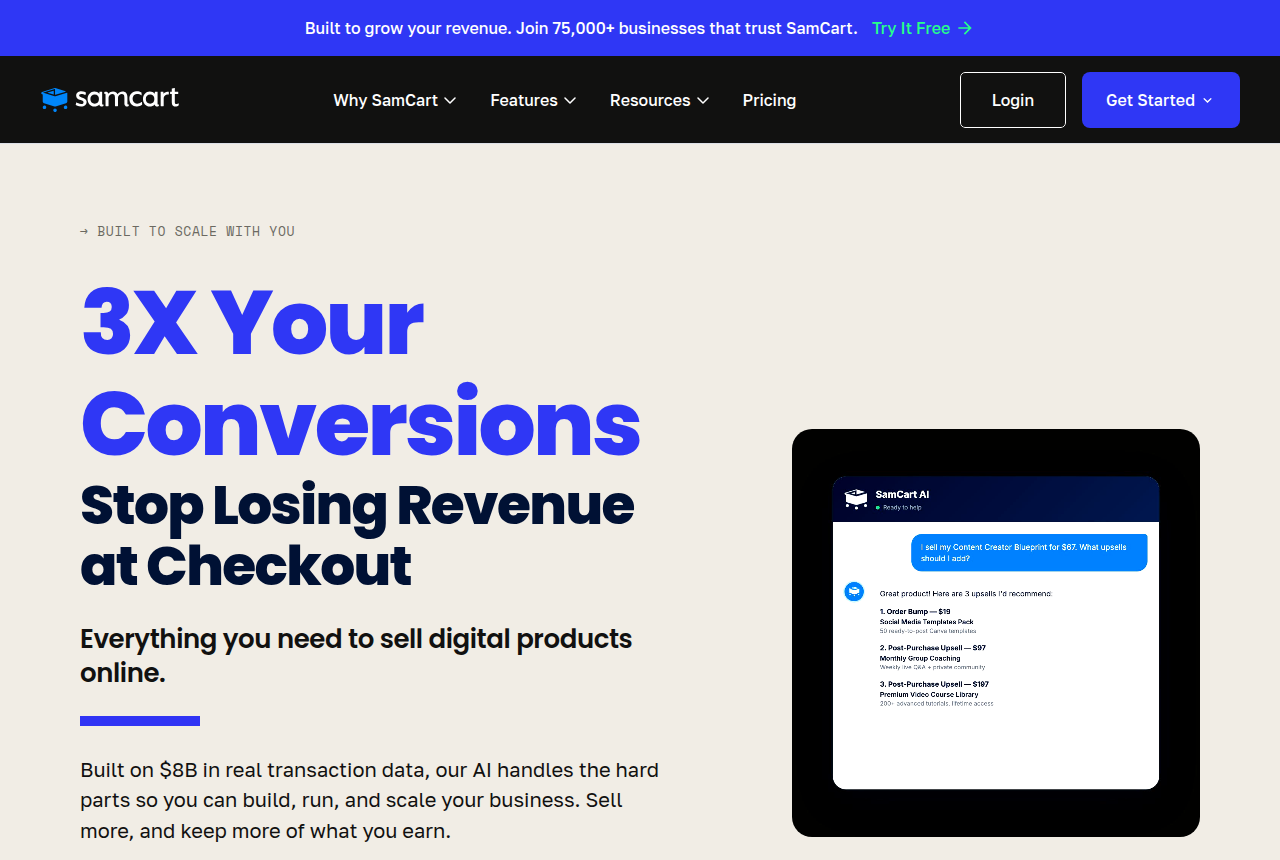
The tactics themselves do not carry a standalone fee. You pay for the checkout platform that can deliver them. On SamCart, Core is $79 per month, while Pro is $199 per month and includes both order bumps and one-click upsells. That means the relevant SamCart price for either tactic is Pro, not the advertised entry tier.
ElasticFunnels starts at $97 per month and includes both features on every plan. Starter, Growth and Scale differ by usage limits rather than feature access. Revenue processed through its own hosted gateways also carries a 0.5% checkout fee. Weigh $97 against $199 with traffic limits, checkout fees, the page builder and the rest of the stack you would otherwise pay for counted in.
Best paid-traffic checkout stack: ElasticFunnels
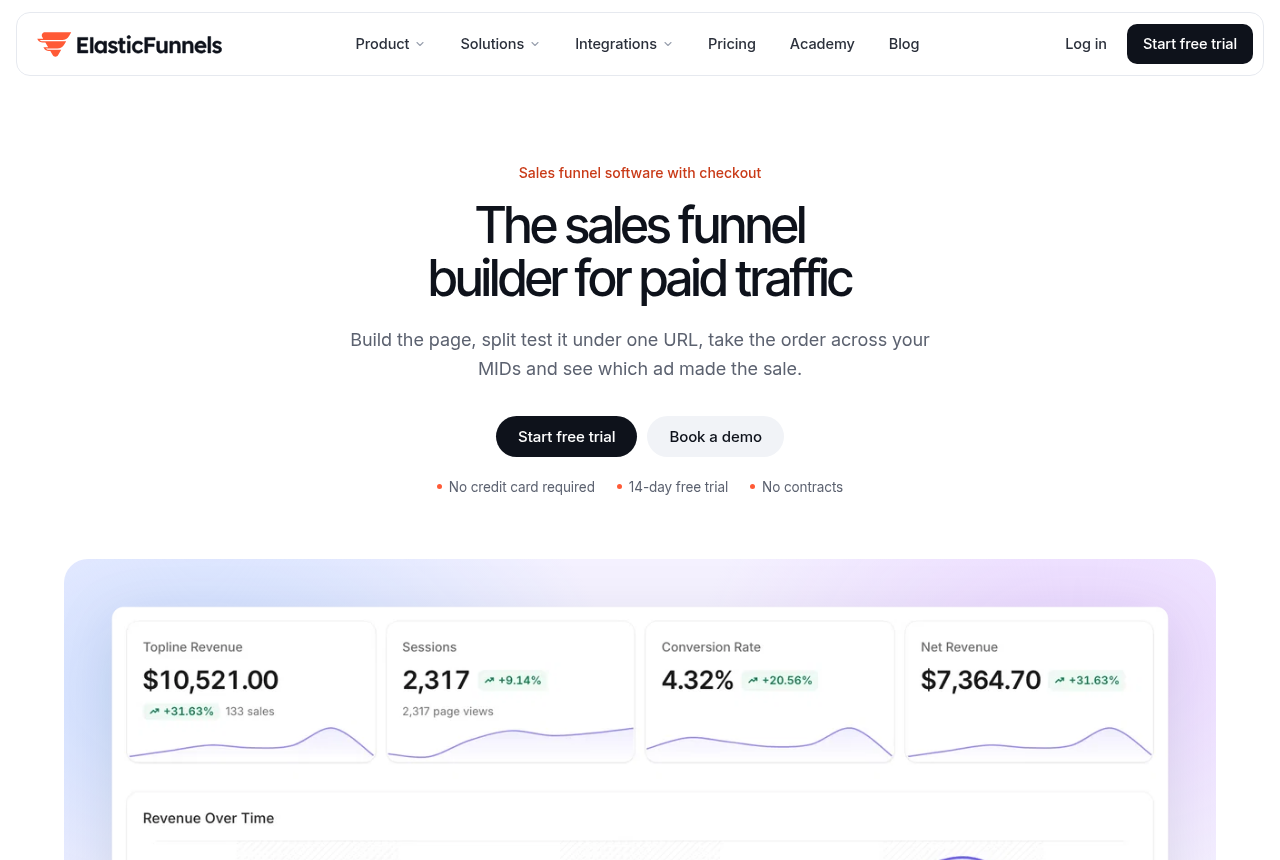
ElasticFunnels is a funnel platform for teams running paid traffic. It combines page building, same-URL split testing, checkout, attribution and CRM records on one data layer. In this comparison, the relevant part is the checkout sequence: an order bump can sit before payment, a one-click upsell can follow it, and the order, rebill and refund stay on the same customer timeline as the campaign session.
The broader stack matters when checkout optimization is not isolated from the ad and landing page. Its AI builder can generate a page from a prompt or clone one from a URL. Variants rotate server-side under one campaign URL, so an ad does not need a new destination each time you test a page. The platform also carries analytics, attribution, CRM pipelines, automations and call-center records.
Every feature is available on Starter at $97 per month, Growth at $197 and Scale at $497. Plans differ by page views, brands, domains, seats and automation runs. The trial lasts 14 days and requires no credit card. Checkout revenue through Stripe, NMI, PayPal, Klarna or Authorize.net carries a 0.5% fee.
Multi-MID routing is narrower than the phrase can sound. It applies only to sellers using several NMI merchant accounts. The first sale can be distributed across those accounts by weight and rules, while upsells and rebills stay with the MID that took the first payment. Teams using one Stripe account still get the page builder, same-URL tests, checkout, attribution and CRM. They simply do not use the NMI routing feature.
The material drawback is outside proof: ElasticFunnels is newer than the platforms it competes with, and there is very little independent third-party review coverage available to check its claims against. Until you run real volume through it, you are relying largely on the vendor's account of how the checkout and reporting hold up. It has been built since 2023, so limited outside coverage is expected for a platform this recent, but that does not remove the uncertainty. Use the 14-day no-card trial to validate the bump, the saved-card upsell and the reporting on your own funnel.
For checkout alone, compare it with SamCart. For a wider funnel bundle, the closer peers are ClickFunnels and Konnektive. ElasticFunnels can run both tactics. The open question is whether bringing pages, checkout and revenue reporting onto one record removes enough handoffs to justify changing the stack.
Frequently asked questions
Order bump or one-click upsell: which should I use?
Can I use an order bump and a one-click upsell together?
Can a one-click upsell hurt the original conversion?
Which software tier includes order bumps and upsells?
Sources
Vendor pages
- SamCart order bumps
- SamCart one-click upsells and downsells
- SamCart pricing
- ElasticFunnels custom checkouts
- ElasticFunnels pricing
Sources
Other sources
2 discussions and reviews read for this page. Quotes are excerpts; open a link to read the original in context.

Written by
Dana Rourke
Lead reviewer
Dana Rourke is the lead reviewer at Campaign Buyer. She owns the tracker and attribution coverage: reading what long-term users report about each tool, checking its documentation and pricing, and verifying prices with the vendor before writing the verdict. Keeping the rankings honest mostly means writing down what the top pick gets wrong, so she does that first.
Last checked 2026-10-12