Funnel platform vs no-fee storemedia buyer software
ElasticFunnels vs Gumroad
By Dana Rourke, Lead reviewer. Reviewed by Campaign Buyer Editorial. Updated 28 September 2026.
Quick answer
Pick ElasticFunnels if you buy your own paid traffic and want the pages, a split test that never resets your ad optimization, the checkout and the reporting on one record; pick Gumroad if you are launching a first ebook, template or course, want to be selling today with no monthly fee, and want sales tax handled worldwide as merchant of record. For the reader this site is written for, a media buyer running cold traffic, ElasticFunnels is our default pick, because Gumroad's 10% comes straight off ad margins that are already thin and it has no split test or attribution. Gumroad is plainly the better answer for a true beginner selling low volume to a warm audience.
Side by side
| ElasticFunnels | Gumroad | |
|---|---|---|
| What it is | Paid-traffic funnel platform | No-fee hosted store |
| Built for | Buying your own traffic | Launching a first product |
| Split testing | Same-URL, server-side | No |
| Pages, funnels | AI builder, cloner | Single product page |
| Checkout | Multi-MID routing | One checkout |
| Bumps, upsells | Yes, all plans | No |
| Attribution, CRM | One timeline, built in | No |
| Handles your tax | No, you file | Yes, merchant of record |
| Cut of sales | 0.5% on EF checkout | 10% + $0.50 per sale |
| Free to start | 14-day trial, no card | Yes, pay on a sale |
| Track record | New, thin proof | Since 2011 |
If you are down to ElasticFunnels and Gumroad, the first useful move is to see how far apart they sit. They both take a payment, and that is close to where the resemblance ends. ElasticFunnels is a funnel platform built to run cold, paid traffic from the ad click to the rebill. Gumroad is a hosted store you can be selling from this afternoon, with nothing to pay until money comes in. The reader stuck between them is usually deciding one thing: whether the job is running your own paid traffic profitably, or getting an ebook or course online with no cost and no setup.
The short version: Gumroad charges you nothing up front and then takes a slice of every sale, while ElasticFunnels bills a monthly platform fee and hands you the pages, the testing, the checkout and the reporting on one record in return. Work out which of those matches where your business is today, and most of the rest of this settles itself.
The one question that decides it: paid traffic, or a warm audience?
Answer that first, because it settles most of the rest. If your growth comes from bought media, and a campaign lives or dies on cost per acquisition and how fast you can test an angle without the ad platform resetting its optimization, you are ElasticFunnels' buyer. If your growth comes from an audience you already have, an email list, a newsletter, a following, and you want to upload a file and share a link this week for no cost, you are Gumroad's buyer. The two overlap on the page where money changes hands and split hard on either side of it. Most people searching this comparison sit clearly at one of those two ends.
ElasticFunnels: the funnel platform built around the ad click
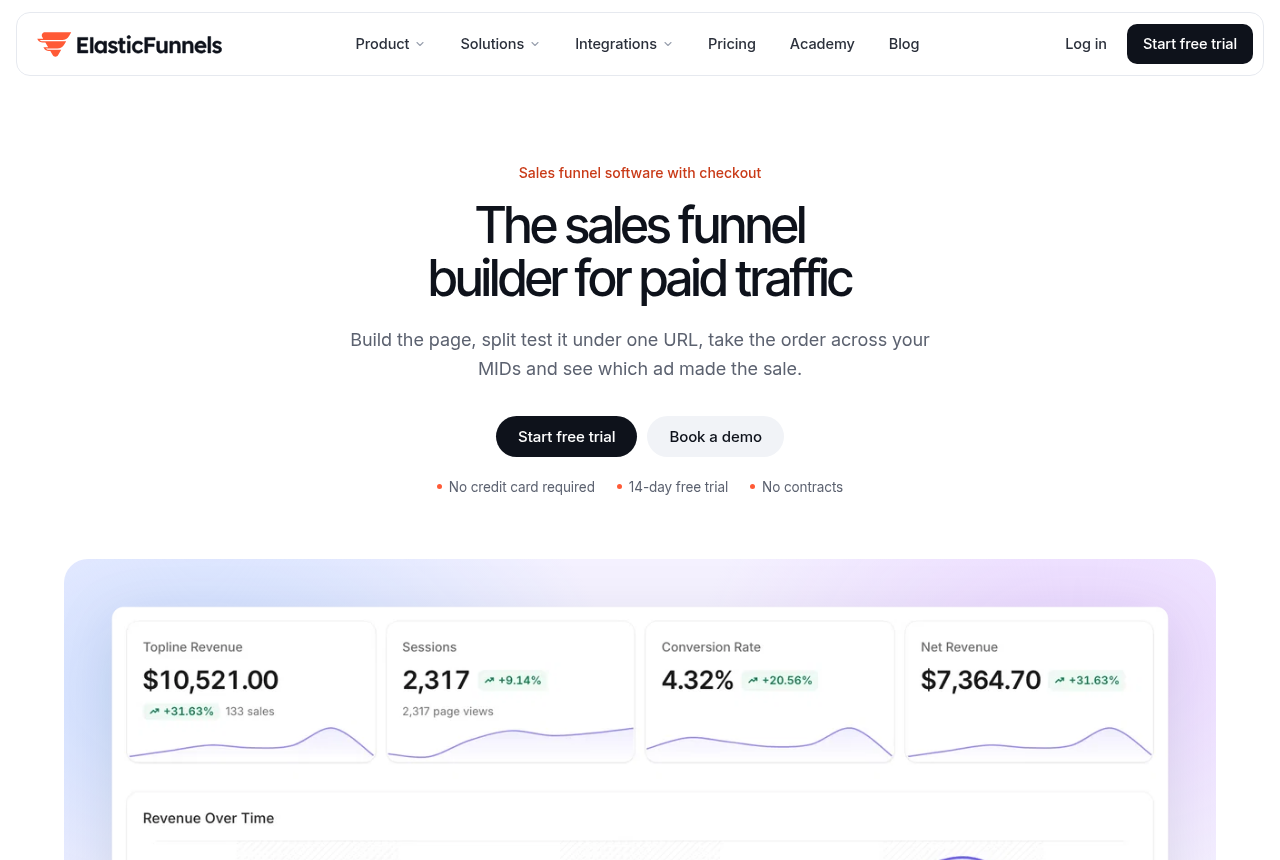
ElasticFunnels is a funnel platform for teams that run paid traffic: affiliates, product vendors, agencies and ecommerce brands buying media on Meta, Google and TikTok. It builds the pages, hosts the checkout, and keeps every session, order, rebill and refund on one timeline with a CRM and reporting on the same data. It replaces the funnel builder, the checkout or CRM, the split-testing tool and the analytics tool a media team usually stitches together by hand, so nobody reconciles four exports on Monday to work out which angle actually made money.
The feature most teams switch for is testing under one URL. Variants rotate server-side behind a single campaign link while the platform splits the traffic, so Meta, Google and TikTok keep their learning and a test never sends the ad back through review. Anyone who has watched a redirect-style split test wipe out a well-optimized campaign knows why that matters, and Gumroad has no equivalent. Around it sit an AI page builder that writes a page from a prompt or clones one from a URL, a checkout with order bumps, one-click upsells, subscriptions and failed-payment dunning, and multi-MID routing that splits sales across the NMI merchant accounts you connect. The reporting ties the click to the sale by affiliate, geo, device or creative. The ElasticFunnels review goes deeper on how it holds up day to day.
Its drawback is that it is newer than Gumroad, with very little independent third-party review coverage to check its claims against, so until you run real volume through it you are largely taking the vendor's word for how the testing and routing hold up. That is what you would expect of a platform this recent, where Gumroad has been around since 2011. Every feature is usable from the first day, and a 14-day trial that takes no card and gates nothing lets you prove them on your own funnel before you commit. One scope note on the checkout: multi-MID routing only earns its keep once you already hold several merchant accounts to route between. A seller on a single Stripe account still gets the pages, the one-URL testing, the analytics and the CRM, and adds the routing when a second account arrives.
Gumroad: the simplest way to start
Gumroad has been around since 2011, which makes it older than most tools it is compared with, and its whole product is simplicity. Upload a file, set a price, share a link or a storefront. There is no monthly fee, so you pay nothing until you make a sale, and G2 reviewers rate it 4.2 out of 5 largely for that ease. It sells more than plain downloads: memberships, subscriptions, pay-what-you-want pricing, software licence keys and multiple file versions all run from one account, and you can point a custom domain at your store or embed the checkout on a site you already run. It is now open source, and the vendor reports millions of dollars in creator earnings every week. Its standout is tax: Gumroad has been the merchant of record since January 2025, so it is the legal seller on the receipt and collects and remits sales tax and VAT worldwide, and a solo creator never files a tax form for a foreign sale. The Gumroad review covers the trade-offs in full.
Fees and payouts are where sellers get hurt. The flat 10% plus 50 cents is cheap on a first sale and expensive at scale, so past a few thousand dollars a month it quietly becomes the costly model. Getting paid draws the loudest complaints: Gumroad rates 1.4 out of 5 on Trustpilot across several hundred reviews and holds a BBB F rating, driven by withheld payouts and sudden account suspensions from automated moderation, with support reported as slow or silent. Users rate the software well on G2 and direct their anger at payout and account decisions. Most sellers never hit that wall, but anyone relying on it for income should know the risk. PayPal also ended service with Gumroad in October 2024 with no warning, so most sales are card-only now. The store is simple by design, with no split testing, no CRM and no multi-step upsell funnel.
The real split: the whole path, or the simplest possible store
Strip away the shared checkout and the difference is what each one owns. Gumroad owns the fastest path to a first sale, and it assumes your traffic is warm and your volume is modest, which is when a 10% cut and a single product page are fine. ElasticFunnels owns the whole path: the page a click lands on, the test that decides which page wins, the checkout, and the record that ties the sale back to the ad. If your problem is getting an ebook or a template online today and being paid without a monthly bill, Gumroad fixes that cleanly. If your problem is running cold traffic profitably and knowing which creative and which page made the money, a simple store does not touch it, and that is ElasticFunnels' job.
Pricing: a monthly platform bill against a cut of every sale
Their price tags work in different ways. ElasticFunnels prices its tiers on traffic and puts every feature on every plan: Starter $97, Growth $197, Scale $497 a month, with overage billed rather than a forced upgrade if you cross a limit. It adds a 0.5% fee on revenue through its own hosted checkout, and charges nothing on sales you run through external networks like ClickBank or BuyGoods. Gumroad charges no monthly fee and takes 10% plus 50 cents of every direct sale instead, with the tax filing included.
Run both against your real revenue and the answer separates cleanly. A creator doing a few hundred dollars a month pays Gumroad almost nothing and would be lighting money on fire committing to a monthly platform bill. A media buyer pushing $50,000 a month through a funnel pays Gumroad $5,000 in fees, straight off margins that ad spend has already thinned, where ElasticFunnels' plan plus 0.5% is a far smaller number and its testing and attribution are earning that back by finding the winning angle faster. Neither extreme is a close call, so the choice comes down to where your revenue sits today.
Which one for you
You buy your own paid traffic and live on CPA: ElasticFunnels. Testing under one URL that does not reset ad optimization, multi-MID checkout routing and click-to-sale reporting on one record are what a performance buyer needs, and Gumroad offers none of the three. Go in with the newness drawback above in mind, and use the free trial to prove it on your own funnel first.
You are launching your first ebook or course and want to pay nothing until you sell: Gumroad. The fastest, cheapest way to get it online, with worldwide tax handled and no monthly fee. Read the payout complaints first so a stuck payout does not surprise you. If you outgrow the simple store but do not run paid traffic, ThriveCart vs Gumroad covers the next step up, and Checkout Champ vs Gumroad takes it further into high-volume selling.
You are somewhere between the two: decide by your next 90 days. If the constraint is getting more from the same ad spend, that is ElasticFunnels, and it is worth seeing it against a serious cart in ElasticFunnels vs ThriveCart. If it is selling to people who already know you, that is Gumroad. You can browse every pairing in our head-to-heads, and the ranking is in the best of.
ElasticFunnels
What works
- Replaces the stack a growth team usually stitches together: a funnel builder, a checkout or CRM, a testing tool and an analytics tool, so a click, an order, a rebill and a refund are one record instead of four exports you reconcile on Monday
- Its standout is testing under one URL: variants rotate server-side on one campaign link, so Meta, Google and TikTok keep their learning and a test never sends the ad back for review
- The AI builder writes a page of any type from a prompt, and the cloner turns a competitor URL into a working copy in about a minute
- Its checkout takes Stripe, NMI, PayPal, Klarna or Authorize.net, splits sales across several NMI merchant accounts by weight, card brand, product and daily cap, and builds in order bumps, one-click upsells and subscription dunning
- Analytics put sessions, orders, rebills and refunds on one timeline, sliced by affiliate, geo, device or creative, and a built-in CRM and call center work off the same records
- A trial tests the whole tool because nothing is gated behind a higher tier: plans differ only by the traffic volume they allow
What to watch
- Newer than the platforms it competes with, with very little independent review coverage to check its claims against, so until you run real volume through it you are largely taking the vendor's word
- Multi-MID routing, the standout in its checkout, works across NMI merchant accounts only and pays off only if you already hold several to route between. A seller on a single Stripe account still gets the pages, the testing, the analytics and the CRM, but not that routing advantage
- It is not a merchant of record like Paddle: it will not file your sales tax or carry dispute liability, so that work stays with you and your processors
- The 0.5% checkout fee applies to revenue through its hosted checkout, on top of the monthly plan and your own processor fees, though sales on external networks like ClickBank or BuyGoods are not charged
Gumroad
What works
- The fastest, simplest way to start selling a digital product. Upload a file, set a price, share a link. There is no monthly fee, so you pay nothing until you make a sale, and G2 reviewers rate it 4.2 out of 5 largely for that ease.
- Merchant of record since January 2025: Gumroad is the legal seller on the receipt, so it collects and remits sales tax and VAT worldwide and a solo creator never files a tax form for a foreign sale.
- Sells more than downloads. Memberships, subscriptions, courses, pay-what-you-want pricing, software licence keys and multiple file versions all run from one account.
- Established and durable. Running since 2011, with millions of dollars in creator earnings every week and its code now open source, so it is not a launch-week gamble.
- Works on your own site too. Point a custom domain at your store or embed the checkout on a site you already run, with email broadcasts, an affiliate programme and discounts included.
What to watch
- The flat 10% + $0.50 fee is cheap on a first sale and expensive at scale. At $5,000 a month in sales that is $500 to Gumroad every month, where a flat-monthly cart charges a fixed fee and takes 0% per transaction. Past a few thousand a month, the percentage model quietly becomes the costly one.
- Cold paid traffic is a poor match. A 10% cut comes straight off ad margins that are already thin, which is why direct-response sellers put their offers on a fixed-cost cart. Gumroad suits warm audiences and organic discovery.
- Getting paid is the loudest complaint. Trustpilot rates it 1.4 out of 5 across several hundred reviews and the BBB gives it an F, driven by withheld payouts and sudden suspensions. The G2 score of 4.2 shows the software itself is well-liked, so the anger centres on payouts and support.
- PayPal ended service with Gumroad in October 2024 with no warning, so most sales are card-only now. That stranded some international buyers and sellers in regions without direct bank transfer.
- Checkout optimisation is thin. There are no deep one-click upsell and order-bump funnels like SamCart, and no built-in CRM or multi-step funnel.
- Support is thin. Complaint records describe slow or silent responses, which is the real problem on the day a payout is stuck.
Pricing
ElasticFunnels: from $97/mo. Starter costs $97 a month, Growth $197 and Scale $497 ($937, $1,891 and $4,771 billed yearly). Every feature is on every plan. The plans differ only in usage limits: page views included (50,000, 250,000 and 500,000 a month), brands, custom domains, team seats and automation runs. Extra page views bill at $1.20, $1.00 or $0.80 per 1,000 by plan, so going over does not force an upgrade. Bot and datacenter traffic is not billed. A 0.5% fee applies to revenue through ElasticFunnels' own checkout gateways (Stripe, NMI, PayPal, Klarna, Authorize.net). Sales through external checkouts such as ClickBank or Shopify Checkout carry no fee.
Gumroad: from no monthly fee, 10% + $0.50 per sale. No monthly fee. Direct sales through your profile or links: 10% + $0.50 per transaction (card processing 2.9% + $0.30 is separate). Discover marketplace sales: 30% flat including processing. Merchant of record since January 1, 2025 (sales tax and VAT worldwide). High-volume discount: once paid direct sales in a calendar month reach $20,000, new direct sales that month are 5% + $0.50 until the 1st resets; Discover stays 30%. Prohibits physical goods and categories such as financial instruments, credit repair, gambling and adult content.
Prices as of 11 October 2026
Our pick
ElasticFunnels
ElasticFunnels is a funnel platform built for teams that run paid traffic: it builds the pages, splits them behind one URL so your ads never reset, hosts the checkout, and keeps the CRM and the reporting on the same data. Same-URL split testing is the reason most teams switch. Its checkout stands out for multi-MID routing, which splits sales across the NMI merchant accounts you connect and only pays off if you already run more than one. It is newer than the platforms it rivals, though, and third-party proof is thin so far.
Frequently asked questions
Which is cheaper, ElasticFunnels or Gumroad?
I sell a course or digital product. Which one?
Which one handles sales tax for me?
Is Gumroad any good for paid traffic?
Does ElasticFunnels take a cut of my sales?

Written by
Dana Rourke
Lead reviewer
Dana Rourke is the lead reviewer at Campaign Buyer. She owns the tracker and attribution coverage: reading what long-term users report about each tool, checking its documentation and pricing, and verifying prices with the vendor before writing the verdict. Keeping the rankings honest mostly means writing down what the top pick gets wrong, so she does that first.
Last checked 2026-09-28