Page bundle vs funnel mapmedia buyer software
AdsBridge vs FunnelFlux
By Dana Rourke, Lead reviewer. Reviewed by Campaign Buyer Editorial. Updated 28 September 2026.
Quick answer
Pick AdsBridge if you want tracking, a drag-and-drop landing page builder and split testing bundled into one cheap cloud subscription for simpler lander-to-offer campaigns; pick FunnelFlux if you run genuinely multi-step funnels, want a visual per-node map that shows exactly where the flow leaks, and need server-side conversions fired back to Meta, Google and TikTok.
Side by side
| AdsBridge | FunnelFlux | |
|---|---|---|
| Deployment | Cloud, managed (since 2013, AWS) | Cloud, managed (Pro is SaaS) |
| Built around | Tracking + landing page builder + split testing | Visual multi-step funnel map, per-node reporting |
| Landing pages | Drag-and-drop builder included | Not built in; you host your own |
| Conversion tracking | Server-to-server postbacks, cookieless | Server-to-server, cookieless JS |
| Conversions to ad platforms | Postbacks to affiliate networks; no native Meta/Google CAPI | Server-side to Meta, Google, TikTok, Microsoft |
| Automatic cost sync | Not native | Via Argosync add-on |
| Pricing unit | Monthly visits | Events (impression, visit, click, conversion) |
| Entry price | $29/mo (100K visits) | $99/mo (2M events), then $10/M |
| Trial | 14-day, no refund on cancel | Free trial (card required) |
| Best for | Beginner or budget buyer who wants pages bundled | Optimizing complex multi-step funnels |
If you are down to AdsBridge and FunnelFlux, you have narrowed to two cloud trackers that both stamp a click, catch the conversion server-side, filter out junk traffic and tell a paid-traffic buyer which source, lander and offer actually made money. Neither asks you to run a server. Where they split is what you want the tracker to be, and that decision settles most of this comparison before you reach a feature list.
AdsBridge is a budget cloud tracker with a landing page builder folded in. It has run since 2013 on AWS, it connects to more than 100 affiliate networks with one-click postback setup, and its headline advantage over a plain tracker is that it builds and split-tests your pages for you. For a beginner or a mid-volume affiliate who does not want a second tool for landers, that bundle from $29 a month is a genuinely different offer.
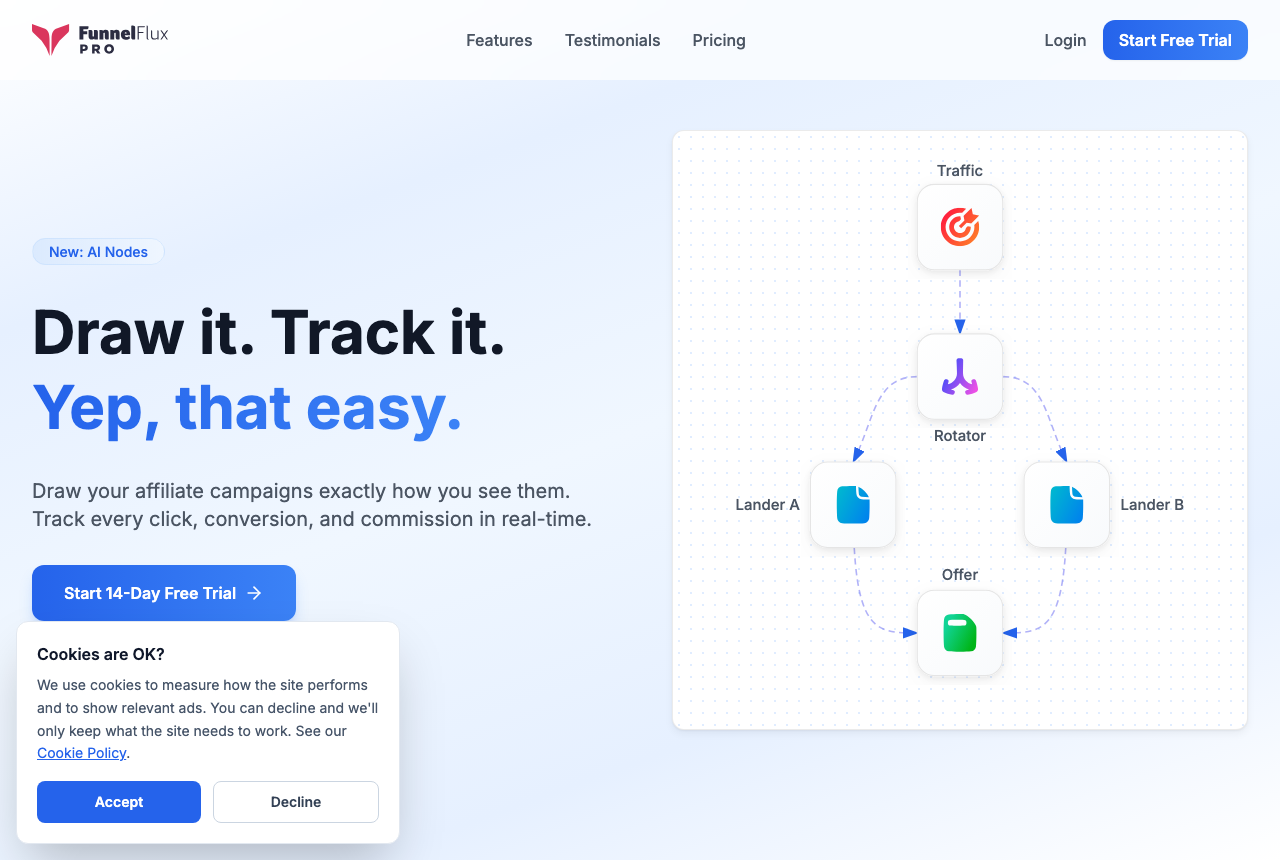
FunnelFlux Pro is a cloud tracker built around a visual funnel map. Instead of a table of campaigns, you draw your landers, advertorials, offers, rotators and conditional routing on one canvas, and the reporting is per node, so a leak between the advertorial and the offer shows up instead of hiding in a spreadsheet. It sends conversions server-side to Meta, Google, TikTok and Microsoft, and it prices by events: $99 a month for 2M, then $10 per extra million. For a buyer whose profit comes from optimizing a complex multi-step flow, that map is the reason to switch.
The decision underneath: build your pages, or map your funnel
Everything else in this comparison hinges on this. AdsBridge folds the page builder in, so you do not run a separate tool for landers: a drag-and-drop editor with templates and HTML access, split testing and automatic traffic-path optimization, all in the same subscription. FunnelFlux does not build pages. It maps and tracks them. You host the landers yourself and point FunnelFlux at them, and in return you get a funnel view no page builder gives you. So the real question underneath "which tracker" is often a different one: are your campaigns simple lander-to-offer flows, or genuinely multi-step funnels. If the flow is one lander to one offer and you want the pages built in, AdsBridge saves you a tool. If the flow has several steps and the money is made by finding the leak, FunnelFlux was built for exactly that.
Feeding the ad platforms: postbacks against server-side conversions
For anyone buying Meta, Google or TikTok traffic to their own offers, this is where the two part on merit. Keeping an ad platform's algorithm bidding on real sales means firing conversions back to the platform server-side. FunnelFlux does that natively, sending conversions to Meta, Google, TikTok and Microsoft. AdsBridge has no native Meta or Google conversion API. It reports conversions to your affiliate networks by server-to-server postback instead. That postback model is fine for pop, push, native and other network traffic, where the network is the thing that needs the conversion. It is a weak fit for a paid-social buyer who needs conversion events landing back in Meta, and it is the clearest single reason a social media buyer lands on FunnelFlux here. One caveat on the FunnelFlux side: automatic ad-spend sync, pulling your cost in so ROI is computed for you, is a separate product called Argosync rather than a built-in feature, so budget for that if live ROI matters to you.
Pricing, on two different meters
The entry prices are not comparable line for line, because the two meter different things. AdsBridge bills by monthly visits and starts at $29 for 100,000 of them, with the full feature set on every plan. FunnelFlux bills by events, where an event is every impression, visit, click and conversion, and starts at $99 for 2M events, then $10 per additional million. On a low-volume single-lander campaign AdsBridge is dramatically cheaper, and it throws in the page builder a FunnelFlux user still has to buy elsewhere. On a high-volume multi-step funnel the gap narrows, because AdsBridge's visit meter climbs too and you may have replaced its page builder anyway. Run both meters against last month's traffic to see which bill is smaller for you.
Learning curve, support and proof
AdsBridge is the easier tool to start. Its support assumes you are new, the network integrations are one click, and a beginner can be tracking the same day. The recurring complaint is redirect speed: a community speed test clocked its redirects slower than several rivals, which matters most on mobile, and reviewers note the dashboard can feel slow and that stability wobbles once daily volume gets extreme. AdsBridge also states it issues no refund on cancellation, so treat its 14-day trial as your one look. FunnelFlux asks more of you up front. The visual canvas is flexible, and that flexibility costs setup time, so the learning curve is real, and its community is smaller than Voluum's or RedTrack's, which means fewer guides when you get stuck. Proof is thin on both: AdsBridge's G2 profile carries too few reviews to lean on, and FunnelFlux is a niche tool without heavy independent review coverage either. Trial each on your own campaigns rather than trusting the scores.
FunnelFlux shows you where a multi-step funnel leaks, and AdsBridge builds the lander, but neither one hosts the checkout and upsell steps that the map points at, and neither keeps the sale on the same record as the click. ElasticFunnels is the adjacent tool for that, a funnel platform rather than a tracker. Its draw for a paid-traffic team is same-URL split testing, where variants rotate server-side under one campaign link so Meta, Google and TikTok never reset their learning and a test never sends the ad back through review, and it keeps the click, the order, the rebill and the refund on one timeline instead of spread across separate exports. Its drawback is age: it is newer than either tracker here, with very little independent third-party review coverage to check its claims against, so until you run real volume through it you are largely taking the vendor's word for what it does. That is what you would expect of a platform this young, and it matters less if you are the kind of buyer who trials a tool on your own campaigns before committing. Consider it when the leak FunnelFlux would find sits in the checkout itself and you would rather fix it where you build. It runs a 14-day trial with no card required, and its plans start at $97 a month.
Our pick, and when the other one wins
Between the two you asked about, our pick is FunnelFlux, for two things this site's reader needs most: a visual per-node map that shows where a multi-step funnel actually leaks, and native server-side conversions to Meta, Google, TikTok and Microsoft that keep a paid-social algorithm optimizing on sales. That is what you pay for when you run your own funnels, and it is worth the higher entry price and the steeper learning curve. But the pick assumes you run multi-step funnels and feed your own ad accounts. If your campaigns are simple lander-to-offer flows, you want the landing page builder and split testing bundled in, and you want the cheapest possible start, AdsBridge is the better answer for you specifically, and it is a fraction of the price. Decide what you want the tracker to be first. The rest follows from it.
AdsBridge
What works
- Tracking, a drag-and-drop landing page builder and split testing come in one subscription, so a beginner does not pay for a separate page tool.
- Cheaper entry than Voluum or RedTrack: $29/mo for 100,000 visits, and every plan carries the full feature set with no features gated to higher tiers.
- Prices by monthly visits rather than events, which is easier to predict than event-based billing when a campaign scales.
- Established since 2013 on AWS infrastructure, with 100-plus one-click network integrations, an anti-fraud filter and a redirectless tracking mode.
What to watch
- Redirect speed is the recurring complaint. A community speed test clocked its redirects slower than several rivals, which matters most on mobile traffic.
- Reviewers report stability flaws once daily volume gets extreme, and the dashboard can feel slow at times.
- No native Meta or Google conversion API. It leans on server-to-server postbacks, so paid-social buyers who want CAPI are better served elsewhere.
- Thin independent proof. Its G2 profile has too few reviews to be useful, so most write-ups are affiliate blogs rather than heavy buyer feedback.
- No permanent free tier, only a 14-day trial, and AdsBridge states it issues no refund on cancellation.
FunnelFlux
What works
- A visual funnel canvas: landers, offers, rotators and conditional routing wired together on one screen
- Node-level reporting shows exactly where a funnel leaks
- Predictable pricing: a $99/mo base plus $10 per extra million events
What to watch
- Expect a learning curve: the routing options take real setup time to master
- Automatic cost sync needs a separate product, Argosync
- A smaller community than Voluum or RedTrack, so fewer guides when you get stuck
Pricing
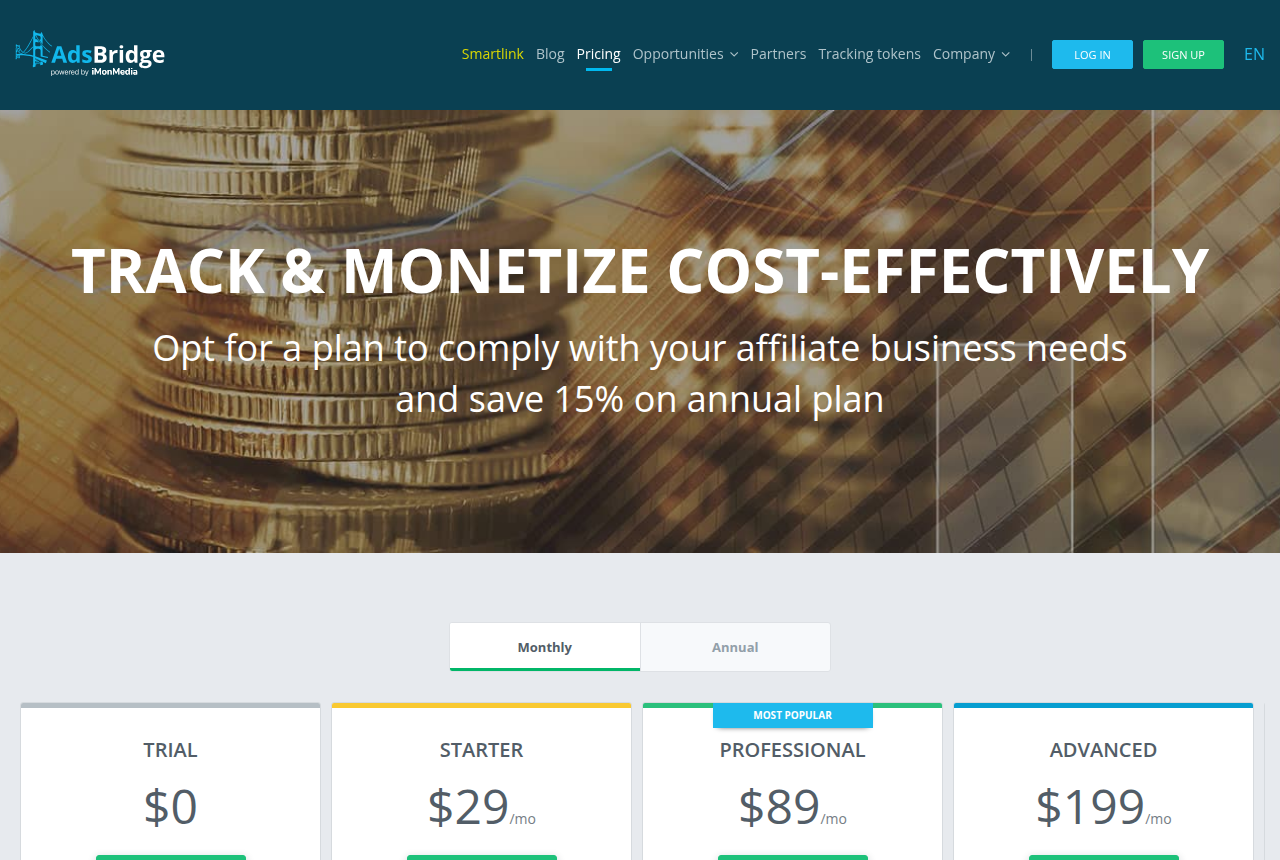
AdsBridge: from $29/mo. AdsBridge prices by monthly visits. Starter costs $29 a month for 100,000 visits. Professional is $89, Advanced $199, Business $379, Agency $499 and Enterprise $799, and Exclusive is quoted individually. Visits over the limit bill per 1,000, from $0.07 on Starter down to $0.029 on Enterprise. Annual billing saves up to 20%. Every plan starts with a 14-day free trial, and cancellations receive no refund.
FunnelFlux: from $99/mo. $99/mo base includes 2M events, then $10 per additional million events. First two custom domains free, then $2 each per month. Monthly, no annual contract.
Prices as of 28 September 2026
Our pick
FunnelFlux
FunnelFlux Pro is the pick if you run multi-step funnels and want to see the whole journey as a map instead of a table of clicks.
Frequently asked questions
Which is cheaper, AdsBridge or FunnelFlux?
Does AdsBridge or FunnelFlux build my landing pages?
Which one feeds conversions back to Meta and Google?
Is FunnelFlux worth roughly three times the entry price?
Sources
Other sources
5 discussions and reviews read for this page. Quotes are excerpts; open a link to read the original in context.
- [ff-home-visual] FunnelFlux Pro homepage
- [ff-home-s2s] FunnelFlux Pro homepage
- [ff-home-pricing] FunnelFlux Pro pricing notes
- [reddit-affmkt] Need software that links ad data with affiliate network data
- [reddit-ppc] Best FB ad tracking software?

Written by
Dana Rourke
Lead reviewer
Dana Rourke is the lead reviewer at Campaign Buyer. She owns the tracker and attribution coverage: reading what long-term users report about each tool, checking its documentation and pricing, and verifying prices with the vendor before writing the verdict. Keeping the rankings honest mostly means writing down what the top pick gets wrong, so she does that first.
Last checked 2026-09-28