Head-to-headmedia buyer software
BeMob vs FunnelFlux
By Dana Rourke, Lead reviewer. Reviewed by Campaign Buyer Editorial. Updated 23 September 2026.
Quick answer
Pick BeMob if you are new to tracking or spending lightly and want a real free tier to learn postbacks and tokens before you commit a budget; pick FunnelFlux Pro if you run multi-step funnels, want to read the whole journey as a visual map with node-level reporting, and are ready to pay for a managed tracker built for optimizing complex flows.
Side by side
| BeMob | FunnelFlux | |
|---|---|---|
| What it is | Cloud tracker with a free tier | Cloud visual funnel tracker |
| Free plan | Yes: 100K events, 10 campaigns | No, 14-day trial needs a card |
| Entry price | $49/mo for 1M events | $99/mo for 2M events |
| Custom domains | Only on the $249 Business plan | First two domains free |
| How you read data | Campaign tables and reports | Visual funnel map, per node |
| Automatic cost sync | Manual or passed in URL | Argosync, a separate product |
| Best-fit user | Beginners and low-spend buyers | Multi-step funnel optimizers |
If you are down to BeMob and FunnelFlux Pro, you have narrowed the field to two cloud trackers that both stamp a click, catch the conversion server-side, fire postbacks to your networks and tell you which source, lander and offer made money. Neither one asks you to run a server. What separates them is who they are built for. BeMob is the tracker you learn on, and FunnelFlux is the tracker you optimize a funnel on. That difference decides this more than any single feature does.
BeMob leads with a genuinely usable free plan and a cheap on-ramp. FunnelFlux leads with a visual funnel canvas and per-node reporting, and it charges for that from day one. One is where you make your early mistakes before money is on the line. The other is where you go once your profit comes from tightening a multi-step flow. Work out which of those you are before you compare a single number.
The two questions that decide it
Answer these first. One: how far along are you, and how much are you spending? If you are validating your first funnels or running light volume, a free tier that teaches you postbacks and tokens is worth more than any advanced feature you will not touch yet. Two: how do you want to read your campaigns? If your money comes from optimizing a three or four step flow and you want to see where it leaks, a table of clicks will fight you, and a visual map will not.
Those two questions usually point at different tools, and that is the honest shape of this matchup. BeMob answers the first buyer. FunnelFlux answers the second. At the entry level the prices sit close enough that cost rarely settles it. Which of those two buyers you are settles it.
BeMob: the tracker to start on
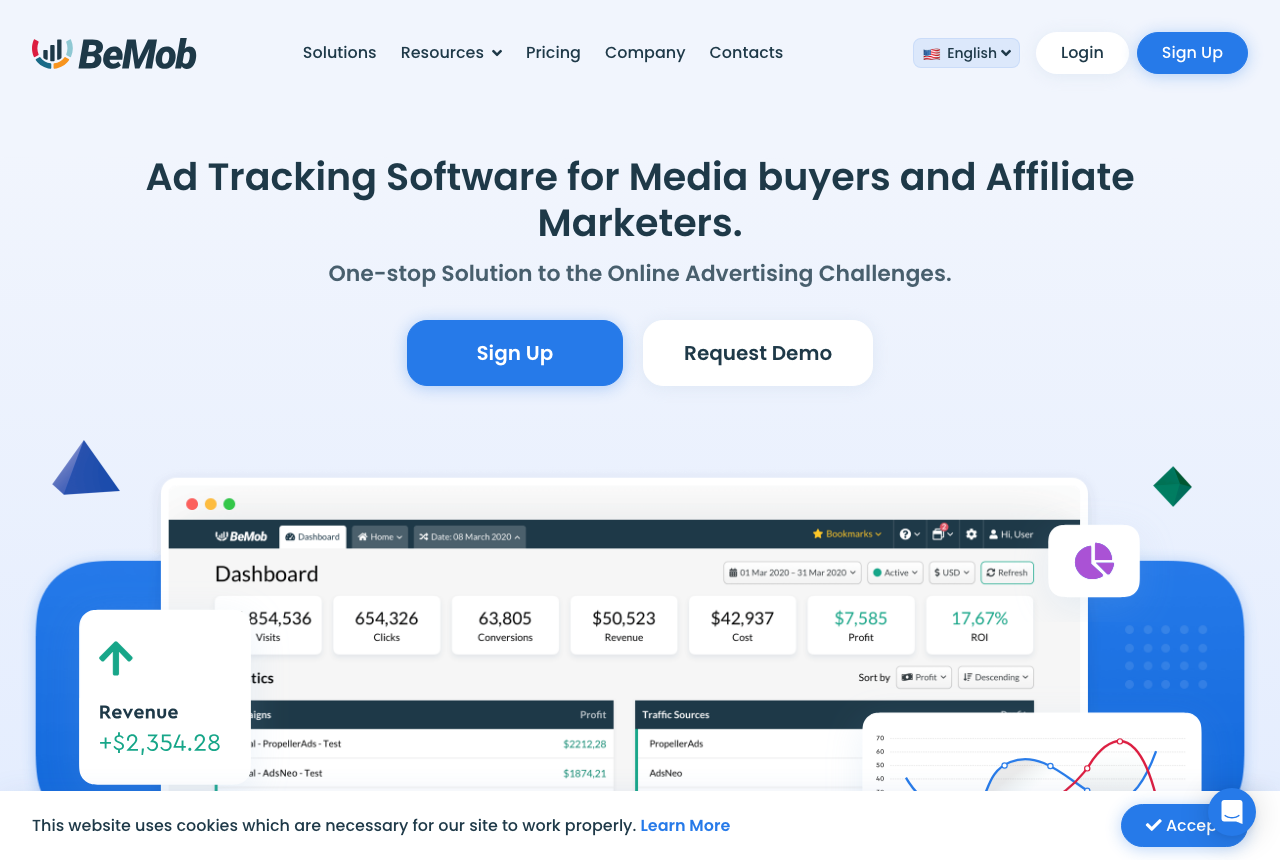
BeMob's free plan is a working tool. It gives you 100,000 monthly events, 10 campaigns, real landing-page and offer management, and reporting good enough to learn how tracking actually works. For a buyer making their first postback mistakes, that is the right place to make them. Paid entry is cheap too, at $49 a month for 1 million events, and because it is cloud-hosted there is nothing to install or patch.
The limits are real and they arrive quickly. BeMob counts every impression, visit, click and conversion as an event, so that free allowance vanishes the moment you run impression-heavy pop or push traffic. Custom tracking and cloaking domains, which serious buyers need, only start on the $249 Business plan. And once you scale past testing, it offers less than Voluum or RedTrack on the deeper reporting a high-spend buyer leans on. Treat BeMob as where you learn, then graduate when your spend justifies it. It is the gentlest on-ramp into tracking on this site, and that is exactly its job.
FunnelFlux Pro: the visual tracker for multi-step funnels
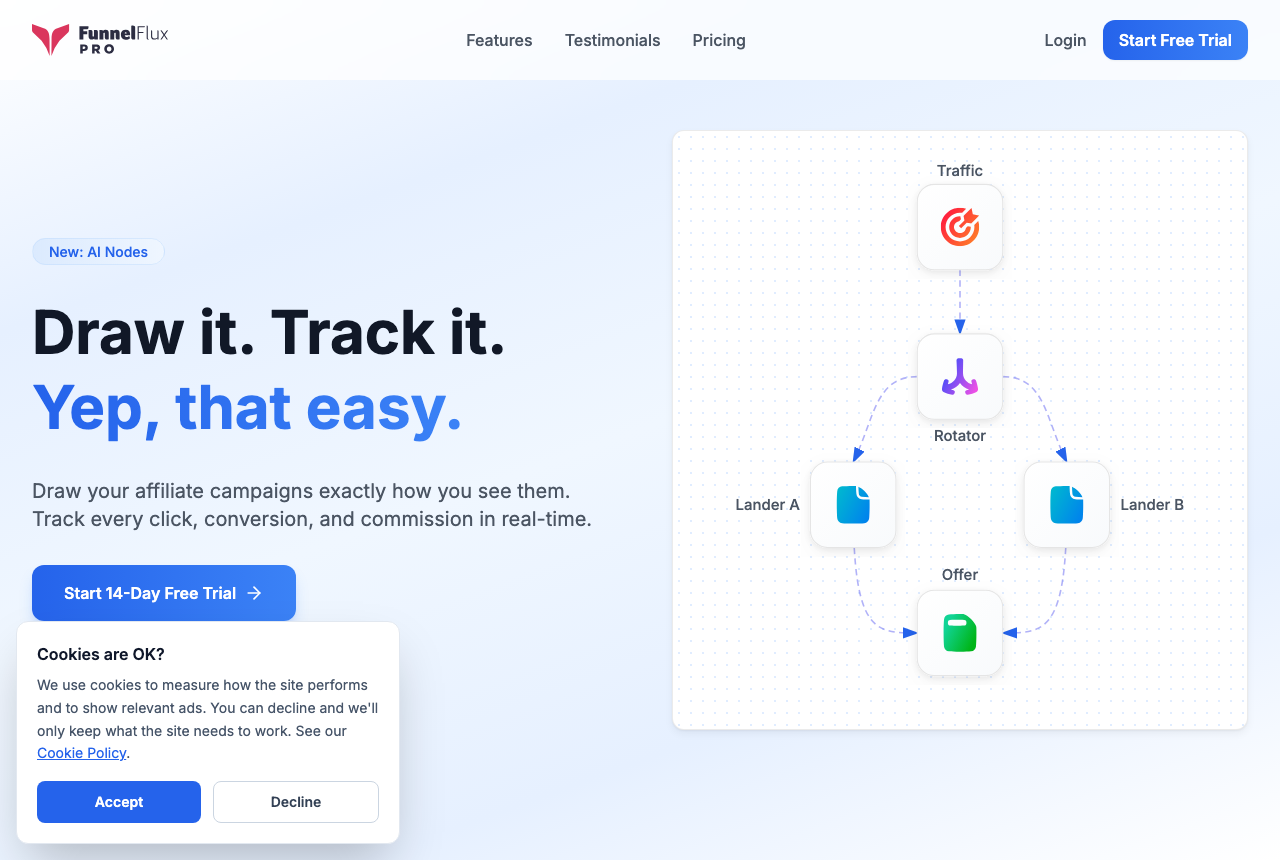
Most trackers show you a table of campaigns. FunnelFlux shows you a map. Landers, offers, rotators and conditional routing are drawn on one canvas, and because the reporting is per node, a leak between the advertorial and the offer is obvious instead of buried in a spreadsheet. For a buyer whose profit comes from complex, multi-step flows, that view is the whole reason to switch, and it is genuinely hard to reproduce in a link-based tracker like BeMob.
It is cloud-hosted, so there is nothing to maintain, and its server-to-server integrations pass conversions to TikTok, Facebook, Microsoft and Google Ads, with cookieless JavaScript tracking that survives browser privacy changes. Pricing is clear: $99 a month covers 2 million events, then $10 per additional million, and the first two custom domains come with the base plan, where BeMob gates them behind a higher tier.
The costs are worth naming. The flexibility of the visual builder comes with a learning curve the docs do not hide, so plan setup time. Automatic ad-cost sync is not native: you either pass cost in the URL or add Argosync, FunnelFlux's separate cost-sync product, which is its own subscription. The community is smaller than Voluum's or RedTrack's, so you will find fewer third-party walkthroughs when you hit an edge case. And the 14-day trial asks for a valid payment method up front, where BeMob's free plan never expires.
Learn cheap, or optimize a funnel
Underneath the feature lists, this is one trade. BeMob gives you a free way in and a cheap paid entry, at the price of less depth and domains locked behind the Business plan. FunnelFlux gives you the funnel map from the first dollar, at the price of a learning curve, a card-required trial and a separate product for cost sync. Neither is better in the abstract.
Match it to where you are. A buyer new to tracking, or one running light volume who wants to understand the plumbing before paying for it, wants BeMob. A buyer optimizing a real multi-step funnel, who thinks in landers and offers and wants to see the whole journey, wants FunnelFlux. If you cannot yet picture your campaigns as a funnel with distinct steps, you are still BeMob's buyer.
Where the pricing actually diverges
The entry prices look close, but they are aimed at different traffic. BeMob's free tier is the cheapest real start of anything on this site, and its first paid tier costs half of FunnelFlux's entry price for half the events. FunnelFlux has no free plan, so at the very bottom a beginner pays nothing to learn on BeMob. As volume climbs, both meter events and both can run into overage, so your real monthly event count sets the bill. BeMob's Business plan is the step that quietly changes its economics once you need cloaking domains.
A third path if you host the funnel yourself
A buyer who outgrows BeMob and is drawn to FunnelFlux's map is often a buyer who has started selling their own offer. For that buyer, ElasticFunnels builds the funnel itself rather than drawing one over pages hosted elsewhere. It is a funnel platform for teams running paid traffic that builds the pages, hosts the checkout, and keeps its ad-spend and conversion reporting on the same data layer as the pages and the sale, so the spend-to-sale record sits next to the order. For affiliate work it fires server-side postbacks to your networks on purchase, refund, chargeback and renewal from its own checkout. It starts with a 14-day free trial that takes no card, which is worth noting next to FunnelFlux's card-required trial.
It is newer than either tracker here, with very little independent review coverage, so until you run real volume through it you are largely taking the vendor's word for how its attribution holds up. BeMob and FunnelFlux, by contrast, have years of public setups behind them. Its reporting also stops at the funnels it hosts, so traffic sent to offers on other people's domains still needs BeMob or FunnelFlux. It suits the seller ready to host pages and checkout in one place.
Which one for you
You are new to tracking or spending lightly: BeMob. The free plan is a real tool, and its first paid tier is a fair step up once you outgrow it. Learn postbacks and tokens here before you pay for anything more advanced.
You run multi-step funnels and want to see them as a map: FunnelFlux Pro. Reading every step of the funnel at once is the reason to pay. The cloud hosting means nothing to maintain, and its entry tier is fair for that view. Budget setup time for the learning curve and add Argosync if you want automatic cost sync.
You host your own offer end to end: look at ElasticFunnels alongside them, with the newness caveat above in mind, and keep a dedicated tracker for traffic you send to offers outside your own domains.
FunnelFlux Pro is our default pick here because more readers who reach this comparison are past the learning stage and want a tracker built to optimize a funnel. BeMob still wins for a beginner. That matches how this site rates the two: BeMob is the pick if you are starting out or spending lightly, and we rank it fourth in our ad tracker ranking for exactly that buyer, while FunnelFlux serves the buyer who has a funnel to tighten. If you want to weigh FunnelFlux against a self-hosted option instead, our Binom vs FunnelFlux Pro page does that.
BeMob
What works
- A genuinely usable free plan: 100K events, 10 campaigns and real reporting
- Cheap paid entry at $49/mo for 1M events
- Cloud-hosted, so there is nothing to install or maintain
What to watch
- 100K free events disappear fast once you log impressions or run any volume
- Custom tracking domains only start on the $249 Business plan
- Less depth than Voluum or RedTrack once you scale past testing
FunnelFlux
What works
- A visual funnel canvas: landers, offers, rotators and conditional routing wired together on one screen
- Node-level reporting shows exactly where a funnel leaks
- Predictable pricing: a $99/mo base plus $10 per extra million events
What to watch
- Expect a learning curve: the routing options take real setup time to master
- Automatic cost sync needs a separate product, Argosync
- A smaller community than Voluum or RedTrack, so fewer guides when you get stuck
Pricing
BeMob: from $49/mo, or free. The Free plan covers 100,000 events a month with one month of data retention. Professional costs $49/mo for 1M events and one month of retention. Business is $249/mo for 10M events and three months, and Enterprise $499/mo for 30M events and six months. BeMob counts every impression, visit, click or conversion as an event. Overage is billed per 1,000 events at $0.05 on Professional, $0.025 on Business and $0.02 on Enterprise. Custom tracking and cloaking domains start on the Business plan.
FunnelFlux: from $99/mo for 2M events. $99/mo base includes 2M events, then $10 per additional million events. First two custom domains free, then $2 each per month. Monthly, no annual contract.
Prices as of 27 September 2026
Our pick
FunnelFlux
FunnelFlux Pro is the pick if you run multi-step funnels and want to see the whole journey as a map instead of a table of clicks.
Frequently asked questions
Which is cheaper, BeMob or FunnelFlux?
Is BeMob really free, or is it a limited trial?
Which handles multi-step funnels better?
Do I need a custom tracking domain, and which one includes it cheaper?
Sources
Other sources
5 discussions and reviews read for this page. Quotes are excerpts; open a link to read the original in context.
- [ff-home-visual] FunnelFlux Pro homepage
- [ff-home-s2s] FunnelFlux Pro homepage
- [ff-home-pricing] FunnelFlux Pro pricing notes
- [reddit-affmkt] Need software that links ad data with affiliate network data
- [reddit-ppc] Best FB ad tracking software?

Written by
Dana Rourke
Lead reviewer
Dana Rourke is the lead reviewer at Campaign Buyer. She owns the tracker and attribution coverage: reading what long-term users report about each tool, checking its documentation and pricing, and verifying prices with the vendor before writing the verdict. Keeping the rankings honest mostly means writing down what the top pick gets wrong, so she does that first.
Last checked 2026-09-23