By Dana Rourke, Lead reviewer. Reviewed by Campaign Buyer Editorial. Updated 23 September 2026.
Quick answer
Pick Binom if you push high volume, want flat pricing that never scales with clicks, and have someone who can run a server; pick BeMob if you are starting out or spending lightly and want a genuine free tier with nothing to install.
Side by side
| Binom | BeMob | |
|---|---|---|
| What it is | Self-hosted click tracker | Cloud-hosted click tracker |
| Hosting | You run your own server | Fully managed, nothing to install |
| Pricing model | Flat $149/mo, no event cap | Free tier, then $49/mo |
| Server-to-server postbacks | Yes | Yes |
| Custom and cloaking domains | Yes, on your own setup | From the $249 Business plan |
| Best-fit volume | Tens of millions of events and up | Low volume, testing and learning |
| Where your data lives | Your own infrastructure | BeMob's cloud |
If you are down to Binom and BeMob, the useful thing to know first is that these two rarely serve the same buyer at the same time. They sit at opposite ends of one line. BeMob is where you start tracking for free while you learn. Binom is where a high-volume buyer lands once event-based pricing on a cloud tracker stops making sense. Most readers choosing between them are really working out which end of that line they are on today.
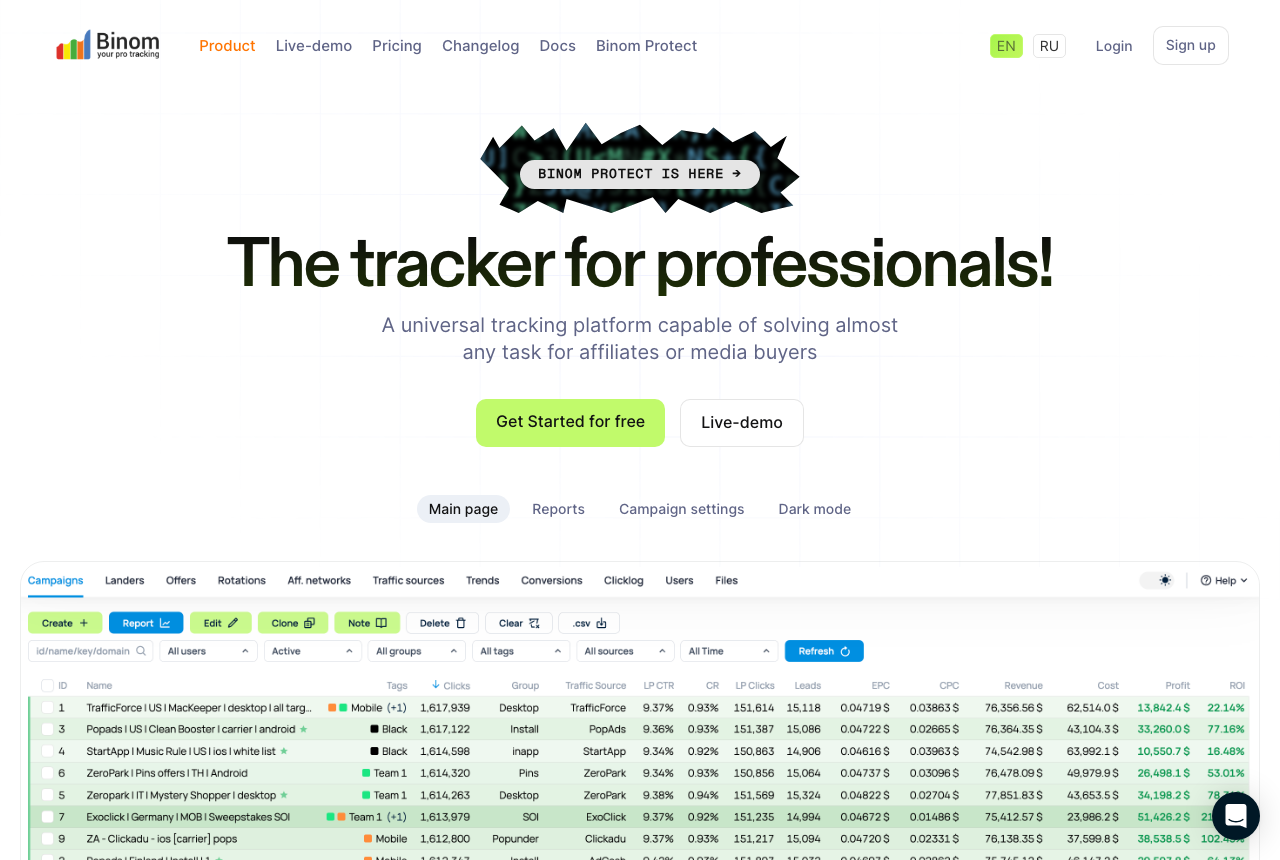
Both do the same core job. They stamp a click, catch the conversion server-side, fire postbacks to your networks, and show you which source, offer and landing page actually made money. The difference that decides everything is your monthly event volume and whether you are willing to run your own server.
The one question that decides it: your volume
Answer this before you compare a single feature. How many tracking events will you log a month, and is that number climbing? BeMob counts every impression, visit, click and conversion as an event. Its free plan covers 100,000 of them, which sounds like plenty until you run impression-heavy traffic like native or push, where it can vanish in a day. Paid BeMob is $49 a month for 1M events and scales up in tiers from there.
Binom ignores that math entirely. It is self-hosted at a flat $149 a month, or $104 billed yearly, with no cap on events at all. A buyer pushing hundreds of millions of clicks a month pays the same as one pushing a few million. So the fork is simple: at low volume BeMob is cheaper and often free, and at high volume Binom's flat price is the rational choice. Somewhere in the middle is a crossover point, and where it falls depends on how impression-heavy your traffic is.
BeMob: the free place to start and learn
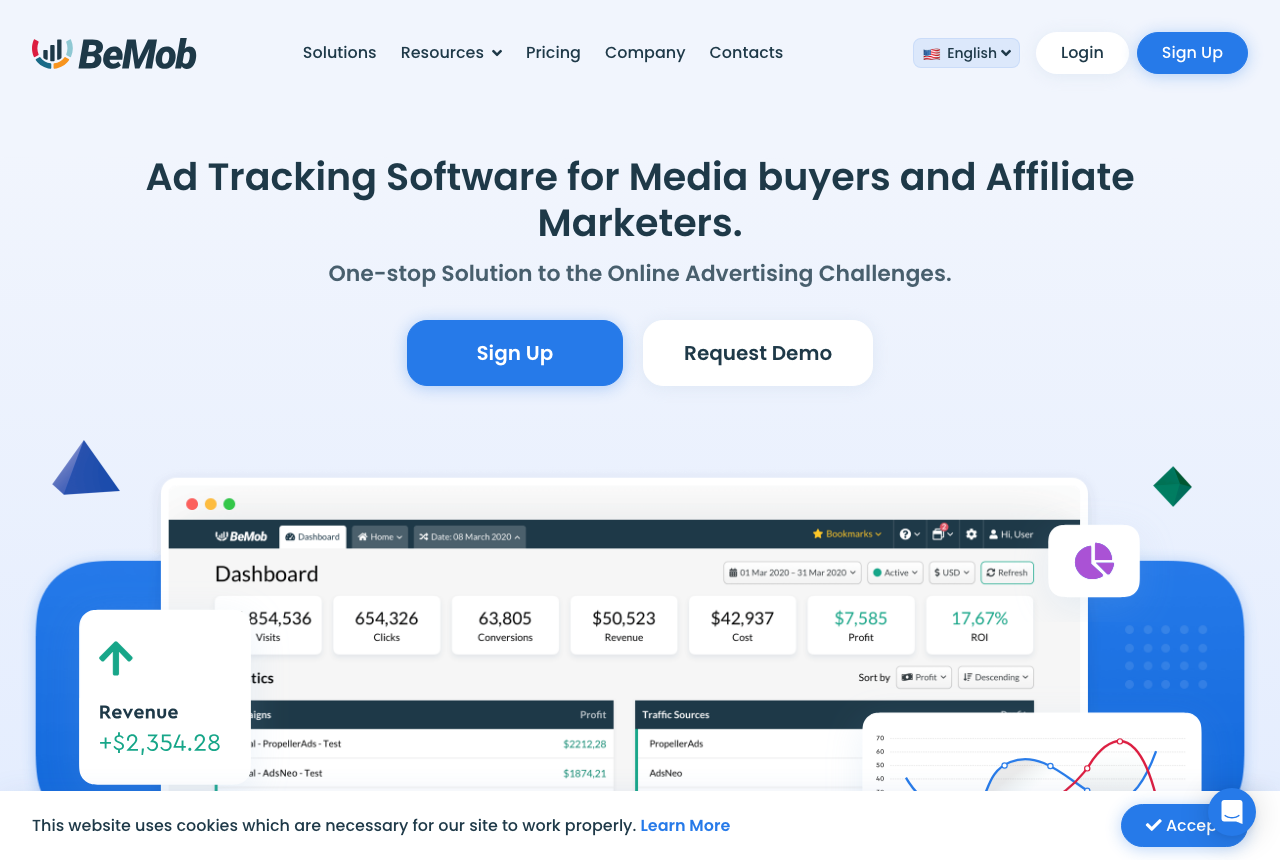
BeMob is the gentlest on-ramp into tracking that exists. The free plan is a working tracker with no time limit: ten campaigns, real landing-page and offer management, and reporting good enough to understand how postbacks and traffic tokens behave. For a buyer validating a first funnel, it is the right place to make the early mistakes before money is on the line. Paid entry is cheap too, and because it is cloud-hosted there is nothing to install or keep patched.
The limits arrive faster than beginners expect. That free allowance disappears the moment you run impression-heavy traffic, and custom tracking and cloaking domains, which most serious campaigns need, only start on the $249 Business plan. BeMob is excellent at getting you tracking for free while you work out whether an offer is worth scaling, and most buyers outgrow the free tier once an offer starts to scale.
Binom: flat, uncapped pricing once volume is real
Binom is the tracker for buyers who have done the math on event-based pricing and did not like the answer. It is self-hosted, so your data never leaves infrastructure you control, and the price stays the same however much traffic you send. For a pop, push or native affiliate doing enormous click counts, that is the whole pitch, and it is decisive.
Speed is the other reason it wins its segment. Redirect and reporting performance at extreme volume is exactly where cloud trackers either choke or bill you into the next tier, and Binom was built for that load. What it costs you is operations. You install it, you keep it updated, and you own uptime and scaling. Its onboarding assumes you already understand postbacks and tokens. If you are not comfortable managing a Linux server, the hours that takes are a real cost, and they are the single biggest reason a buyer picks a cloud tracker instead.
Self-hosted vs cloud: the trade you are really making
Underneath the pricing, this is a self-hosted versus cloud decision, and it cuts two ways. Self-hosting Binom gives you data ownership, flat costs and raw speed, at the price of running infrastructure you are responsible for. Cloud-hosted BeMob gives you zero maintenance and instant setup, at the price of event-based billing and a ceiling you eventually hit. A solo buyer testing offers wants nothing to maintain and will take the cloud tier every time. A high-volume affiliate with a technical hand on the team wants the flat bill and the control, and will happily run the server.
One honest note for the beginner: if you are choosing between these two and the idea of patching your own tracker gives you pause, start on BeMob. You can always move to Binom later when your volume and your comfort both justify it, and plenty of buyers do exactly that.
Where the crossover actually falls
BeMob charges by the event and Binom charges a flat licence, so run the comparison on your own traffic. If you run a few hundred thousand clean events a month, BeMob is cheaper or free and there is no reason to run a server for it. If you run tens of millions of events, especially impression-heavy native or push, Binom's flat price is well below what a cloud tracker's tiers would bill, and the server pays for itself. The crossover sits wherever the cloud bill matches Binom's licence plus your server costs.
A third path if you host the funnel yourself
Binom and BeMob both assume the pages and the checkout live somewhere else, and they follow the traffic there. ElasticFunnels is a funnel platform for teams running paid traffic that hosts those pieces itself. It builds the pages, hosts the checkout, and keeps its ad-spend and conversion reporting on the same data layer as the pages and the sale, so the spend-to-sale number sits beside the order. For affiliate work, it fires server-side postbacks to your networks on purchase, refund, chargeback and renewal from its own checkout, which suits a vendor who runs everything in one place and does not want a second login for tracking. It starts with a 14-day free trial that takes no card, on plans from $97 a month plus 0.5% of revenue processed through its hosted checkout.
Its drawback is a short public record. ElasticFunnels is newer than Binom or BeMob, and there is very little independent review coverage to check its attribution against, while both trackers here have years of public setups and threads behind them. That is what you would expect of a platform this young, and the no-card trial lets you test it on your own offer first. Its reporting also covers only the funnels it hosts, so traffic that closes on offers across other people's domains still needs a dedicated tracker like these two.
Which one for you
You are new to tracking or spending lightly: BeMob. The free tier is real, there is nothing to install, and it is the cheapest sensible way to learn how tracking works before money is on the line. Nothing in this pair beats free at low volume.
You push high volume and can run a server: Binom. Flat, uncapped pricing and speed at extreme load are exactly what event-based cloud billing punishes, and if you have a technical hand on the team the server cost is worth it.
You host your own offer end to end: look at ElasticFunnels alongside them, with its thin outside track record in mind, and keep a dedicated tracker for any traffic that closes off your own domains.
BeMob is our default pick because more readers who reach this comparison are at the stage where a free cloud tier is the right start and running a server is not yet worth it. On its own turf, high-volume affiliate traffic, Binom is plainly the better tool. Match the pick to where you are today, and move when your event counter tells you to.
Binom
What works
- Self-hosted, so your data stays on your own infrastructure and there is no per-event tax
- Flat $149/mo, or $104 billed yearly, with no traffic-volume cap, so cost does not scale with clicks
- Built for speed at pop, push and native volumes where cloud trackers get expensive
What to watch
- You run the server, including updates, uptime and scaling
- The setup is the most technical of any tracker here
- Support and onboarding assume you already know postbacks and tokens
BeMob
What works
- A genuinely usable free plan: 100K events, 10 campaigns and real reporting
- Cheap paid entry at $49/mo for 1M events
- Cloud-hosted, so there is nothing to install or maintain
What to watch
- 100K free events disappear fast once you log impressions or run any volume
- Custom tracking domains only start on the $249 Business plan
- Less depth than Voluum or RedTrack once you scale past testing
Pricing
Binom: from $149/mo. Binom v2 (self-hosted) is $149/mo, or $104/mo billed yearly. Binom Cloud (managed hosting) is $299/mo. Each additional license is $75 ($52 yearly). A 14-day trial with no traffic or feature limits, extendable to 30 days on request. Binom Protect (bot and cloaking protection) is a separate $69/mo yearly add-on.
BeMob: from free, then $49/mo. The Free plan covers 100,000 events a month with one month of data retention. Professional costs $49/mo for 1M events and one month of retention. Business is $249/mo for 10M events and three months, and Enterprise $499/mo for 30M events and six months. BeMob counts every impression, visit, click or conversion as an event. Overage is billed per 1,000 events at $0.05 on Professional, $0.025 on Business and $0.02 on Enterprise. Custom tracking and cloaking domains start on the Business plan.
Prices as of 23 September 2026
Our pick
BeMob
BeMob is the pick if you are new to tracking or spending lightly and want a real free tier before you commit.
Frequently asked questions
Which is cheaper, Binom or BeMob?
Is BeMob genuinely free, or is it a limited trial?
Do I have to run a server to use Binom?
Can I start on BeMob and switch to Binom later?
Do Binom or BeMob build my landing pages and checkout?
Sources
Other sources
2 discussions and reviews read for this page. Quotes are excerpts; open a link to read the original in context.

Written by
Dana Rourke
Lead reviewer
Dana Rourke is the lead reviewer at Campaign Buyer. She owns the tracker and attribution coverage: reading what long-term users report about each tool, checking its documentation and pricing, and verifying prices with the vendor before writing the verdict. Keeping the rankings honest mostly means writing down what the top pick gets wrong, so she does that first.
Last checked 2026-09-23