Direct-response vs funnel buildermedia buyer software
Checkout Champ vs ClickFunnels
By Dana Rourke, Lead reviewer. Reviewed by Campaign Buyer Editorial. Updated 27 September 2026.
Quick answer
Pick Checkout Champ if you already sell at real volume and need one-click upsells, subscriptions and payments routed across many merchant accounts from one direct-response CRM, and can commit to $300 a month plus 1% of sales with no free trial; pick ClickFunnels if you sell courses, coaching or your own offers and want the pages, checkout, upsells and email running as one funnel you can start yourself from $97 a month.
Side by side
| Checkout Champ | ClickFunnels | |
|---|---|---|
| What it is | DR ops platform | Funnel builder |
| Built for | Volume DR sellers | Creators, coaches |
| Self-serve | No, demo only | Yes |
| Entry price | $300/mo + 1% | $97/mo |
| Upsells, bumps | Yes | Yes |
| Multi-MID routing | 270+ gateways | One processor |
| Subscriptions | Yes | Yes |
| Courses, community | No | Yes |
| Reporting, CRM | Deep, multi-store | Light CRM |
| Track record | ~12 G2 reviews | 10+ yrs, 4.6/5 |
If you are choosing between Checkout Champ and ClickFunnels, the first thing to get straight is that they solve different problems. Both sell online and both try to raise the value of an order, and the overlap mostly stops there. ClickFunnels is a funnel builder for people selling their own offers: courses, coaching, info products. Checkout Champ is a direct-response platform built to run high-volume selling across many payment accounts. The reader stuck between them is usually deciding one thing: whether they are big enough, and committed enough, to run the heavier machine.
ClickFunnels helped make "sales funnel" a category, and after more than a decade it is one of the most recognized funnel builders online, with about 4.6 out of 5 across more than 400 G2 reviews and thousands on Trustpilot. Checkout Champ runs on the Konnektive CRM engine and reports more than $7 billion processed, over 200 million transactions a year and 60,000-plus users, routing charges across 270-plus gateways. One is a proven tool you switch on yourself from $97 a month. The other is an operations platform you are onboarded onto after a demo, with a $300 monthly floor and a share of sales on top.
The one question that decides it: are you at volume, and ready to commit?
Settle this before you compare a single feature. Checkout Champ is not sold self-serve. There is no free trial and no public signup. You book a demo, get a quote, and go through a setup period with an assigned account manager. Pricing opens at $300 a month: Growth costs $300 plus 1% of gross sales and is aimed at sellers past roughly $50,000 a month, and Enterprise serves sellers past about $1 million a month. Add-ons such as fraud screening, 3-D Secure and account updater bill as separate line items, and staying with your account manager past the 60-day setup is another monthly charge. That is a real commitment, and it only pays off once your volume is large enough to earn it back.
ClickFunnels works the other way. You sign up yourself, pick a plan from $97 to $297 a month, and build your first funnel the same day from a large template library, with no onboarding call. So the choice turns on stage: whether you already do serious direct-response volume and need routing and depth, or you want a whole funnel live this week without a sales call.
Checkout Champ: the direct-response platform
Checkout Champ is built for the seller whose margin lives in average order value and in keeping payments flowing at scale. On-page and pop-up order bumps, true one-click upsells and dynamic upsell offers that change by product are the front end, with A/B/C/D split testing on pages, prices, products and upsell flows behind them. The separator is the payment layer. Intelligent billing logic spreads volume across the 270-plus gateways and merchant accounts you connect, so one account having a bad day does not stop the money, and subscription billing runs on any account you attach with no extra platform fee. Reporting and CRM run deep, and you manage multiple stores and thousands of SKUs from one dashboard.
Two costs come with that power. First, tracking and attribution are on you. Sending paid traffic across custom landers, redirects and separate domains can drop click IDs and split cookies, so Meta and Google cannot match the conversion. It is a wiring problem rather than a defect, but it needs server-side tracking and someone technical to own it. Second, it does not manage chargebacks: the vendor's own FAQ says it reports disputes after they post and recommends you hire a separate chargeback company. Independent proof is thin too, around a dozen G2 reviews with some marked as incentivized, which is what you get from a platform sold by demo rather than self-serve.
ClickFunnels: the proven way to launch a funnel fast
ClickFunnels runs the whole path from click to customer in one account: landing and sales pages, a checkout with order bumps and one-click upsells, email follow-up, a light CRM, courses and a community. Non-technical sellers praise its drag-and-drop editor and prebuilt funnel templates most, and it takes no cut of your sales. For a creator, a coach or an info-product seller who wants a funnel and the course and community around it live fast, the pitch holds up, and the strong aggregate scores back it.
Where it draws complaints is price and billing. Plans run $97 to $297 a month, and users say the cost climbs quickly if you only need part of it. Billing and cancellation are the loudest gripes, along with confusion between the older ClickFunnels Classic and the newer 2.0 accounts, and some long-time users feel 2.0 was a step back. Its checkout runs on a standard processor, so it does not route a declined charge to a second merchant account, and its course and membership delivery is weaker than a dedicated platform. For its intended buyer none of that is a dealbreaker. For a high-volume direct-response seller, the single-processor checkout and the lack of multi-account routing are.
The real split: reach and ease versus routing and depth
Strip away the shared surface and the difference is what each one optimizes for. ClickFunnels optimizes for speed: a whole funnel, course and community live this week from $97, with a decade of proof and a huge template ecosystem, on a standard checkout. Checkout Champ optimizes for the seller whose daily problem is keeping payments flowing across many accounts at volume, who needs dynamic upsells and deep reporting, and who can justify a demo, a $300 floor and 1% of sales. If shipping and selling an offer to an audience is your problem, that is ClickFunnels. If routing volume and squeezing order value at scale is your problem, that is Checkout Champ.
A third option built for paid traffic: same URL, routed checkout, one data layer
ElasticFunnels earns a place in this decision because it sits between the two on exactly the axis a paid-traffic buyer cares about. Its lead feature is same-URL split testing: variants rotate server-side under one campaign link, so Meta, Google and TikTok keep their learning and a test never sends the ad back through review. That is the piece neither Checkout Champ nor ClickFunnels offers. Around it sit an AI page builder that writes a page from a prompt or clones one from a URL, a hosted checkout with order bumps, one-click upsells and subscription dunning, and multi-MID routing that splits sales across the NMI merchant accounts you connect. Sessions, orders, rebills, refunds and ad spend land on one timeline with a CRM and call center on the same data, so you are not reconciling exports to see which angle made money. It is self-serve with a 14-day free trial and no card. Each plan carries every feature and the tiers differ only by traffic, opening at $97 a month, with a 0.5% fee on revenue through its own hosted checkout.
The honest limit is that ElasticFunnels is newer than either of these, and there is very little independent third-party review coverage to check its claims against, so until you run real volume through it you are largely taking the vendor's word for how the routing and reporting hold up. That is what you would expect of a platform this new, and the trial lets you run the pages, the same-URL testing and the routed checkout on your own traffic before you pay. Scope the routing, too. Checkout Champ spreads volume across 270-plus gateways, far more than the NMI merchant accounts ElasticFunnels routes between, so a seller who needs to spread volume across a large book of merchant accounts still has the stronger fit in Checkout Champ. ElasticFunnels is the pick for the paid-traffic seller who wants the pages, the testing, a routed checkout and the reporting on one platform they can start today.
Which one for you
You sell courses, coaching or your own offers and want a funnel live fast: ClickFunnels. Pages, checkout, upsells, email, courses and a community in one self-serve account from $97, a decade of track record and the largest template library in the category. Budget for the tier that carries what you need, because the bill climbs, and test the checkout before you trust it with a launch.
You already sell at real volume and route across many accounts: Checkout Champ. Multi-gateway routing across 270-plus accounts, dynamic upsells, deep reporting and multi-store management are what you are buying, and the $300 a month plus 1% is earned back once your volume needs that redundancy. Budget the all-in number with add-ons, and plan for someone technical to own tracking.
You run your own paid-traffic offers and want the pages, testing and checkout on one platform: look at ElasticFunnels alongside them, with the newness caveat above in mind, because same-URL split testing and a routed checkout on one data layer are the things neither Checkout Champ nor ClickFunnels puts together.
Between the two head-to-head, ClickFunnels is our default pick, because most people weighing these two have yet to reach the volume that justifies Checkout Champ's demo-gated pricing, and ClickFunnels covers the whole funnel self-serve with a decade of proof behind it. For a direct-response seller already running upsells and subscriptions at real volume across several merchant accounts, Checkout Champ is plainly the better fit, and it is the one we would pick in that seller's shoes.
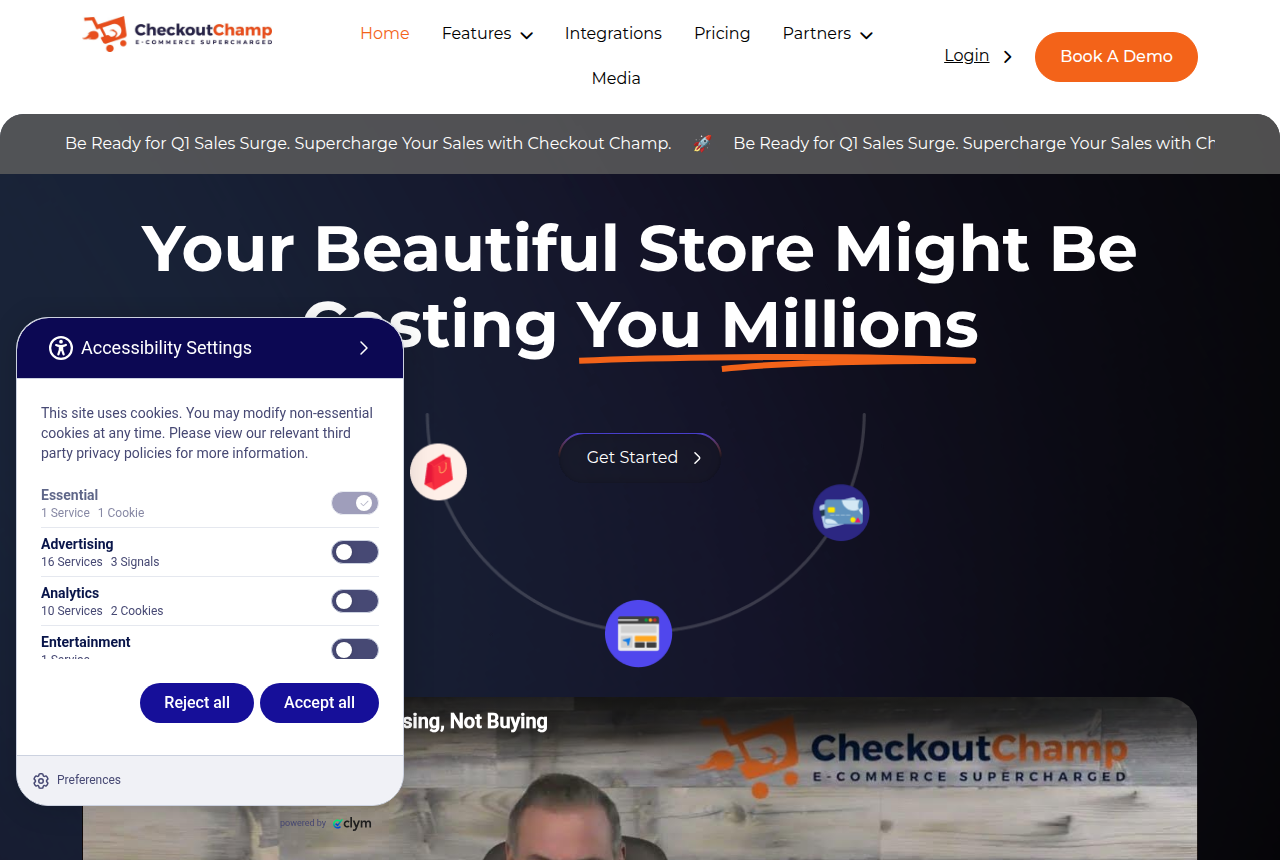
Checkout Champ
What works
- Built to raise order value at volume. On-page and pop-up order bumps, true one-click upsells, and dynamic upsell offers that change by product, with A/B/C/D split testing on pages, prices, products and upsell flows. This is the machinery a direct-response seller buys it for.
- Multi-gateway routing is the real separator. Intelligent billing logic spreads volume across 270+ gateways and merchant accounts, so you get redundancy if one account has a problem, and subscription billing runs on any account you connect with no extra platform fee. The digital-product carts on this site cannot do this.
- One CRM for many stores. Reporting and CRM run deep, you manage multiple storefronts and thousands of SKUs from a single dashboard, and there is a customer portal for subscription self-service and a documented API for headless setups. Reviewers single out the reporting depth.
- Hands-on setup support. Each account is assigned an account manager who can configure it with you on a kickoff call, and long-term users repeatedly praise the live support.
What to watch
- Access is by demo and quote, with no self-serve signup. Plans open at $300/mo plus 1% of gross sales, and add-ons like fraud screening, 3DS, consent management and account updater bill as separate line items. Keeping your account manager after the 60-day setup period is another monthly charge, so the all-in bill runs above $300.
- Tracking and attribution are on you. Sending paid traffic across custom landers, redirects and separate domains can drop click IDs and split cookies, so Meta and Google cannot match the conversion. Server-side tracking fixes it, and someone technical has to own that setup.
- Chargebacks are reported after they post and left for you to manage. The vendor's own FAQ recommends bringing a separate chargeback company, an added cost in the high-risk categories it otherwise suits.
- Thin independent proof. Public review volume is small, around a dozen G2 reviews with some marked incentivized, and the Reddit footprint is sparse. That is what you would expect of a specialist platform sold by demo, and it puts more weight on what the demo shows you on your own offers.
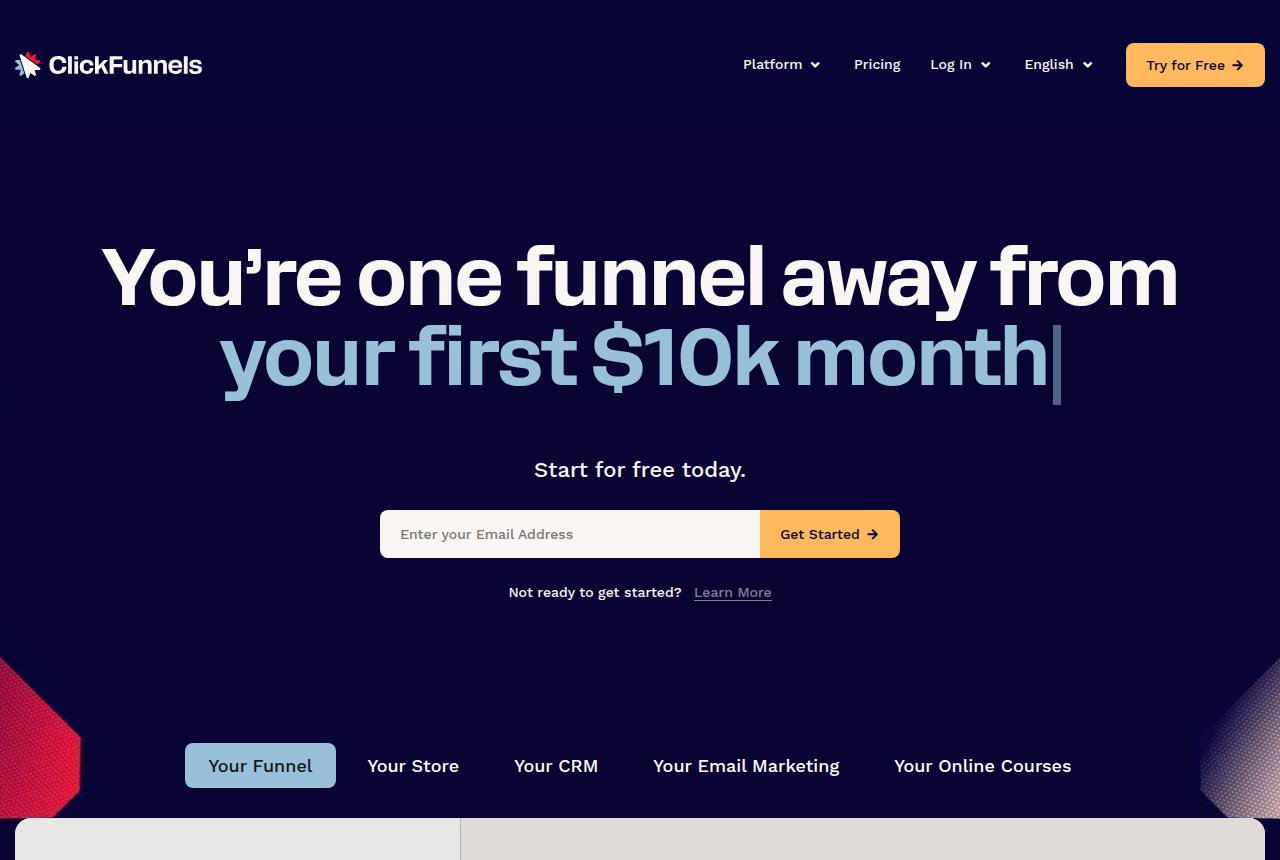
ClickFunnels
What works
- Runs the whole funnel in one account: pages, checkout, email, a light CRM, courses and a community, so you are not stitching four tools together
- Fast to get live. The drag-and-drop editor and prebuilt funnel templates are the most-praised part, especially for non-technical sellers
- Smart Checkout is built for selling, with order bumps and one-click upsells aimed at raising average order value
- Strong aggregate scores: about 4.6 out of 5 across more than 400 G2 reviews and thousands of Trustpilot reviews
- Takes no cut of your sales, includes hosting, and carries a 30-day money-back guarantee
What to watch
- Priced at the top of the market. Plans run $97 to $297 a month, and users say the cost adds up fast, especially if you only need part of it
- Billing and cancellation are the loudest complaints, along with confusion between ClickFunnels Classic and the newer 2.0 accounts
- Some long-time users feel 2.0 was a step back from Classic, and marketers report occasional bugs and page speed that is hit or miss
- Less flexible than a custom stack, and course and membership delivery is weaker than a dedicated platform
Pricing
Checkout Champ: from $300/mo + 1%. Access is by demo, with no self-serve free trial on the pricing page. Growth costs $300 a month plus 1% of gross sales processed through the platform. Enterprise is $300 a month with a volume-based reduction in that percentage. Standard payment-processor fees apply on top. Add-ons such as PAAY 3DS, Fraud Manager, Clym.io and Account Updater bill as separate line items. The EULA's Exhibit A also lists tiered percentage fees by monthly gross sales, plus a $0.05 charge per decline when the decline rate passes 20% in a billing period.
ClickFunnels: from $97/mo. Launch is $97, Scale $197 and Optimize $297 a month on monthly billing, or about $81, $164 and $248 a month paid yearly. Dominate is $5,997 a year and sold annually only. The first three plans open with a free trial, refunds are honoured for 30 days, and ClickFunnels takes no percentage of sales.
Prices as of 12 October 2026
Our pick
ClickFunnels
ClickFunnels is the pick if you sell coaching, courses or info products and want the pages, checkout, upsells and email running as one funnel instead of four separate tools. It is fast to launch and covers the whole sales process end to end. The trade-offs are real: it sits at the top of the market on price, the bill climbs as you scale, and billing and cancellation draw the most complaints.
Frequently asked questions
Which is cheaper, Checkout Champ or ClickFunnels?
Does Checkout Champ have a free trial?
Which is better for selling a course or coaching program?
Can ClickFunnels route payments across several merchant accounts?
Which one handles high-risk offers?
Sources
Other sources
6 discussions and reviews read for this page. Quotes are excerpts; open a link to read the original in context.

Written by
Dana Rourke
Lead reviewer
Dana Rourke is the lead reviewer at Campaign Buyer. She owns the tracker and attribution coverage: reading what long-term users report about each tool, checking its documentation and pricing, and verifying prices with the vendor before writing the verdict. Keeping the rankings honest mostly means writing down what the top pick gets wrong, so she does that first.
Last checked 2026-09-27