PPC pages vs free suitemedia buyer software
Unbounce vs Systeme.io
By Dana Rourke, Lead reviewer. Reviewed by Campaign Buyer Editorial. Updated 4 October 2026.
Quick answer
Pick Unbounce if you buy paid search or social traffic and the job is landing pages, message match and serious page testing, and your checkout and email already live somewhere else; pick Systeme.io if you are a solo creator or beginner who wants funnels, email, a course and your own affiliate program in one cheap login, starting on a free plan, and can live with a basic page builder.
Side by side
| Unbounce | Systeme.io | |
|---|---|---|
| What it is | Paid-traffic page builder | One-login creator suite |
| Best for | Paid-search message match | Beginners on a budget |
| Core strength | A/B tests and Smart Traffic | Funnel, email, course in one |
| Landing pages | Specialist, mature editor | Basic, templated |
| Dynamic text | Yes, from Experiment | No |
| A/B testing | Yes, from Experiment | Basic |
| Smart Traffic routing | Yes, from Optimize | No |
| Checkout | No, connect your own | Yes, simple |
| Email marketing | No | Included, unlimited |
| Courses and affiliates | No | Included |
| Transaction fees | None (no checkout) | 0% |
| Free plan | No, 14-day trial | Yes, usable |
| Entry price | $29/mo | Free, then $17/mo |
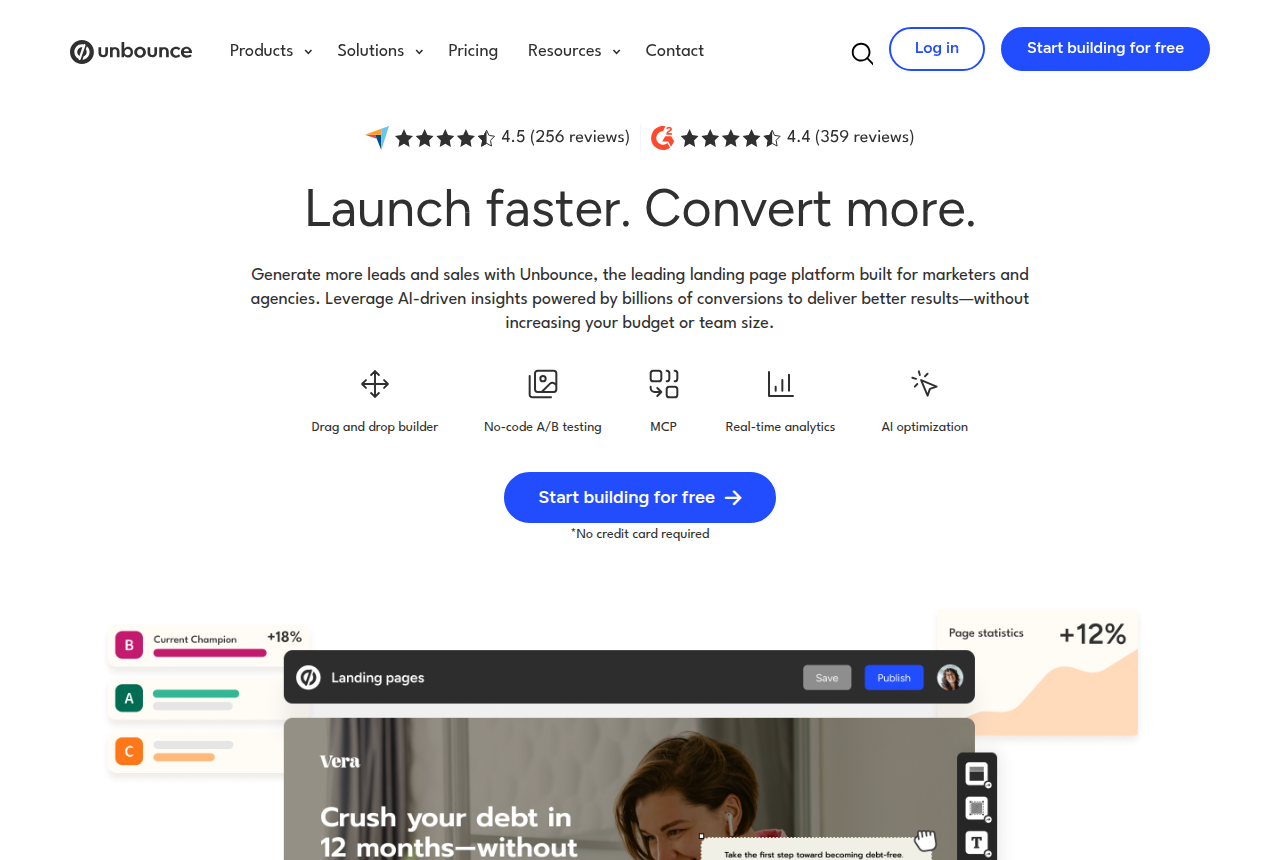
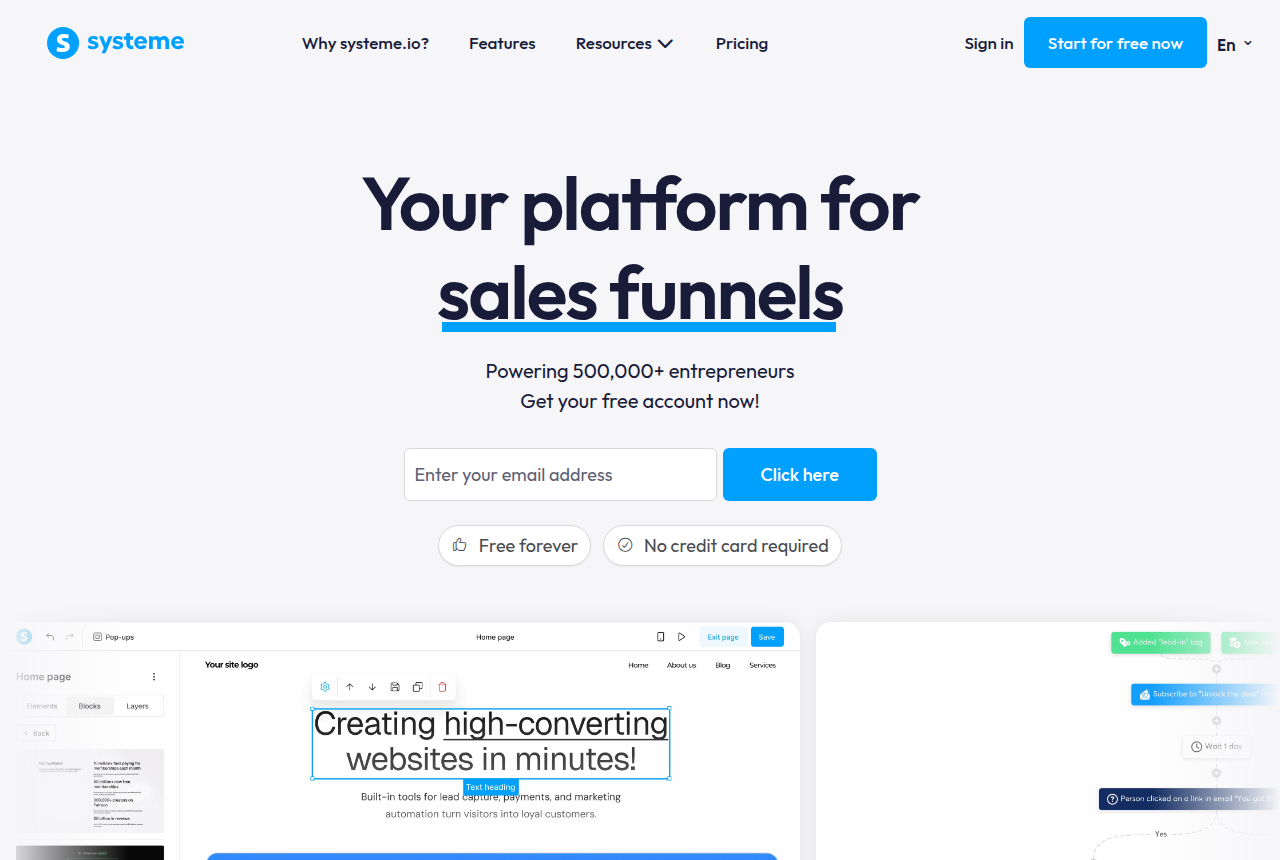
Unbounce and Systeme.io both put a page in front of your traffic, and that is about where the overlap ends. Unbounce is a specialist landing-page and conversion tool aimed at people buying paid search and social clicks: its job is message match and testing, and it hands the checkout, the email and the customer record to other systems. Systeme.io is a one-login platform for solo creators and beginners: funnels, email, a course, a blog and a built-in affiliate program in a single cheap account, with a free plan that never expires. If you are down to these two, you are really choosing between a sharp tool for one job and a cheap kit for the whole small business.
The one question that decides it
Do you want the best page for paid traffic, or the cheapest way to run a whole small business? Once you name that fork, the answer is usually obvious.
If your pages are where you win or lose, because you buy Google or Meta clicks and the headline has to match the search, Unbounce is built for exactly that and Systeme.io is not. If you have no stack yet and a tight budget, and you need a funnel, an email list, a course and partner commissions without paying for each one, Systeme.io does all of that from a free plan and Unbounce does none of it. Each reaches a little into the other's territory. Neither does the other's job well, and paying for the strength you will not use is the usual regret with both.
The case for Unbounce
For a search-ad buyer, the biggest post-click lever is message match: the page headline echoing the exact query the visitor just typed. Unbounce's dynamic text replacement does that automatically, swapping the headline per keyword, and its Smart Traffic feature then routes each visitor to whichever variant converts their kind of traffic best. That pairing is why serious PPC teams still name it first, and it has a deep template library and a mature editor behind it.
The catch is where those features sit. Starter at $29 a month hosts pages and little else. Dynamic text and A/B testing start on the Experiment plan at $149 a month, and Smart Traffic on Optimize at $249, so the Unbounce that people recommend is really a $149-and-up product. Pricing is also metered by monthly unique visitors, which brings overage pressure as a campaign scales, and the builder draws steady complaints: its fixed-section layout and mobile handling frustrate enough users that some call editing in it painful. And it stops at the page. There is no checkout, no email marketing and no CRM, so everything after the click lives in other tools you pay for and connect yourself.
The case for Systeme.io
Systeme.io comes at the problem from the opposite end: give a beginner the whole kit in one account, cheaply. The free plan is the draw, and it is genuinely usable: up to 2,000 contacts, three sales funnels, a course, a blog and an affiliate program of your own, with no card and no expiry. Paid plans run $17 to $97 a month, well under funnel-first rivals that open near $97, and what pushes you up the tiers is your contact count. There are no transaction fees on any plan and email sends are unlimited, so the bill does not balloon as your list and sales grow. Long-time users keep it for the reason they picked it: fewer moving parts and less setup than gluing a page builder, an email tool and a course host together.
The limits are the flip side of that simplicity. The page builder and templates are basic, fine for a straightforward funnel but restrictive if you want pixel-level control or a high-end brand look, and there is no message-match or automatic traffic routing of the kind Unbounce sells. Conditional email logic, deeper checkout customization and heavier CRM work are where sellers say they eventually leave for a specialist. Courses and communities are good enough but trail dedicated tools. One more thing worth knowing: Systeme.io runs a strong affiliate program, so a lot of its glowing coverage, including Reddit "honest review" posts, reads as promotional. Trust what your own free-plan trial shows you over that hype.
If the traffic is paid, a third name belongs here
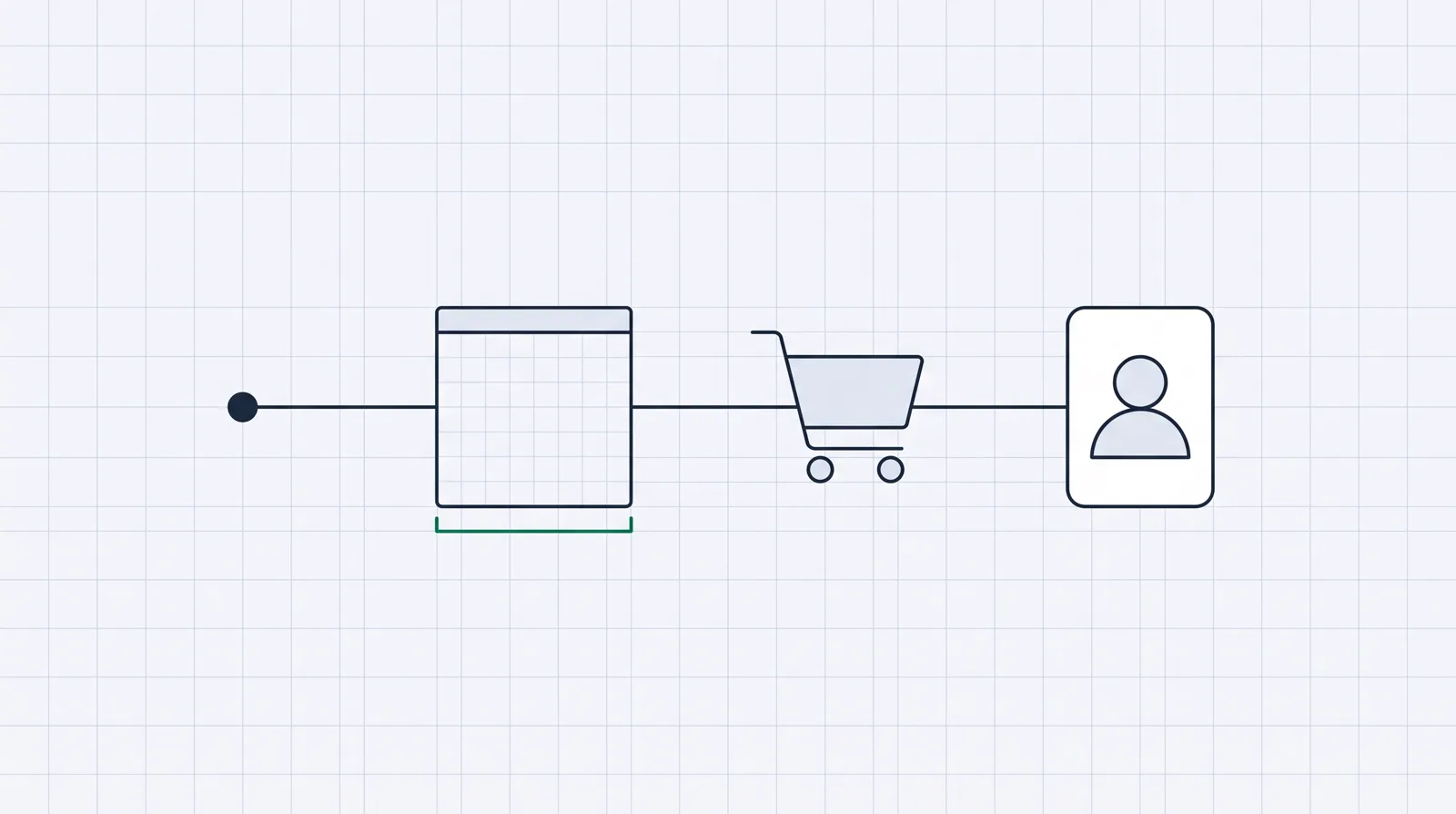
Both of these assume the page is the hard part. For a media buyer, the page is only the first segment of the path, and the gap both leave is what happens to the ad platform's learning when you test, and whether the click, the order and the refund ever land on one record.
ElasticFunnels is a funnel platform built for teams that buy traffic. It builds the pages, with an AI builder that can write one from a prompt or clone an existing URL, and its lead feature is same-URL split testing. Variants rotate server-side under one campaign link, so Meta, Google and TikTok keep optimizing and a test never sends the ad back through review. That is the difference from Unbounce's A/B testing, where each variant is its own URL, and from Systeme.io's lighter split testing. Around the page it hosts a checkout with order bumps and one-click upsells, routes payments across more than one merchant account, and keeps the session, the order, the rebill and the refund on one timeline with a CRM and attribution on the same data, so you can see which ad actually made money without stitching exports together.
Against this pair it sits in a third spot. If your budget is genuinely zero, Systeme.io's free plan is the honest answer, and Unbounce has years of CRO case studies that ElasticFunnels cannot match. What it adds over both is testing that keeps ad learning intact and one source of truth for a paid campaign, which matters most once real spend is flowing. Its weakness is proof: ElasticFunnels is newer than both, and there is very little independent third-party review coverage to check its claims against, so until you run real volume through it you are largely taking the vendor's word for it. That is what you would expect of a platform this recent next to a CRO tool and a creator suite that have both been around for years. Its 14-day trial needs no card, every feature is on every plan from $97 a month, and it adds 0.5% only on revenue through its own hosted checkout, so you can test the split testing and the checkout on your own campaigns before you commit.
Which one for you
Pick Unbounce if you buy paid search or social traffic and the job in front of you is landing pages, message match and serious page testing, and your checkout and email already live somewhere else. Budget for the Experiment plan, where dynamic text and A/B testing actually live, or Optimize for Smart Traffic, since the entry tier is too thin for PPC work.
Pick Systeme.io if you are a solo creator or a beginner who wants funnels, email, a course and partner commissions in one cheap login, and you would rather start free and upgrade by contact count than pay for four tools. Accept a basic builder and a ceiling on automation and checkout that you may outgrow once your offers get complex.
And if the engine is paid traffic rather than an audience you already own, weigh a funnel platform like ElasticFunnels alongside both. Either way, read our full Unbounce review and Systeme.io review first, and browse the other head-to-heads and the full ranking before you commit.
Unbounce
What works
- The page headline updates to match each search query, the core PPC lever
- Smart Traffic routes each visitor to the variant most likely to convert them
- A large template library and a mature builder
What to watch
- Dynamic text and split testing start on the $149/mo Experiment plan, about five times the $29 Starter price
- Monthly unique-visitor caps bring overage anxiety at scale
- The builder frustrates on fixed-section layout and mobile, enough that some users call it painful
Systeme.io
What works
- The free plan runs a working business: up to 2,000 contacts, 3 sales funnels, a course, a blog and your own affiliate program, with no credit card and no expiry date. You can launch a live funnel before paying a cent.
- One login replaces four subscriptions. Funnels, email, courses, a website and affiliate management run from the same account, so there is no glue code between a page builder, an email tool and a course host.
- Cheap even when you pay. Paid plans start at $17/mo and top out at $97/mo for unlimited contacts, well below funnel-first rivals that open near $97 and climb from there.
- No transaction fees, ever. Every plan takes 0% on top of your Stripe or PayPal fees, and email sends are unlimited, so the bill does not balloon as your sales and list grow.
- Fast to learn and launch. Long-term users keep it for the same reason they picked it: fewer moving parts and less setup, which is what a first funnel actually needs.
What to watch
- The page builder and templates are basic. Fine for simple funnels and landing pages, but restrictive if you want pixel-level control or a high-end brand look. One long-term user called the editor "okay, but branding always felt slightly off for higher end offers".
- You can outgrow the automation and checkout. Conditional email logic, deeper checkout customization like tax handling, and heavier CRM or multi-brand workflows are where sellers say they leave for a specialist. The simplicity that draws you in is also the limit.
- Courses and communities are good enough, but they trail dedicated tools like Skool, and some niche features, such as natively collecting testimonials, need a third-party workaround.
- Much of the online praise is affiliate-driven. Systeme.io runs a strong affiliate program, and a lot of its glowing coverage, including Reddit "honest review" posts, reads as promotional. Weight your own free-plan trial over the hype.
Pricing
Unbounce: from $29/mo. Monthly prices: Starter $29 for 5 pages and 500 visitors. Build $99 for unlimited pages and 20,000 visitors. Experiment $149 adds unlimited A/B testing and dynamic text replacement, with 30,000 visitors. Optimize $249 adds AI traffic optimization and 50,000 visitors. Yearly billing saves 25%. Pages keep running past the traffic limit, and the extra visitors are billed as a one-time overage fee. There is no native checkout.
Systeme.io: from $0 (free plan). Free: 2,000 contacts, 3 funnels, 1 course, no card. Startup $17/mo: 5,000 contacts, 10 funnels, 5 courses. Webinar $47/mo: 10,000 contacts, 50 funnels, 20 courses. Unlimited $97/mo: unlimited contacts, funnels, courses. All plans: unlimited email sends, 0% transaction fees.
Prices as of 12 October 2026
Our pick
Unbounce
Unbounce is the pick if you buy Google Ads and live or die on message match, and you can justify the Experiment tier.
Frequently asked questions
Which is cheaper, Unbounce or Systeme.io?
Is Systeme.io's free plan enough to run paid traffic to?
Does Unbounce include a checkout or email list like Systeme.io?
What if you buy your own paid traffic to these pages?
Sources
Other sources
5 discussions and reviews read for this page. Quotes are excerpts; open a link to read the original in context.
- [hn-good-experience] Ask HN: Best landing page builder?
- [hn-nontechnical] Ask HN: Best landing page builder?
- [capterra-campaigns] Unbounce reviews
- [capterra-mobile] Unbounce reviews
- [trustpilot-value] Unbounce reviews

Written by
Dana Rourke
Lead reviewer
Dana Rourke is the lead reviewer at Campaign Buyer. She owns the tracker and attribution coverage: reading what long-term users report about each tool, checking its documentation and pricing, and verifying prices with the vendor before writing the verdict. Keeping the rankings honest mostly means writing down what the top pick gets wrong, so she does that first.
Last checked 2026-10-04