The proven volume tracker against solo-friendly first-party trackingmedia buyer software
Voluum vs ClickMagick
By Dana Rourke, Lead reviewer. Reviewed by Campaign Buyer Editorial. Updated 24 September 2026.
Quick answer
Pick Voluum if you buy affiliate or native media at real volume and want the proven, well-documented tracker that holds up under load, priced by events, and you can absorb the higher bill; pick ClickMagick if you run your own Meta, Google or YouTube traffic as a solo advertiser or affiliate and want a flat, predictable bill, first-party tracking and a morning email that tells you what to scale or cut.
Side by side
| Voluum | ClickMagick | |
|---|---|---|
| What it is | Proven cloud tracker | First-party CAPI tracker |
| Best for | Affiliate, native at scale | Solo Meta, Google, YouTube |
| How you read it | Campaign reports | A morning email |
| Priced by | Events, with overages | Tracked visitors |
| Ecosystem | Deeply documented | Vendor case studies |
| Outside proof | Established | Thin, disputed |
If you are deciding between Voluum and ClickMagick, you have narrowed the field to two cloud trackers that both stamp a click, catch the conversion server-side, and feed it back to the ad platform through its conversion API. Neither asks you to run a server, and both promise cleaner data than the browser pixel now gives you. What separates them is who each was built for.
Voluum is the proven default a scaled affiliate or native buyer reaches for. ClickMagick is the first-party tracker for someone buying their own ads alone. That gap decides this more than any single feature does, so work out which buyer you are before you compare prices.
The two questions that decide it
Answer these first. One: what kind of traffic do you buy, and how much of it? If you run offers at real volume across several sources, you want the tracker other buyers have already documented and that holds its speed under load. If you buy your own Meta, Google or YouTube traffic as a solo operator, you want a clean feedback loop and something to tell you what to do with the numbers each morning.
Two: how much do you value the ecosystem around the tool? Voluum comes up in nearly every affiliate and native thread, so the setups, integrations and fixes you will need have already been written down. ClickMagick's public proof is thinner, and you lean more on its own guides.
What Voluum is built to do
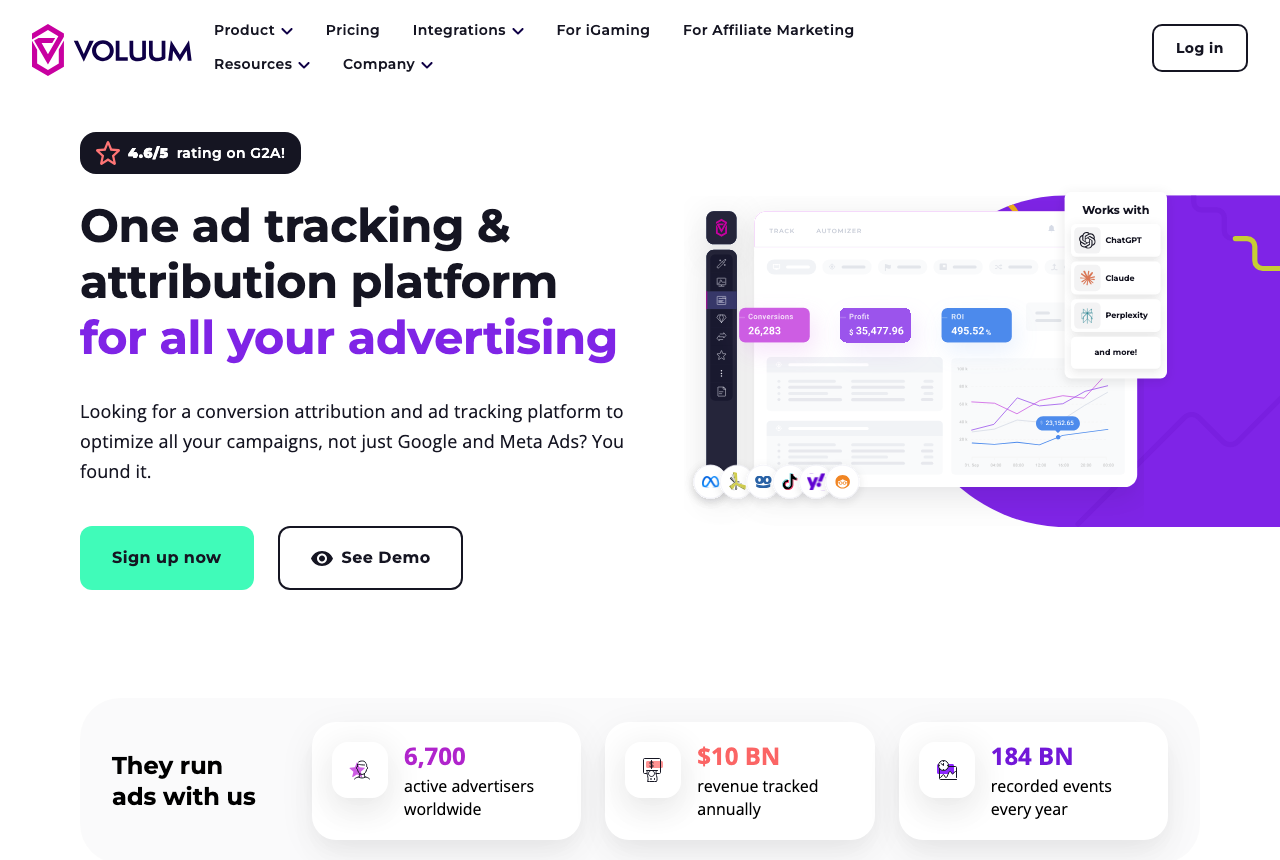
Voluum is the tracker most affiliates learned on, and that history is its real advantage. For Meta and native campaigns it is the default answer in public threads, which means the integrations and fixes you will need are already documented. When something breaks at 2am, that body of answers is worth more than a feature checkbox.
Redirects stay reliable at volume, reporting holds up under load, and anti-fraud and traffic-distribution rules come built in. It sends conversions back to Meta, TikTok and Google through CAPI, and one account covers affiliate, native and lead-gen campaigns, so a buyer with a mixed book is not paying for three tools. Our Voluum review and Voluum against RedTrack go deeper on where it sits in the tracker field.
Voluum is the most expensive mainstream tracker here, and event overages on top of each tier make the bill harder to predict as traffic grows. For a buyer tracking one offer or still learning the plumbing, much of that capacity sits idle.
What ClickMagick is built to do
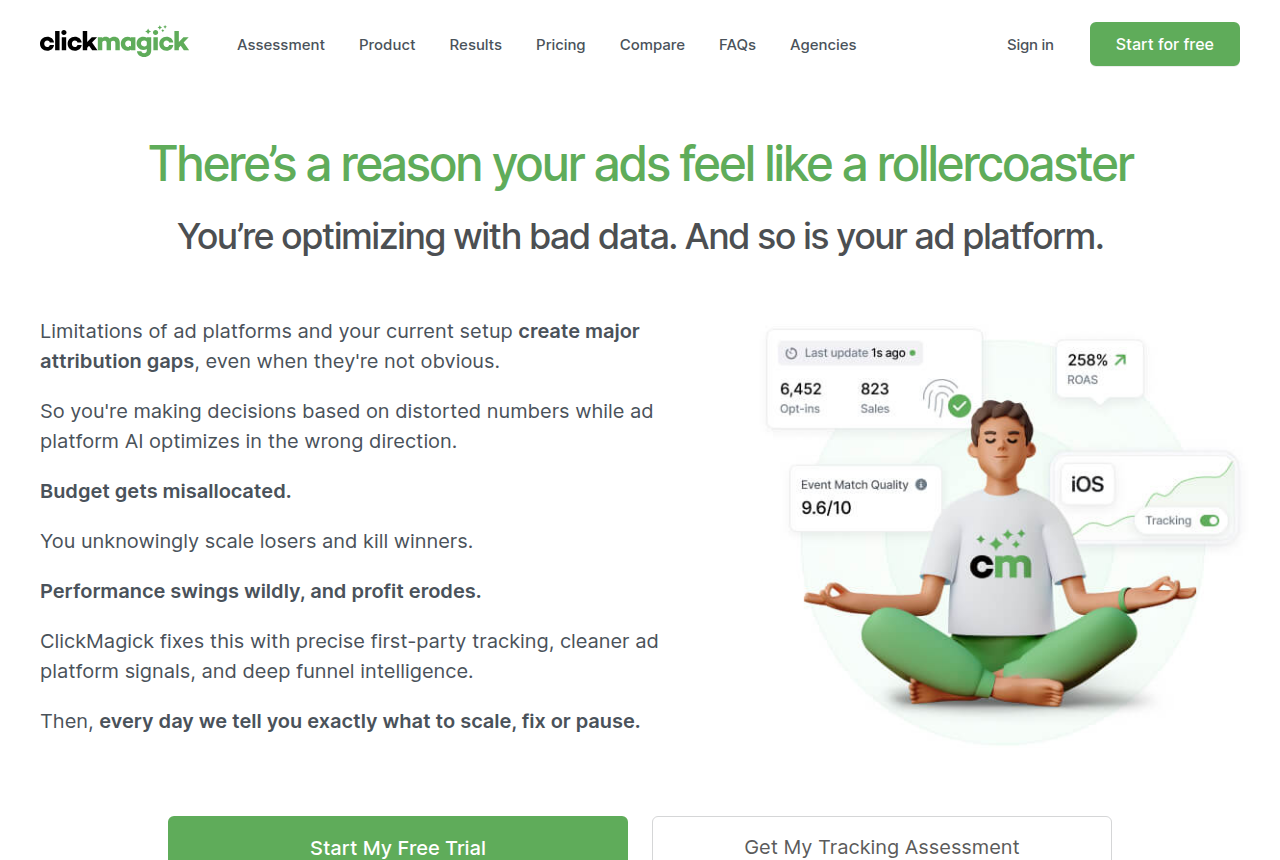
ClickMagick has tracked links since 2014 and now bills itself as an attribution platform it calls TrueTracking. Its buyer is narrower than the marketing suggests: an affiliate, a one-person advertiser or someone selling their own info-product, running paid traffic on their own Meta, Google or YouTube ad accounts. First-party tracking on a custom domain plus CAPI feeds cleaner conversions back so the platform's AI stops optimizing toward the wrong people. Its full review covers the setup in detail.
Two things set it apart for that buyer. The first is Morning Magick, a daily email that reads your stats overnight and tells you what to scale, pause or fix, which suits someone with no analyst. The second is support, the most praised part of the product in public reviews: fast replies, often the same day, sometimes with a screen recording attached. Pricing is based on the visitors you track, so the bill stays flat when a campaign wins.
ClickMagick has no meaningful G2 or Capterra presence, and it stopped maintaining its Trustpilot page after disputing a batch of reviews, so you lean on the vendor's own case studies more than you would like. Check its numbers against the ad network, GA4 and your backend before you move budget.
How they actually differ
Set the shared CAPI feature aside and three differences decide it.
The buyer each one assumes. Voluum assumes volume and a mixed book: offers across several sources, tracked from one account that holds up under load. ClickMagick assumes your own ad accounts, sending clicks to your own pages and offers. Push ClickMagick toward a sprawling multi-network affiliate setup and you work against its grain. Use Voluum as a gentle first tracker and you overpay for depth you will not touch yet.
How you read the data. Voluum gives you campaign tables and reports and expects you to work them. ClickMagick hands you a morning email with a verdict. Pick by whether you want the raw report or the recommendation.
How the bill behaves. Voluum meters events, so a traffic spike can push you into the next tier mid-month, with overages on top. ClickMagick charges by the visitors you track, so the bill is predictable, though the Starter plan runs out quickly once you buy real volume. To weigh ClickMagick against a funnel-mapping tracker instead, see FunnelFlux against ClickMagick.
A third path, if you also build and host the funnel
Both of these track traffic to pages that live somewhere else. Neither builds landing pages or hosts a checkout. If you are also deciding where the pages and the checkout will live, a funnel platform answers a bigger question, and ElasticFunnels is one to weigh.
ElasticFunnels is a funnel platform for teams running paid traffic. It builds the pages, split-tests variants under one URL so the ad platform keeps its learning, and hosts the checkout with order bumps, upsells and subscriptions. Sessions, orders, rebills and refunds share one timeline with its CRM and attribution. Because the checkout sits on the same record as the click, a purchase is logged directly, and the platform fires affiliate postbacks and reports ad spend against conversions itself, the jobs Voluum and ClickMagick do for pages hosted elsewhere. It starts with a 14-day free trial that takes no card. Plans run from $97 a month, plus 0.5% on revenue processed through its own hosted checkout.
Its drawback is that it is newer than Voluum and ClickMagick, with very little independent review coverage to check its claims against, so until you run real volume through it you are largely relying on the vendor's word for how its attribution holds up. That is what you would expect of a platform this young, and the no-card trial lets you test it on your own funnel first. It only helps if you want to move the pages and checkout too. If you are happy with where your pages live and just need to track the traffic to them, pick between Voluum and ClickMagick.
Which one for you
You buy affiliate or native media at real volume: Voluum. The documented setups, reliability under load and built-in anti-fraud rules are what you pay for, and they keep the tracker from becoming your bottleneck.
You run your own Meta, Google or YouTube traffic as a solo buyer: ClickMagick. The flat bill, the first-party feedback loop and a morning email with next steps are worth more to you than a room full of reports.
You also need to build and host the funnel: look at ElasticFunnels alongside them, keeping its newness in mind, and keep a dedicated tracker for any traffic that lands on other people's domains.
Voluum is our default pick, though it costs more, because more readers who reach this comparison already buy media at volume and need a tracker that holds up. We rank it second in our ad tracker ranking for the scaled paid-traffic buyer, with ClickMagick lower down as the first-party pick for buyers running their own accounts.
Voluum
What works
- The default recommendation for Meta and native affiliate traffic, so setups and integrations are well documented
- Fast redirect and reporting infrastructure that holds up at volume
- Anti-fraud and traffic-distribution rules come standard
What to watch
- The most expensive mainstream tracker: $119/mo billed annually to start, $299 to reach 5M events
- Event overages are billed on top, so costs are hard to predict as traffic grows
- You pay for polish you may not need if your funnels are simple
ClickMagick
What works
- Flat monthly price based on the visitors you track, not a cut of your revenue, so the bill does not climb every time a campaign wins.
- First-party TrueTracking with a custom domain and CAPI feeds cleaner conversion data back to Meta, Google and YouTube, which users credit for better ad optimization.
- The Morning Magick email reads your stats each morning and names what to scale, pause or fix, which suits a solo buyer with no analyst.
- Support is the most-praised part in public reviews: fast replies, often the same day, sometimes with screen recordings.
What to watch
- The Starter plan tracks just 10,000 visitors for $79, so anyone buying real volume is pushed to the $199 Standard tier fast.
- Independent proof is thin. There is no meaningful G2 or Capterra presence, and ClickMagick stopped maintaining its Trustpilot page after disputing fake reviews, so you lean on the vendor's own case studies more than you would like.
- Its numbers will differ from what the ad network reports, so reconcile them against GA4 and your backend before you move budget.
- Setup rewards patience. Postbacks, cross-domain tracking and CAPI all need wiring, and a botched setup is behind most of the accuracy complaints.
Pricing
Voluum: from $119/mo, billed annually. Profit costs $119 a month billed annually and includes 1M events. Scale costs $299 a month billed annually for 5M events. The pricing page shows no month-to-month figure. Events over the Profit limit bill at $0.06 per 1,000.
ClickMagick: from $79/mo, 10K visitors. Starter costs $79 a month for 10,000 tracked visitors. Standard is $199 a month for 100,000, and Pro is $349 a month for 1,000,000. Billed yearly, the three cost $790, $1,990 and $3,490. Extra sites or stores are $40 a month on Standard and Pro.
Prices as of 14 September 2026
Our pick
Voluum
Voluum is the pick if you run affiliate or native campaigns and want the proven, low-friction tracker other buyers already use, provided you can absorb the price.
Frequently asked questions
Which is cheaper, Voluum or ClickMagick?
Do Voluum and ClickMagick send conversions back to Meta and Google?
Can either one track a sale that closes weeks after the click?
Why is ClickMagick's outside proof described as thin?
Sources
Other sources
2 discussions and reviews read for this page. Quotes are excerpts; open a link to read the original in context.

Written by
Dana Rourke
Lead reviewer
Dana Rourke is the lead reviewer at Campaign Buyer. She owns the tracker and attribution coverage: reading what long-term users report about each tool, checking its documentation and pricing, and verifying prices with the vendor before writing the verdict. Keeping the rankings honest mostly means writing down what the top pick gets wrong, so she does that first.
Last checked 2026-09-24