Tracker with pages vs attributionmedia buyer software
AdsBridge vs Hyros
By Dana Rourke, Lead reviewer. Reviewed by Campaign Buyer Editorial. Updated 28 September 2026.
Quick answer
Pick AdsBridge if you run paid traffic to a short funnel that closes on a web checkout you control, want a cloud tracker with a landing page builder and split testing bundled in for the lowest entry price, and mostly work postback-friendly pop, push, native and affiliate offers; pick Hyros if you sell high-ticket or info products through long webinar, email and call journeys and need attribution that follows a lead from the first click to a sale that closes weeks later on your CRM.
Side by side
| AdsBridge | Hyros | |
|---|---|---|
| What it is | Cloud tracker with a page builder | Long-journey attribution platform |
| How it measures | Click-level, server-to-server postbacks | Multi-touch across calls, email and CRM |
| Best-fit funnel | Short, closes on a web checkout | Long high-ticket, call and webinar funnels |
| Best-fit ad spend | Any, from the first dollar | Roughly $50k a month and up |
| Builds landing pages | Yes, drag-and-drop, split-tested | No, tracking and attribution only |
| Native CAPI to ad platforms | No, postback-first | Yes, server-side |
| Pricing | $29/mo, published, by visits | Quote after a demo call |
| Entry effort | An afternoon of setup | Sales call, then onboarding |
Two tools that fight the same enemy for very different buyers
If you are down to AdsBridge and Hyros, the first thing to fix is the assumption that these are two versions of one tool with a clear winner. They are not. AdsBridge is a low-cost cloud tracker that also builds your landing pages. Hyros is an attribution platform built to follow a long, high-ticket buying journey across calls, email and a CRM. Both exist to catch the conversions the browser pixel now drops, but they are built for funnels of very different lengths and buyers of very different sizes.
The short read: AdsBridge is the cheaper, more general tool for an affiliate or media buyer running paid traffic to a short funnel who also wants pages and split testing bundled in. Hyros is the specialist for someone selling high-ticket or info products through webinars, email sequences and sales calls, spending enough that a point of attribution accuracy moves real money. Read our AdsBridge review and Hyros review for the long form on each. This page is about the one decision.
The one question that decides it: how long is your funnel?
Answer this before you weigh a single feature. If the buyer pays on the same visit, or within a short window, on a web checkout you control, AdsBridge sees the whole path and its tracking is all you need. If the payment comes after a lead form, an email sequence, a webinar and a human on a call, sometimes weeks after the ad was clicked, that is the journey Hyros was built to hold together, and a postback-based cloud tracker will struggle to connect the ad to a payment that lands on your CRM long after.
The second half of the same question is what you sell and how much you spend. Hyros is aimed at high-ticket info products, coaching, webinars and call funnels doing real multi-platform ad spend. Buyers put the honest threshold around $50k a month with a genuinely complex funnel. Below that, its machinery is wasted and its private quote will feel steep. AdsBridge works at any budget and never asks how big your funnel is, and its entry plan is priced for a buyer still testing a first offer. Name your funnel length and your monthly spend and the choice is mostly made.
AdsBridge: a cheap tracker with the pages built in
AdsBridge answers the beginner's question: what if I want tracking and landing pages in one cheap subscription? It stamps every click, catches the conversion server-side, and fires it back to affiliate networks by postback, and it bundles a drag-and-drop landing page builder with templates, HTML access and split testing into the same plan, so you do not pay for a separate page tool. It has run since 2013 on AWS infrastructure, serves buyers across 160-plus countries, and connects to more than 100 affiliate networks with one-click postback setup. Every plan carries the full feature set with nothing gated to higher tiers, and it prices by monthly visits rather than events, which is easier to predict when a campaign scales.
Redirect speed is the loudest complaint: a community speed test clocked its redirects slower than several rivals, and that matters most on mobile traffic where every hop costs conversions. Reviewers report stability wobbles once daily volume gets extreme, and the dashboard can feel slow. It has no native Meta or Google conversion API, so a paid-social buyer who wants CAPI events pushed back into the platform is better served elsewhere. Its independent proof is thin too: its G2 profile has too few reviews to lean on and most write-ups are affiliate blogs, so the 14-day trial tells you more than its star rating can. There is no permanent free tier, and AdsBridge states it issues no refund on cancellation.
Hyros: attribution built for the long, high-ticket journey
Hyros targets the funnel that does not end at a checkout. If your sale happens after a lead opt-in, an email sequence, a webinar or a sales call, standard pixels lose the thread. Hyros tracks server-side and stitches the journey across payment processors and CRMs, adding call tracking and multi-touch attribution so a lead can be followed from the first ad click to a payment that clears days or weeks later. It feeds those conversions back to Meta and Google server-side, so the platforms keep optimizing on the fuller picture. That is why info-product sellers, coaches and high-ticket advertisers credit it with surfacing revenue the ad platforms never attributed, and it is the point where Hyros is plainly stronger than a postback-based tracker like AdsBridge.
Hyros comes with two cautions. Pricing is quote-driven and opaque: Hyros publishes no plan prices, so you book a demo or setup call and are quoted a number aimed at higher-spend accounts. And its figures are modelled, so they will diverge from what Meta and Google report, and they do not bring back every conversion lost to iOS privacy changes. For a simple, low-AOV store with a short buying cycle, that machinery is wasted, and a cheaper tracker or a Shopify-first dashboard is the better fit.
Pricing: a published number against a private quote
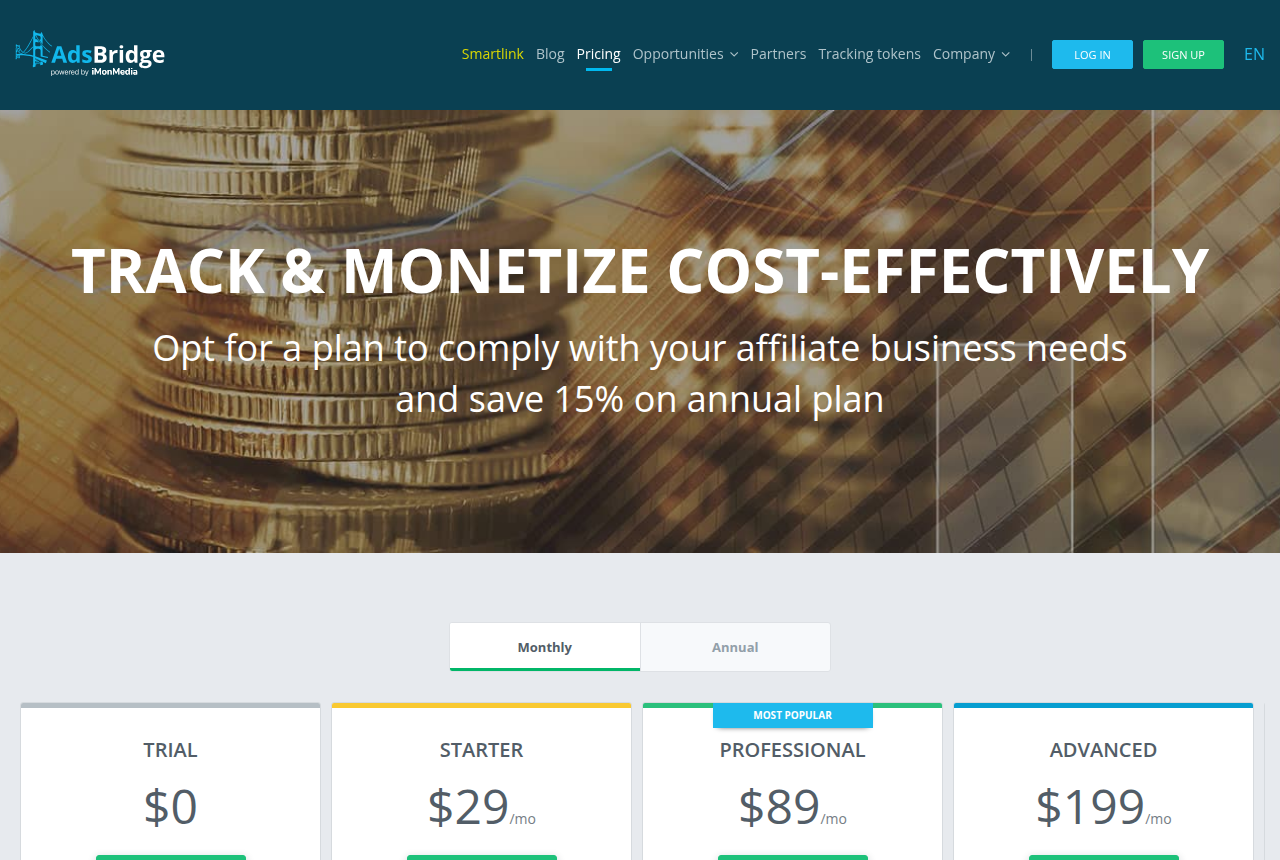
The two price on different axes. AdsBridge publishes its plans: $29 a month for 100,000 monthly visits, then $89 and $199 as visits climb, with the full feature set on every tier. You can size the bill yourself before you talk to anyone. Hyros publishes nothing. Its cost is quoted after a call and pitched at higher-spend accounts, where a point of attribution accuracy moves five or six figures of ad budget.
A high-volume pop or push campaign can burn through AdsBridge's visit allowance fast, so size the plan on your true monthly traffic. Hyros's quote scales with your spend and the complexity of your setup, and you only see it after the sales conversation.
The build layer neither of these touches
There is a third answer worth naming, because neither of these tools builds the funnel whose numbers they report. AdsBridge builds landing pages but hosts no checkout and keeps no orders, rebills or refunds on the same record as the click. Hyros models the journey but assumes the pages, the checkout and the CRM already live somewhere else. ElasticFunnels is a funnel platform that keeps that middle on one data layer. Its same-URL split testing rotates variants server-side under one campaign link, so Meta, Google and TikTok keep their learning and a test never sends the ad back through review. On top of that it adds an AI page builder that can clone a page from a URL, a hosted checkout with order bumps and one-click upsells, and analytics and attribution on the same records as the pages and the checkout, with a CRM, automations and a call center on that same timeline. A click, an order, a rebill and a refund are one record rather than four exports to reconcile. It starts with a 14-day free trial and takes no card, from $97 a month, with every feature on every plan.
For this pair it answers a different question from either tool. It does not fire postbacks at AdsBridge's click granularity for offers that close on other people's networks, and it does not run the long-journey, multi-touch model Hyros sells to call funnels. It builds and sells the offer that both of them measure, so a buyer whose traffic closes on a CRM or on networks they already run still needs a dedicated tracker for that part. Its honest limit is newness: there is very little independent third-party review coverage to check its claims against, so until you run real volume through it you are largely taking the vendor's word on how its attribution holds up. That is what you would expect of a platform this recent next to a tracker running since 2013. The reporting, the checkout and the split testing are all usable from day one, and the free trial lets you prove them on your own funnel before you pay.
Which one for you
You send ad clicks to a short funnel and want tracking plus pages for the least money: AdsBridge. It tracks clicks, fires postbacks to networks, and bundles a split-tested landing page builder into its cheapest plan, and it has done the job since 2013.
You sell high-ticket or info products through webinars, email and sales calls: Hyros. Tying a payment that clears weeks later on your CRM back to the ad that started it is exactly what it is built for, and at high monthly spend that attribution is worth the private quote.
You host your own offer end to end and want the pages, the checkout and the spend-to-sale number in one place: look at ElasticFunnels alongside them, with the newness caveat above in mind. It hosts the pages and the checkout that AdsBridge and Hyros would otherwise measure from outside.
AdsBridge is our default pick because more of this site's readers buy paid traffic to shorter funnels at moderate spend than run six-figure high-ticket call funnels, so it is the tool the larger group actually needs, and its published price fits a buyer still sizing the problem. On its own high-ticket, long-journey turf, Hyros is plainly the better fit, and it is the stronger tool the moment your sale closes on a call weeks after the click. Still weighing the field? Both sit in our best ad tracker ranking, and you can line either against the category leader in RedTrack vs AdsBridge and RedTrack vs Hyros, or browse all head-to-heads.
AdsBridge
What works
- Tracking, a drag-and-drop landing page builder and split testing come in one subscription, so a beginner does not pay for a separate page tool.
- Cheaper entry than Voluum or RedTrack: $29/mo for 100,000 visits, and every plan carries the full feature set with no features gated to higher tiers.
- Prices by monthly visits rather than events, which is easier to predict than event-based billing when a campaign scales.
- Established since 2013 on AWS infrastructure, with 100-plus one-click network integrations, an anti-fraud filter and a redirectless tracking mode.
What to watch
- Redirect speed is the recurring complaint. A community speed test clocked its redirects slower than several rivals, which matters most on mobile traffic.
- Reviewers report stability flaws once daily volume gets extreme, and the dashboard can feel slow at times.
- No native Meta or Google conversion API. It leans on server-to-server postbacks, so paid-social buyers who want CAPI are better served elsewhere.
- Thin independent proof. Its G2 profile has too few reviews to be useful, so most write-ups are affiliate blogs rather than heavy buyer feedback.
- No permanent free tier, only a 14-day trial, and AdsBridge states it issues no refund on cancellation.
Hyros
What works
- Server-side tracking that follows long journeys through calls, webinars and CRMs
- Finds sales that Meta and Google miss on multi-step funnels
- Pulls sales data from payment processors and CRMs alongside site analytics
What to watch
- Overkill below roughly $50k/mo in ad spend
- Pricing is opaque and quote-driven on the main site
- Its revenue figures are modelled, so expect them to diverge from what the ad platforms report
Pricing
AdsBridge: from $29/mo. AdsBridge prices by monthly visits. Starter costs $29 a month for 100,000 visits. Professional is $89, Advanced $199, Business $379, Agency $499 and Enterprise $799, and Exclusive is quoted individually. Visits over the limit bill per 1,000, from $0.07 on Starter down to $0.029 on Enterprise. Annual billing saves up to 20%. Every plan starts with a 14-day free trial, and cancellations receive no refund.
Hyros: from a custom quote. Hyros publishes no plan prices. It sells one plan with everything included, and the price follows the revenue Hyros tracks for you. The figure is quoted on a setup call and is aimed at higher-spend accounts.
Prices as of 28 September 2026
Our pick
AdsBridge
AdsBridge is a real, long-running cloud tracker that bundles a landing page builder and split testing for less than Voluum or RedTrack, so it fits an affiliate who wants tracking and pages in one low-cost tool. Skip it if fast redirects at high volume or a native Meta conversion API are what you are paying for, because that is where buyers report it trailing the leaders.
Frequently asked questions
Which is cheaper, AdsBridge or Hyros?
Do AdsBridge and Hyros do the same thing?
Which should a high-ticket coaching or webinar funnel use?
What if you also need to build and host the funnel?
Sources
Other sources
6 discussions and reviews read for this page. Quotes are excerpts; open a link to read the original in context.
- [ab-statsdrone-speed] AdsBridge Review: Overview, Features, Pros & Cons, Pricing
- [ab-statsdrone-diff] AdsBridge Review: Overview, Features, Pros & Cons, Pricing
- [ab-affmaven-stability] Real AdsBridge Review 2026: Better Than Voluum?
- [ab-affmaven-opt] Real AdsBridge Review 2026: Better Than Voluum?
- [ab-affiliatefix-support] AdsBridge reviews
- [ab-g2-thin] AdsBridge Reviews

Written by
Dana Rourke
Lead reviewer
Dana Rourke is the lead reviewer at Campaign Buyer. She owns the tracker and attribution coverage: reading what long-term users report about each tool, checking its documentation and pricing, and verifying prices with the vendor before writing the verdict. Keeping the rankings honest mostly means writing down what the top pick gets wrong, so she does that first.
Last checked 2026-09-28