Merchant of record vs the creator's cartmedia buyer software
Paddle vs ThriveCart
By Dana Rourke, Lead reviewer. Reviewed by Campaign Buyer Editorial. Updated 24 September 2026.
Quick answer
Pick Paddle if you sell software or SaaS across many countries and want a merchant of record that files your sales tax, screens fraud and answers chargebacks for you; pick ThriveCart if you sell courses or digital products and want a proven cart, with a lifetime buy-once option, that adds no fee of its own on top of the processor you already use.
Side by side
| Paddle | ThriveCart | |
|---|---|---|
| What it is | Merchant of record | Cart on your processor |
| Built for | Software and SaaS sellers | Course and digital creators |
| Its own fee | 5% + 50¢ a sale | Flat plan, none on sales |
| Sales tax and VAT | Filed and remitted for you | You handle it |
| Chargebacks | Contested automatically | Left to your processor |
| High-risk offers | Not allowed | Not allowed |
| Route across your MIDs | No | No |
If you are down to Paddle and ThriveCart, drop the idea that they are two versions of the same checkout. They sit on opposite sides of the one question that matters in payments: who is the legal seller. Paddle becomes the seller for you. ThriveCart never touches the money at all. The reader stuck between them is really deciding what kind of seller they are, and once that is clear the choice mostly makes itself.
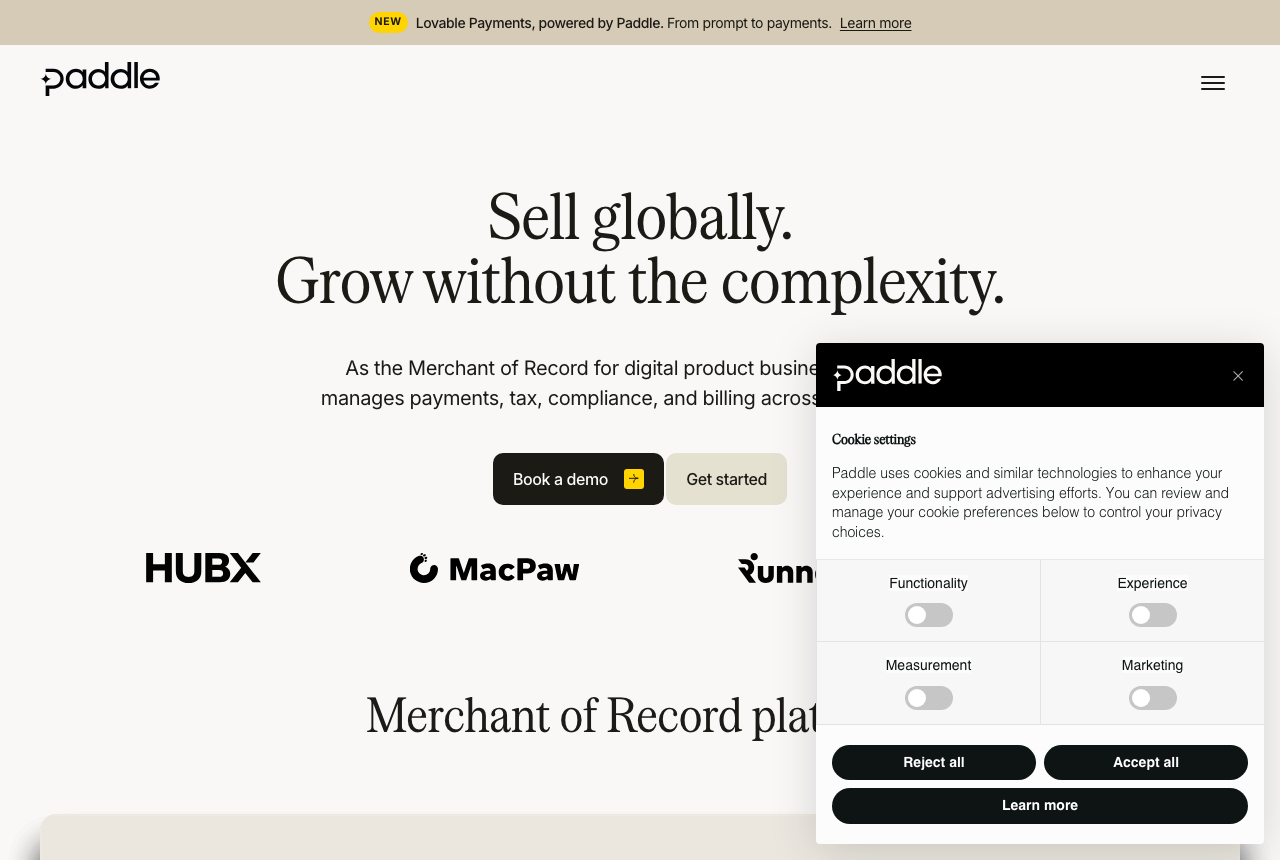
Paddle is a merchant of record. It takes the payment, charges the tax, and answers to the card networks as the seller on the receipt, which suits a software or SaaS business selling into dozens of countries. ThriveCart is a cart that sits on top of a processor you already use. You connect Stripe, PayPal or Authorize.Net, and ThriveCart handles the checkout, the bumps and the upsells while your processor handles the money. One removes the compliance job entirely. The other leaves it with you and gives you a strong cart to sell through.
The one question that decides it: who is the legal seller?
Answer this before you compare features. A merchant of record is the legal seller on the transaction. With Paddle, the customer buys from Paddle, and Paddle then pays you. Paddle therefore calculates and files sales tax and VAT worldwide, screens the payment for fraud, and takes the chargeback when a buyer disputes. For a software company selling into many tax jurisdictions, that removes the most tedious job in payments. With ThriveCart you remain the seller: the processor account, the tax filings and the disputes are yours. In return you get a cart you own outright and no cut taken on top of your processor.
So the fork comes down to how much of the payments job you want to keep. Keep none of it and pay a percentage for the privilege, which is Paddle. Keep all of it and pay a flat fee for a cart, which is ThriveCart.
Paddle: the merchant of record
Paddle solves a different problem from most carts, and it solves it well. As the seller on the receipt it registers for tax, collects the right rate, tracks the filing deadlines and remits worldwide, so cross-border sales tax and VAT stop being your problem. Its price is one bundled rate, 5% plus 50 cents a Checkout transaction, with no monthly fee and no migration fee, and its own comparison puts that against roughly 7% and up once a plain processor bolts on tax, churn recovery and fraud tools. Its revenue recovery retries a failed renewal up to seven times across about a month and emails the customer to update a card, and as the seller it contests chargebacks for you automatically, using the transaction records it already holds.
The costs are the flip side of handing over the seller role. The 5% plus 50 cents sits well above a bare processor rate, and the gap only widens as you scale. You never control a dispute, Paddle keeps its fee even on a chargeback it wins, and a seller who drifts above a 0.65% chargeback rate can be throttled or suspended. Its acceptable-use policy bars a long list of categories, so most high-risk, adult, gambling and financial-trading sellers cannot onboard at all, and a June 2025 FTC settlement, in which Paddle paid $5 million over certain tech-support billing schemes, has made that screening stricter. Because you sell on Paddle's rails, a declined card has no second processor of yours to fall back to.
ThriveCart: the creator's cart on your own processor
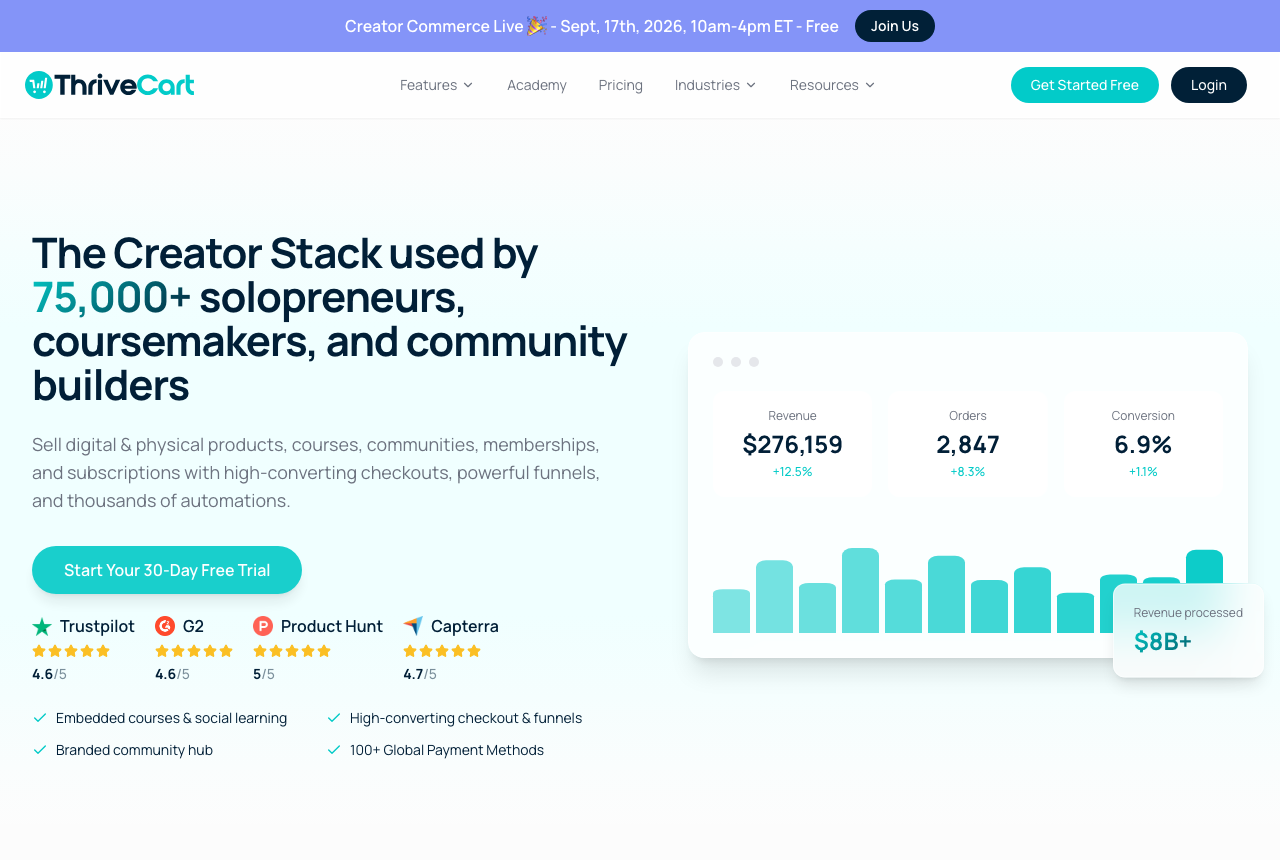
ThriveCart built its reputation on two things: a checkout that converts and, for a decade, a lifetime licence you paid for once. Its cart is the draw. Order bumps, one-click upsells, split-tested checkouts and an affiliate centre that course and digital-product sellers lean on, now wrapped in a landing-page builder and a bundled Academy for hosting courses. It connects Stripe, PayPal or Authorize.Net and charges nothing of its own on top of the processor's fee, so what you pay to sell is just the gateway rate.
On pricing, ThriveCart changed in 2026. It added Standard and Pro+ subscription plans, each with a 30-day trial, and it kept the one-time lifetime licence available for buyers who would rather pay once. What it delegates is everything on the money side. Payments run through the single processor you connect, so a declined card has no fallback account. High-risk business is out, because the gateways behind it ban those categories and ThriveCart cannot route around the ban. How hard a failed payment is retried is the processor's job and it varies a lot: Stripe's smart retries try up to eight times, PayPal retries a few times then suspends, and Authorize.Net does not auto-retry at all. ThriveCart's own reminder emails are a Pro and Pro+ feature, and disputes are left to whichever gateway took the money, so it brings no chargeback tooling of its own.
Pricing: a cut of every sale versus a flat fee
The two charge in different ways. Paddle takes its percentage of every Checkout sale and files your taxes inside that number, so its cost rises directly with revenue and buys you the compliance work. ThriveCart charges a flat subscription, or a one-time lifetime licence, takes nothing of its own on your sales, and leaves the processor fee, roughly 2.9% plus 30 cents on Stripe, and the tax filing to you. At low volume Paddle's percentage is cheap and the tax handling is close to free money. At high volume the percentage is the expensive part, and a flat cart plus your own processor is the cheaper base, provided you are willing to own the compliance it does not touch. Work out both on your real monthly volume, and put a value on the hours that tax filing and dispute handling would cost you.
The shared limit for a paid-traffic seller
There is a reader both of these tools quietly rule out, and it is this site's core reader: the direct-response media buyer running their own offers. Two things decide it. Neither tool takes high-risk business, so a restricted offer is a non-starter on both. And neither can route a charge across several merchant accounts you hold, because Paddle only uses its own rails and ThriveCart only uses the one processor you connect. For a buyer whose margin depends on spreading volume across several merchant accounts, that missing routing is the gap that sends them looking past both.
A third path: keep your own accounts and route across them
ElasticFunnels is built for exactly that buyer, and it fills the gap both tools leave. It is a funnel platform with a hosted checkout as one part: it builds the pages, splits them under one URL so your ads never reset their learning, hosts the checkout with order bumps and one-click upsells, and keeps the CRM and the reporting in one place. On the payment side, the part that matters here, its checkout takes Stripe, NMI, PayPal, Klarna or Authorize.net and splits sales across the NMI merchant accounts you connect by weight, card brand, product and daily cap, with subscription dunning and save offers built in. For a seller running offers on accounts they already hold, that multi-account routing is the thing Paddle and ThriveCart cannot do. It starts with a 14-day free trial and takes no card.
Its drawback is that it is newer than Paddle or ThriveCart, with very little independent review coverage to check its claims against, so until you run real volume through it you are largely relying on the vendor's word for how the routing and the reporting hold up. That is normal for a platform this young, and the pages, the same-URL testing, the checkout and the routing can all be tried inside the trial. You also stay the seller of record with ElasticFunnels, filing your own sales tax and carrying your own disputes, so a software company that wants that burden gone is still better served by Paddle.
Which one for you
You sell software or SaaS across many countries: Paddle. The merchant-of-record model files your sales tax and VAT, screens fraud and answers chargebacks for you, and for a cross-border software business, shedding that work is worth the percentage. Its no-lock-in policy lets you leave later if the percentage outgrows the value.
You sell courses or digital products through your own processor: ThriveCart. A proven cart with order bumps, upsells and an affiliate centre, a lifetime buy-once option, and no fee of its own on top of Stripe or PayPal is the setup a creator wants. Just accept that tax, dunning and disputes stay with you and your processor.
You run your own paid-traffic offers across merchant accounts you hold: look at ElasticFunnels alongside them, keeping its newness in mind, because multi-account routing and same-URL testing are the things neither Paddle nor ThriveCart offers.
Between the two, Paddle is our default pick, because it removes more of the payments job than ThriveCart does. It owns the tax, the fraud screening, the dunning and the disputes, where ThriveCart delegates all of them to your processor. For a creator who wants a cheap cart they buy once and are happy to run their own processor, ThriveCart is plainly the better fit.
Paddle
What works
- Registers as the seller for tax, so it calculates, files and remits sales tax and VAT worldwide and carries that compliance load for you
- One bundled rate covers payments, fraud screening, subscription billing, buyer support and disputes, with no separate platform fee
- Its payment recovery retries a failed renewal up to seven times across about a month and emails the customer to update a card
- It contests chargebacks for you automatically, using the transaction evidence it already holds as the seller on the receipt
What to watch
- Its rules bar a long list of restricted categories, so most nutra, supplement and other high-risk sellers cannot onboard at all
- You cannot move volume between several of your own accounts. You sell on Paddle's rails, so a declined card has no second processor to fall back to
- At 5% plus $0.50 a transaction it sits well above the bare processor rate, and that gap only widens as you scale
- You never control a dispute. Paddle keeps its fee even when it wins one, and can throttle or suspend a seller above a 0.65% chargeback rate
ThriveCart
What works
- A lifetime licence has long been the draw, so nothing recurring lands on your bill once you have bought in
- Creator-focused cart features are strong: order bumps, one-click upsells, split-tested checkouts and a built-in affiliate centre
- Connects Stripe, PayPal or Authorize.Net and adds nothing of its own on top of the processor's fee
- Once on Pro+ it adds its own reminder emails, subscription analytics and deeper reporting
What to watch
- The money runs through the one processor you connect, so a declined card has no second account to fall back to
- No high-risk support either. The big gateways all bar those categories, and ThriveCart cannot work around the ban
- How hard a failed payment is retried is the processor's job. Authorize.Net does not retry at all, and ThriveCart's own reminders need the Pro+ tier
- Disputes sit with the processor, not with ThriveCart, so it brings no dedicated chargeback tooling to lean on
Pricing
Paddle: from 5% + 50¢ a sale. Pay-as-you-go costs 5% plus 50 cents per checkout transaction. There is no monthly fee and no migration fee. That rate covers payments, checkout, subscription billing, global tax and compliance, fraud protection, chargebacks and buyer support. Custom pricing is available for high-volume businesses and for products priced under $10.
ThriveCart: from $37/mo billed annually. Standard $37/mo billed annually or $47/mo monthly; Pro+ $67/mo annual or $87/mo monthly (30-day trial). Lifetime Standard still sold at checkout.thrivecart.com/thrivecart-standard-account/ (commonly $495). Pro+ annual add-on for affiliates, dunning, multiple bumps, custom domains. 0% platform fees on sales.
Prices as of 12 October 2026
Our pick
Paddle
Paddle is the checkout to pick if you sell software or SaaS and want a platform that becomes the legal seller for you. It calculates your sales tax, owns fraud screening and takes disputes off your plate. It is the wrong tool for direct response, though: its rules bar most high-risk products, you cannot route a charge across accounts you hold, and the 5% plus 50 cents a sale climbs as you grow.
Frequently asked questions
Which is cheaper, Paddle or ThriveCart?
Is Paddle or ThriveCart a merchant of record?
Can I sell high-risk offers on Paddle or ThriveCart?
Does ThriveCart still offer a lifetime licence?
Sources
Other sources
7 discussions and reviews read for this page. Quotes are excerpts; open a link to read the original in context.
- [aup] Understanding Paddle's Acceptable Use Policy (AUP)
- [aup-prohibited] Paddle prohibited categories
- [reddit-warning] I want to share my experience with Paddle as a warning to other SaaS founders
- [reddit-earlystage] Do not use Paddle if you're an early-stage startup
- [ftc] Paddle Will Pay $5 Million to Settle FTC Allegations
- [trustpilot] Paddle Reviews | Read Customer Service Reviews of paddle.com
- [pricing] All-in-One Pricing, No Hidden Costs | Paddle

Written by
Dana Rourke
Lead reviewer
Dana Rourke is the lead reviewer at Campaign Buyer. She owns the tracker and attribution coverage: reading what long-term users report about each tool, checking its documentation and pricing, and verifying prices with the vendor before writing the verdict. Keeping the rankings honest mostly means writing down what the top pick gets wrong, so she does that first.
Last checked 2026-09-24