By Dana Rourke, Lead reviewer. Reviewed by Campaign Buyer Editorial. Updated 23 September 2026.
Quick answer
Pick Replo if you run a direct-response Shopify store, spend real money on ads, and need to launch and split-test campaign pages fast; pick Shogun if you are an established store with a content team that needs reusable sections, version history and a review workflow, and can absorb its $199 or $499 tier to get them.
Side by side
| Replo | Shogun | |
|---|---|---|
| Best for | DTC brands running paid ads | Stores with a content team |
| Entry price | $99/mo, billed annually | $39/mo (free drafts) |
| Split testing and analytics | Built in, UTMs preserved | Not its focus |
| Reusable sections, versioning | Basic | Its main draw |
| Team review workflow | Limited | On $199 and $499 tiers |
| Editor to build in | Few speed complaints | Buyers call it slow |
| Mobile page weight | Script-heavy | Also flagged heavy |
If you are down to Replo and Shogun, you have already settled the bigger question: you want a builder that works inside your Shopify store. Both install as Shopify apps, render pages inside your theme, read your live product and cart data, and send the visitor straight to native checkout. So they do the same job for two different kinds of buyer, and the honest question is which one you are.
Replo is the one a direct-response brand reaches for once real ad budget is flowing, because it is built to ship and test campaign pages fast. Shogun is the one an established store with a content team reaches for, because shared sections, rollback and an approval step are its real draw. Paying for testing speed you will not use wastes money, and running a content team on a builder with no governance wastes hours. Match the tool to how you actually work, and the rest of this is detail.
The one question that decides it: are you buying ads, or running a content team?
Answer that before you compare a single feature. If your store lives or dies on paid traffic and your profit turns on how fast you can launch a new angle and split-test it, you are Replo's buyer. If several people publish pages on the same store and your bottleneck is coordination (keeping shared sections in sync, rolling back a bad edit, stopping two people overwriting a live page), you are Shogun's buyer, and you can justify its higher tiers.
Everything else follows from that. A media buyer needs built-in testing and clean attribution more than an approval workflow. A content team needs reuse and review more than a test loop it will run once a quarter.
Replo: the builder for a paid-traffic DTC brand
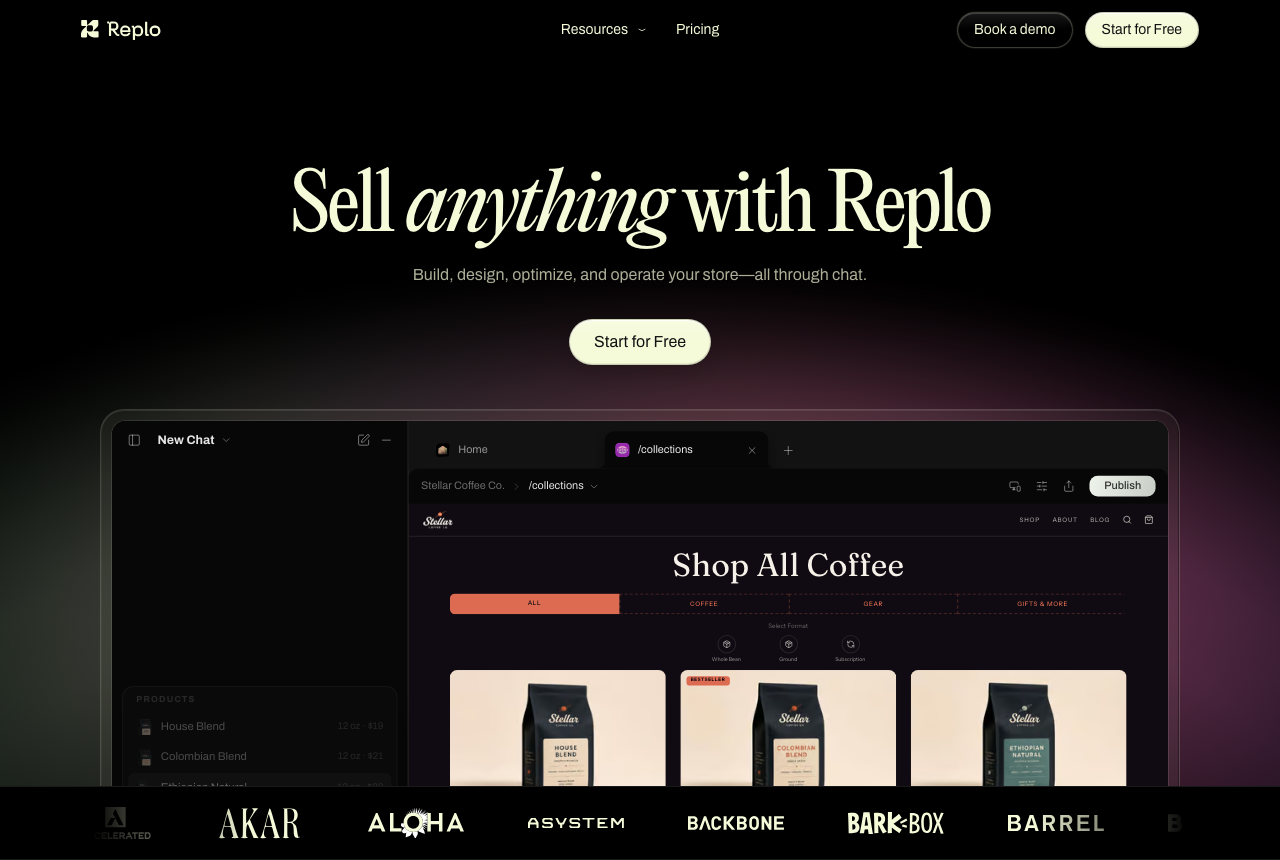
Replo is the on-store builder a media buyer reaches for when the store lives on ads. You build the advertorial, the listicle, the quiz or the offer page inside Shopify, it pulls live product and cart data, and the visitor drops straight into native checkout. For the ad funnel a direct-response brand actually runs, that is the shape you want, and nothing in the on-store class makes the path shorter.
The reason it earns its slot for this buyer is that the measurement is attached to the speed. Split tests and their reports are built into the tool, the test links keep your UTMs intact so Meta and Google attribution survives the experiment, and a growth marketer ships a new angle this week instead of queuing behind engineering. That loop of build, test and read the result is what you pay more than a budget builder for.
It is the dearer builder in this pair, running from about $99 a month on annual Starter to $499 on Pro. Buyers also say the design is strong but the output runs script-heavy, which shows up as slower load on a mid-range phone, which is most of your traffic. One setup wrinkle for a paid-traffic buyer: its A/B test runs on a separate subdomain instead of your store root, so wiring a campaign is an extra step. It pays off once spend is real and is hard to justify before that.
Shogun: the builder for a store with a content team
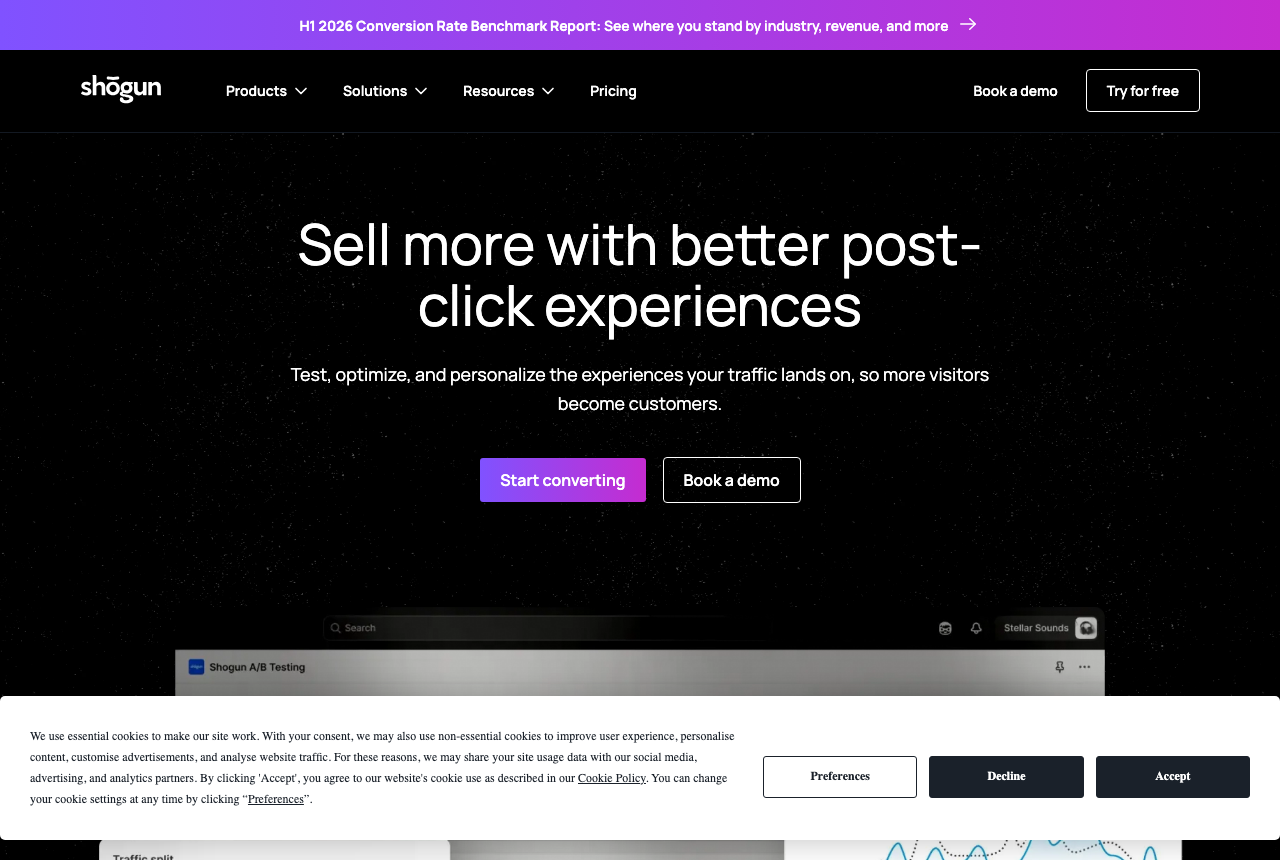
Shogun is aimed at the store that has outgrown a solo builder. Its governance tools matter when several people publish pages on one shop: a change to a shared section updates everywhere it appears, version history lets you roll back a bad edit, and the review workflow stops two people overwriting each other. You can build a page in the free draft mode before you commit to a plan, and it carries a long track record and a large review base.
For a team running structured content operations, that governance is the reason to look, and it is where Shogun still earns its place. The features that justify it over a cheaper builder sit above the entry plan, on the $199 and $499 tiers, so Shogun only pays off once the team and the page volume are real. Its recurring weak point is the editor: buyers describe it as slow to build in, sluggish to load and laggy to drag, to the point that some reverted to plain Shopify pages. Older feedback also flags the front-end weight the whole class of builders is known for, and that it injects its own tracking pixel.
The real gap for an advertiser: split testing and attribution
If a single feature separates these two for a media buyer, it is testing, and it favors Replo. Replo runs experiments inside the tool and keeps your UTMs intact through the test link, so a variant does not break Meta or Google attribution. Shogun is built for publishing and governance, and its A/B testing comes as a separate app with its own plans. For a buyer whose profit comes from finding the angle that converts, that built-in loop is most of Replo's case. For a content team that tests a page once a quarter, it is a feature they would pay for and rarely open. In one line: Replo optimizes an ad funnel, and Shogun runs a content library.
The editor and the weight: both need discipline
Two daily-use notes, because they cut in different directions. Shogun's editor is the complaint that comes up most from its buyers, slow to load and laggy to drag across every machine they tried, so if you live in the builder every day, price that in. Replo's editor draws fewer speed complaints, but its published pages carry a lot of script, and older Shogun feedback reports the same, so both add front-end weight. The rule holds whichever you buy: use the builder for the campaign and landing pages that change often, keep your core theme, product pages and collections native, and test the built page on a throttled mobile connection before you point spend at it. Paid traffic is judged on the slowest quarter of loads, so the phone test is the one that matters.
Pricing: what each price actually buys
On the sticker, Shogun opens cheaper, but neither buyer's reason to pay sits on the entry tier. Replo's testing comes with the tool, and the bill climbs toward Pro as your page and traffic needs grow. On Shogun, the entry plan is the cheap one, and the reuse, rollback and approval tools that are the reason to choose it at all live on its upper tiers. A paid-traffic brand pays more on Replo and gets the testing loop, while a content team pays a lot more on Shogun to get the governance. Compare them on the plan that carries what you need.
A third path if you would rather run your own checkout
Both tools build the page inside Shopify and pass the visitor to its native checkout, which is what most stores want. If your margin turns on the checkout itself (order bumps, one-click upsells, subscription billing, or routing a charge across several merchant accounts you already hold), the page is only half the funnel. ElasticFunnels is a funnel platform for teams running paid traffic that covers both halves. Its AI builder writes a page from a prompt or clones one from a URL, its same-URL split tests change the variant without changing the campaign link or sending the ad back for review, and it hosts its own checkout with upsells and multi-account routing. It starts with a 14-day free trial that takes no card, on plans from $97 a month plus 0.5% of revenue processed through its hosted checkout.
Its drawback is a short public record. It is newer than Replo or Shogun, with very little independent review coverage to check its claims against, which is normal for a platform this young, and the no-card trial lets you put a test campaign through it before you decide. It also runs its own checkout in place of Shopify's, so it suits a seller who wants to own that step. For pages built inside a Shopify theme, Replo and Shogun remain the direct answer.
Which one for you
You run a DTC brand spending real money on paid traffic: Replo. Built-in split testing with UTMs intact, live product data and fast iteration are what the ad budget is paying for, and they are the difference between testing a new angle this week and waiting on a developer. Accept the higher price and watch your mobile load.
You are an established store with a content team: Shogun. Its governance tools justify the upper tiers once several people publish to the same storefront and overwriting a live page is a real risk. Accept that the editor is slow to build in, because that is the trade for the governance.
Your margin turns on upsells and payment routing: look at ElasticFunnels alongside them, with its thin outside track record in mind, if you are prepared to run your own checkout instead of Shopify's.
Replo
What works
- Built for direct-response Shopify stores: it reads live product and cart data, so an advertorial or listicle page links straight into native checkout
- Split tests and analytics ship inside the tool, and the test links keep your UTMs intact so Meta and Google attribution survives the experiment
- Fast to build campaign pages, so a buyer can test a new angle this week instead of queuing behind engineering
What to watch
- The dearest builder here. Starter is about $99/mo billed annually and Pro reaches $499, and the free plan only previews pages
- Buyers say the design is strong but the output is script-heavy, which shows up as slower load on mobile
- The A/B test runs on a separate subdomain rather than your store root, so it is an extra setup step when you buy ads
Shogun
What works
- Shared page blocks, saved versions and an approval step suit a team publishing many pages against one store
- A long track record and a large review base on the Shopify App Store
- You can build a page in the free draft mode before you commit to a paid plan
What to watch
- The editor is the recurring gripe: buyers call it unbearably slow to build in, enough that some revert to plain Shopify pages
- The useful tiers jump to $199 and $499/mo, well above PageFly for a comparable job
- Older feedback flags the same front-end weight the category is known for, and that it injects its own tracking pixel
Pricing
Replo: from $99/mo. The free plan gives 1,000 one-time credits to try the agent. Starter is $99 a month billed annually, 17% less than paying monthly. It includes 10,000 credits a month, one custom domain, 100,000 visitor sessions a month and full analytics. Pro is $499 a month billed annually, with 50,000 credits and 500,000 visitor sessions a month, 10 hours of onboarding and a Slack channel. Custom plans are priced on a call.
Shogun: from $39/mo. Draft Mode $0/month: design only, zero published pages. Build $39/month ($31/month billed annually): 25 published pages, page analytics, A/B testing and personalization with up to 2,000 monthly tracked users (MTUs) on tests. Grow $199/month ($159 annual): unlimited published pages, content scheduling, 10,000 MTUs. Advanced $499/month ($399 annual): unlimited pages, content sync across stores, 50,000 MTUs. MTUs count unique shoppers who hit a page with an active A/B test or personalization in a month. Separate Shogun A/B Testing app has its own plans from $39/month. Verified 2026-10-12 on getshogun.com/pricing.
Prices as of 12 October 2026
Our pick
Replo
Replo is the pick if you run a direct-response Shopify store, put real budget into ads, and need to launch and test campaign pages fast. It is the most capable on-store builder here for ad funnels, and the priciest. Pages can get heavy, and the free plan only previews, it will not publish a live page.
Frequently asked questions
Which is cheaper, Replo or Shogun?
Are Replo and Shogun the same kind of tool?
Which one is better for A/B testing?
Is Shogun's editor really that slow?
Do Replo and Shogun have real free plans?
Sources
Other sources
4 discussions and reviews read for this page. Quotes are excerpts; open a link to read the original in context.
- [replo-shopifydev-good] Anyone tried Replo? : r/shopifyDev
- [replo-heavy] Anyone figured out how to convert a Replo page into Shopify Liquid? : r/shopify
- [replo-cost] Claude & Landing Pages : r/shopify
- [replo-best-builder] Is there a specific page builder that you would recommend? : r/shopify

Written by
Dana Rourke
Lead reviewer
Dana Rourke is the lead reviewer at Campaign Buyer. She owns the tracker and attribution coverage: reading what long-term users report about each tool, checking its documentation and pricing, and verifying prices with the vendor before writing the verdict. Keeping the rankings honest mostly means writing down what the top pick gets wrong, so she does that first.
Last checked 2026-09-23