A profit and attribution suite against a no-code conversion feedermedia buyer software
Triple Whale vs AnyTrack
By Dana Rourke, Lead reviewer. Reviewed by Campaign Buyer Editorial. Updated 24 September 2026.

Quick answer
Pick Triple Whale if you run a Shopify or DTC brand and want blended profit, MER and customer acquisition cost across every channel in one dashboard, and you will keep your UTMs clean; pick AnyTrack if you mainly need conversions fed back to Meta, Google and TikTok server-side without a developer and do not need a profit picture across sources. Triple Whale measures which campaigns actually made money, and pulls your ad spend in to do it. AnyTrack feeds clean conversions to the ad accounts and stops there. It is cheaper and quicker to wire up, but it is a feeder, not the answer to where the money went.
Side by side
| Triple Whale | AnyTrack | |
|---|---|---|
| What it is | Profit and attribution suite | No-code CAPI feeder |
| Core job | Measure blended profit | Feed conversions to platforms |
| Best for | Shopify and DTC brands | Stores, own-site affiliates |
| Ad spend and ROI by source | Yes, blended | No |
| Setup | Pixel plus integrations | No-code tag |
| Priced by | Revenue, by quote | Sessions |
| Entry price | Free, paid by quote | Free, then $100/mo |
| Outside proof | Established | Thin, disputed |
If your shortlist is down to Triple Whale and AnyTrack, you are weighing two tools that both promise numbers you can trust more than the ad account's own ROAS, and that were built for two different jobs. Triple Whale is a profit and attribution suite for a Shopify or DTC brand that wants to see where the money went. AnyTrack is a no-code conversion feeder for the person who runs their own site or store and wants sales fed back to the ad platforms. The reader stuck between them is really deciding which of those two problems is theirs, and once that is clear the choice makes itself.
Triple Whale is the operator's measurement tool. A first-party pixel and a set of integrations pull your ad spend, orders and costs into one place, and the dashboard reports blended MER, customer acquisition cost and profit across every channel rather than trusting each ad platform's self-reported ROAS. It is fast, it is built for Shopify, and it is the kind of dashboard a whole team will actually open in the morning. It rewards clean UTMs, and the first version is rarely right until your tagging is disciplined, but for a brand spending real money it answers the question that matters: which campaigns made money. The full Triple Whale review covers where its accuracy holds and where it wobbles.
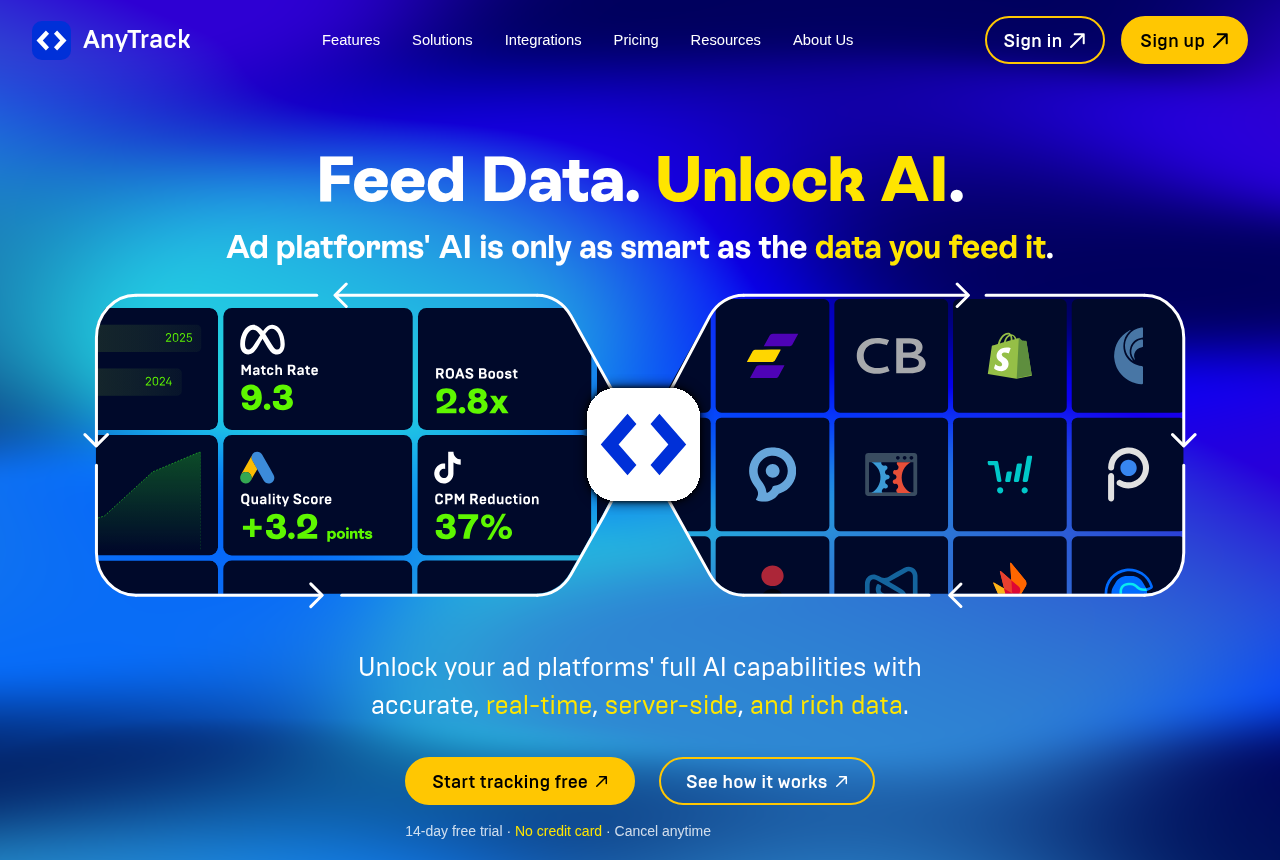
AnyTrack comes at conversions from the other end. It sits on your site as a no-code tag, watches every click, lead and sale, and sends those conversions back to six ad platforms server-side through each platform's conversion API. You do not stand up a server-side Google Tag Manager container or write postback logic yourself. It also covers 90-plus affiliate networks, ecommerce platforms and CRMs out of the box, so a store owner or an affiliate can wire clean data into Meta and Google without a developer. The AnyTrack review covers how well that holds up, and where the complaints cluster.
Who each one is really for
Triple Whale suits a Shopify or DTC brand buying paid traffic across several channels that has outgrown the ad platforms' own dashboards and wants one blended read on profit. It speaks the language of MER, contribution margin and cohort payback, and it earns its keep when there is enough spend that a two-percent error in attribution is real money. When the storefront is on Shopify and the budget runs across Meta, Google, TikTok and email, Triple Whale is built for that shape.
AnyTrack suits a different operator: someone running a Shopify store, a lead-gen site or their own offers who buys traffic and mainly needs those conversions fed back into the ad accounts so the algorithms bid on real sales instead of a half-blocked pixel. If you have no data engineer and no appetite to build server-side tracking, the no-code setup is the draw. It is a feeder, not a measurement suite, so it does not give you the blended profit view a brand uses to decide how to split a budget.
The dividing line is measure versus feed
The single distinction that should decide this is what each tool does with a conversion. Triple Whale records it, then blends it with your spend and costs to tell you which channel and campaign was actually profitable. AnyTrack records it, then pushes it back to Meta, Google, TikTok and the rest through their conversion APIs so the ad platforms can optimize on it. Triple Whale helps you read the money. AnyTrack feeds the algorithm. They answer two different questions that happen to share a search box.
There is a real gap on each side. AnyTrack does not pull your ad spend in to compute ROI across sources, so it does not answer "which of my campaigns is actually profitable" on its own. Triple Whale does answer that, but it is a reporting layer over a store you host elsewhere and takes real setup, where AnyTrack is a tag you can drop on a site in an afternoon. If reading profit by source is the point, the best attribution software ranking places Triple Whale against the heavier platforms a brand graduates to, and Triple Whale vs Northbeam covers that step up.
Where the money actually goes
The two do not price on the same axis, and one of them does not publish a figure at all. Triple Whale has a free plan with no card, and its paid tiers, Foundation, Automate and Enterprise, are quoted after a walkthrough and scale with your store's revenue rather than a public monthly price, so you learn the number on a call. They are 12-month commitments, so you are budgeting for the year. AnyTrack bills by sessions: a free plan capped at 5,000, then $100 a month for 100,000 on Starter, $150 for 500,000 and $300 for three million. Its free plan sends nothing through the conversion API, so most people actually start on Starter.
Watch AnyTrack's overage. Once you pass your session cap it bills automatically, from $0.40 down to $0.20 per 1,000 sessions, and you cannot switch that off on a paid plan. Count your real monthly sessions rather than your budget, and size the plan above your peak so a traffic spike or a bot wave does not surprise you.
The catch on each
Triple Whale's limit is the commitment and the discipline it asks for. The 12-month term priced by revenue is a real decision for a smaller store, and the dashboards are only as honest as your UTMs, so expect the first month to go on setup. Users also report data quirks, such as VAT counted in revenue, so reconcile against the backend before you trust a number to the penny. RedTrack vs Triple Whale covers the choice between a media-buyer's click tracker and a DTC profit suite if that is the real fork.
AnyTrack's catch is support and proof. Unanswered tickets and trial-cancellation disputes recur across Trustpilot and PPC threads, and the outside record is thin: two reviews on G2 and 3.4 out of 5 from eleven reviews on Trustpilot make it hard to sanity-check against the crowd. Test the support inside the 14-day trial, which takes no card, before you commit a budget. BeMob vs AnyTrack and Binom vs AnyTrack cover the choice if a campaign click tracker is what you are really after.
A third path if you host the funnel yourself
Both of these read traffic that lands on pages and a checkout you host somewhere else, usually Shopify. If you are still deciding where the funnel itself lives, one option changes the tracking question instead of answering it. ElasticFunnels is a funnel platform for teams that buy paid traffic: it builds the pages, split-tests variants under one URL so Meta, Google and TikTok never reset their learning, and hosts the checkout with order bumps and upsells. Because the checkout runs on the same platform as the pages, a purchase is a first-party event on the same record as the click, so it can fire conversions back to the ad platforms and report ad spend against those conversions without a separate feeder or a separate profit tool stitched on top.
That only helps if you want to move the pages and checkout too, and it does not replace what Triple Whale does across a store's whole channel mix: if your storefront stays on Shopify and your spend runs across many sources, a dedicated profit suite still reads the fuller picture, and pages that live elsewhere still need a feeder like AnyTrack. ElasticFunnels is also newer than either tool here, and there is very little independent third-party review coverage to check its claims against, so until you run real volume through it you are largely taking the vendor's word for it, which is what you would expect of a platform this recent while both of these have years of public setups to compare against. Its 14-day trial takes no card, so proving it out costs only time. Plans start at $97 a month, and it charges 0.5% only on revenue that runs through a checkout it hosts, nothing on sales that settle on Shopify or an outside network. If your store already runs on Shopify and you just need measurement or a conversion feed on top, this comparison is the one that matters.
Which one for you
Three quick reads:
- Shopify or DTC brand that needs to see profit across channels: Triple Whale. Blended MER, CAC and profit in one operator-friendly dashboard, worth the commitment once your spend and UTMs justify it.
- Store owner or affiliate who needs clean conversions in the ad accounts: AnyTrack. The no-code conversion feed is its whole reason to exist, and it works if you accept the thin outside proof and watch the session bill.
- Still choosing where the funnel lives: look at ElasticFunnels before you bolt a tracker or a profit suite onto a stack you have not built yet.
For the wider field, the best ad tracker ranking and every head-to-head place both against the tools a scaled buyer reaches for next.
Triple Whale
What works
- Built for Shopify: first-party pixel, MER, blended CAC and profit in one dashboard
- Lower entry cost than the other serious attribution tools here
- Fast, operator-friendly dashboards the whole team will actually open
What to watch
- The first dashboard is rarely right until your UTMs are clean and consistent
- Paid plans are 12-month commitments priced by GMV
- Users report data quirks such as VAT counted in revenue, so reconcile against the backend
AnyTrack
What works
- No-code setup. You connect the tag and your ad accounts from a dashboard instead of standing up a server-side Google Tag Manager container.
- Server-side and client-side tracking run together, so a blocked pixel or an iOS restriction does not silently drop the conversion.
- Feeds conversions back to seven ad platforms through the Conversion API, and covers 90+ affiliate networks, ecommerce platforms and CRMs out of the box.
- A real free plan and a 14-day trial with no credit card, so you can prove the tracking before you pay.
What to watch
- Support and billing draw the most complaints. Unanswered tickets and trial-cancellation disputes recur across Trustpilot and PPC threads, so test support inside the trial.
- Thin independent proof. Two reviews on G2 and 3.4 out of 5 from eleven reviews on Trustpilot make it hard to sanity-check against the crowd.
- Session-based pricing with automatic overage. A traffic spike pushes you past your cap and bills $0.40 to $0.20 per 1,000 sessions, and you cannot switch it off on a paid plan.
- No automatic ad-spend sync. Unlike RedTrack or Voluum it does not pull your cost in, so ROI across sources has to be computed somewhere else.
Pricing
Triple Whale: from free (paid by quote). The free plan needs no credit card and includes the Moby AI assistant. The paid tiers, Foundation, Automate and Enterprise, are quoted after a walkthrough and scale with your store revenue. The vendor publishes no dollar figure for them.
AnyTrack: from free, then $100/mo. The free plan costs nothing and covers 5,000 sessions a month, one website, one ad platform and one conversion source, without the Conversion API. Starter is $100/mo for 100,000 sessions, all seven ad platforms, 100+ integrations and real-time CAPI. Personal is $150/mo for 500,000 sessions, three sites, GA4, cross-domain tracking and webhooks. Advance is $300/mo for 3M sessions, ten sites, ten seats and dedicated support. Annual billing gives two months free. Overage runs $0.40 to $0.20 per 1,000 sessions and cannot be turned off on paid plans. Extra websites cost $30/mo on Advance. Paid plans start with a 14-day trial.
Prices as of 23 September 2026
Our pick
Triple Whale
It is the pick if you run a Shopify or DTC brand and want attribution and profit dashboards in one place, and you will keep your UTMs clean.
Frequently asked questions
Which is cheaper, Triple Whale or AnyTrack?
Do Triple Whale and AnyTrack do the same thing?
Does AnyTrack show which campaigns are profitable?
Is Triple Whale worth the commitment for a smaller store?
Can I use both?
Sources
Other sources
9 discussions and reviews read for this page. Quotes are excerpts; open a link to read the original in context.
- [reddit-must-4yr] Is triple whale a must?
- [reddit-must-50k] Is triple whale a must?
- [reddit-must-overlap] Is triple whale a must?
- [reddit-vsmeta-unprofitable] Triple Whale vs Meta Reporting?
- [reddit-vsmeta-confused] Triple Whale vs Meta Reporting?
- [reddit-ecom-convoluted] Triple Whale?
- [reddit-ecom-repeats] Triple Whale?
- [reddit-ecom-amazing] Triple Whale?
- [reddit-ecom-sonar-100k] Triple Whale?

Written by
Dana Rourke
Lead reviewer
Dana Rourke is the lead reviewer at Campaign Buyer. She owns the tracker and attribution coverage: reading what long-term users report about each tool, checking its documentation and pricing, and verifying prices with the vendor before writing the verdict. Keeping the rankings honest mostly means writing down what the top pick gets wrong, so she does that first.
Last checked 2026-09-24