A Shopify profit dashboard against a solo advertiser's trackermedia buyer software
Triple Whale vs ClickMagick
By Dana Rourke, Lead reviewer. Reviewed by Campaign Buyer Editorial. Updated 23 September 2026.

Quick answer
Pick Triple Whale if you run a Shopify or DTC brand and want blended profit, MER and contribution margin in one dashboard your whole team opens every morning; pick ClickMagick if you are a solo advertiser, affiliate or info-product seller running your own Meta, Google or YouTube traffic and want a flat, predictable bill, first-party tracking, and a daily email that names what to scale or cut.
Side by side
| Triple Whale | ClickMagick | |
|---|---|---|
| What it is | Shopify profit dashboard | First-party CAPI tracker |
| Best for | Shopify or DTC brand | Solo or affiliate buyer |
| Measures | Blended profit and MER | Clicks and conversions |
| How you read it | One team dashboard | A morning email |
| Pricing | $219/mo, GMV-scaled | $79 to $349/mo |
| Commitment | 12-month annual | Monthly, 14-day trial |
| Outside proof | Established | Thin, disputed |
If you are deciding between Triple Whale and ClickMagick, start by dropping the idea that one is a better version of the other. Triple Whale is a Shopify-native profit and attribution dashboard. ClickMagick is a first-party click tracker for people who buy their own ads. They answer different questions, so the real decision is which measurement problem you have.
Triple Whale pulls your Shopify orders, ad spend and a first-party pixel into one screen that shows blended MER, CAC and contribution margin, so a brand can see whether it made money today. ClickMagick stamps each click, catches the conversion on its own servers, and sends it back to Meta, Google and YouTube through their conversion APIs, so the ad platforms keep optimizing on data the browser pixel now drops. Triple Whale tells a store how its whole media budget is doing. ClickMagick keeps a single buyer's pixels honest across their own campaigns.
What each one actually measures
Be precise about the output, because that is the real fork. Triple Whale gives you a blended, operator-facing picture of the whole store: spend in, revenue out, margin after costs, on one screen a founder will open every morning. Its weakness is that a blended number hides which specific click drove which sale, and it is only as clean as the UTMs feeding it. ClickMagick gives you a click-level record: this click, from this source, produced this conversion, and here it is sent back to the platform. Its strength is a deterministic, source-level count you can act on. Its blind spot is the whole-business view: margins, costs and the store's P&L sit outside it.
A brand operator deciding whether the business is healthy needs the blended dashboard. A media buyer optimizing individual campaigns needs the source-level record.
Triple Whale: the Shopify profit dashboard your team will open
Triple Whale is the operator-facing tool for a Shopify or DTC brand. Its pixel feeds a daily profit screen that founders and marketers both use. It enters well below a modeled-attribution platform like Northbeam on its Foundation tier, which is why most brands under roughly $10M in GMV should start here. Our Triple Whale review and the RedTrack against Triple Whale piece go deeper on where it sits.
Its drawback is that the first dashboard is rarely right. Users report early inaccuracies, and the usual cause is missing or messy UTMs. Paid plans are also 12-month commitments scaled by your GMV, so the bill rises with revenue, and buyers have flagged quirks such as VAT counted inside revenue. Reconcile it against your Shopify backend for the first few weeks.
ClickMagick: the tracker for buyers running their own ads
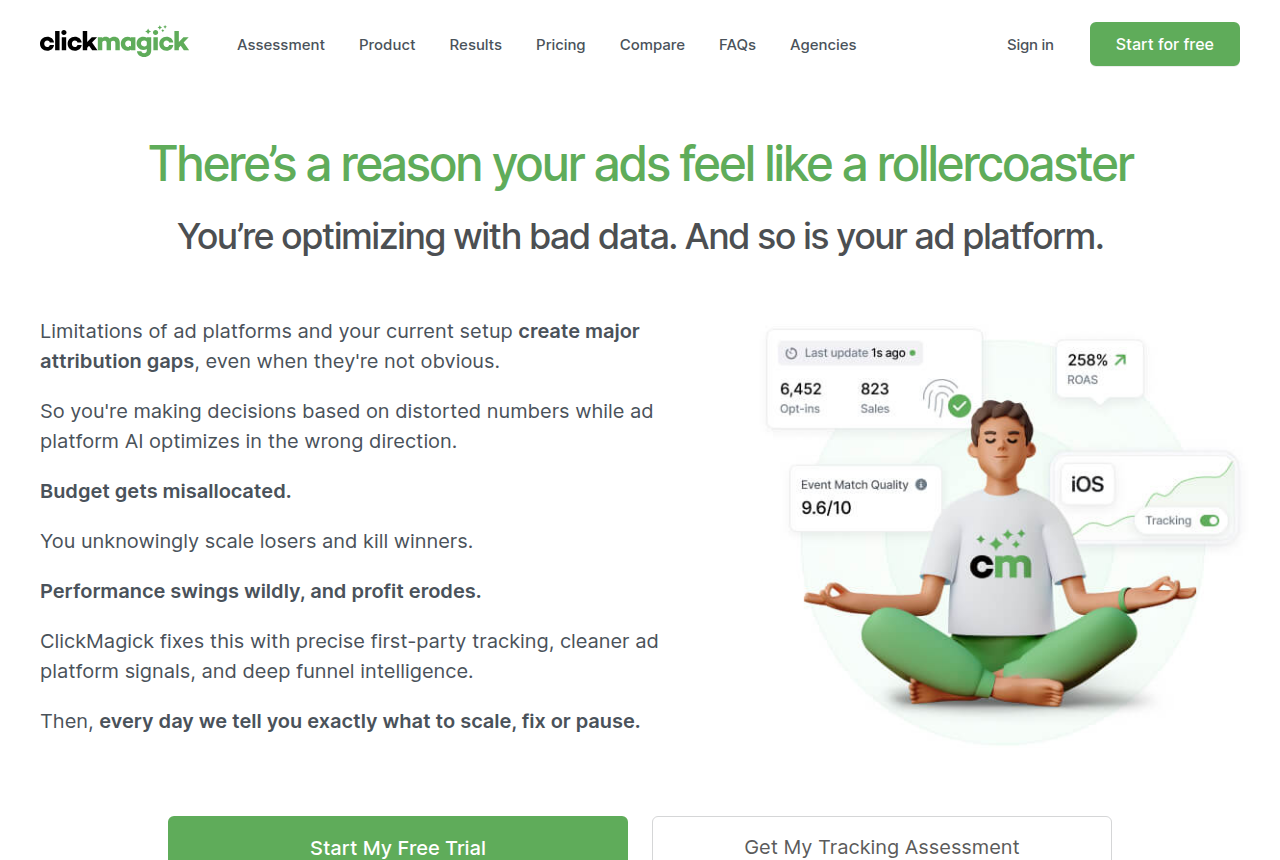
ClickMagick has tracked links since 2014 and now bills itself as an attribution platform it calls TrueTracking. The buyer it fits is narrower than its marketing suggests: an affiliate, a solo advertiser, or someone selling their own info-product, running paid traffic on their own Meta, Google or YouTube ad accounts. First-party tracking on a custom domain plus CAPI feeds cleaner conversions back so the platform's AI stops optimizing toward the wrong people. Its full review covers the setup in detail, and Hyros against ClickMagick sets it beside a long-funnel attribution tool.
Two things set it apart for that buyer. The first is Morning Magick, a daily email that reads your stats overnight and tells you what to scale, pause or fix, which suits someone with no analyst. The second is support, the most praised part of the product in public reviews: fast replies, often the same day, sometimes with a screen recording attached. Pricing is based on the visitors you track, so the bill stays flat when a campaign wins.
Its weak spot is independent proof. There is no meaningful G2 or Capterra presence, and ClickMagick stopped maintaining its Trustpilot page after disputing a batch of reviews, so you lean on the vendor's own case studies more than you would like. Check its numbers against the ad network, GA4 and your backend before you move budget.
The price gap tells you who each is for
Triple Whale's entry plan costs well over twice ClickMagick's, and the gap reflects two different products. The profit dashboard is priced for a store that wants its whole media performance and margin in one operator view. The tracker is priced for anyone who needs conversions counted and fed back to the platforms.
Triple Whale is a GMV-scaled annual commitment, so the figure grows with the store and locks in for a year. ClickMagick is a monthly bill by tracked visitors: the Starter allowance runs out fast once you buy real volume, and each extra site adds $40 a month.
A third path if you host the funnel yourself
Neither of these tools builds the funnel whose numbers they report. Triple Whale reads your Shopify store and ClickMagick tracks the clicks, and both assume the pages and the checkout live somewhere else. ElasticFunnels is a funnel platform for teams running paid traffic that covers that middle: it builds the landing pages, split-tests variants under one URL so the ad platform never resets its learning, hosts the checkout with order bumps and one-click upsells, and keeps sessions, orders, rebills and refunds on one timeline with a CRM and attribution on the same data.
Because the checkout sits on the same record as the click, a purchase is logged directly, and the platform fires affiliate postbacks and reports ad spend against conversions itself. For a seller who runs an offer outside Shopify and would otherwise wire ClickMagick onto a separate page builder, that is a real alternative. It starts at $97 a month with a 14-day trial that needs no card, and it charges 0.5% only on revenue processed through its own hosted checkout.
Its drawback is that it is newer than Triple Whale or ClickMagick, with very little independent review coverage to check its claims against, so until you run real volume through it you are largely relying on the vendor's word for how its reporting holds up. That is what you would expect of a platform this young, and the no-card trial is the way to test it first. It also only helps if you want to move the pages and checkout onto one platform. If your store already lives on Shopify, Triple Whale remains the profit view. If your pages live elsewhere and you only need to track the traffic to them, ClickMagick remains the answer.
Which one for you
You run a Shopify or DTC brand and want blended profit in one screen: Triple Whale. A daily view of MER, CAC and margin earns its entry price once the whole team uses it, provided you keep your UTMs clean.
You buy your own paid traffic as an affiliate, course seller or one-person shop: ClickMagick. First-party tracking plus CAPI fixes a drifting pixel without a store attached, and the flat bill and morning email suit a buyer with no analyst. For that buyer it is the better tool.
You host your own offer and want the spend and the sale in one place: look at ElasticFunnels alongside them, keeping its newness in mind, then add a dedicated tracker later if your traffic ever closes off your own domains.
Triple Whale
What works
- Built for Shopify: first-party pixel, MER, blended CAC and profit in one dashboard
- Lower entry cost than the other serious attribution tools here
- Fast, operator-friendly dashboards the whole team will actually open
What to watch
- The first dashboard is rarely right until your UTMs are clean and consistent
- Paid plans are 12-month commitments priced by GMV
- Users report data quirks such as VAT counted in revenue, so reconcile against the backend
ClickMagick
What works
- Flat monthly price based on the visitors you track, not a cut of your revenue, so the bill does not climb every time a campaign wins.
- First-party TrueTracking with a custom domain and CAPI feeds cleaner conversion data back to Meta, Google and YouTube, which users credit for better ad optimization.
- The Morning Magick email reads your stats each morning and names what to scale, pause or fix, which suits a solo buyer with no analyst.
- Support is the most-praised part in public reviews: fast replies, often the same day, sometimes with screen recordings.
What to watch
- The Starter plan tracks just 10,000 visitors for $79, so anyone buying real volume is pushed to the $199 Standard tier fast.
- Independent proof is thin. There is no meaningful G2 or Capterra presence, and ClickMagick stopped maintaining its Trustpilot page after disputing fake reviews, so you lean on the vendor's own case studies more than you would like.
- Its numbers will differ from what the ad network reports, so reconcile them against GA4 and your backend before you move budget.
- Setup rewards patience. Postbacks, cross-domain tracking and CAPI all need wiring, and a botched setup is behind most of the accuracy complaints.
Pricing
Triple Whale: from $219/mo. The free plan needs no credit card and includes the Moby AI assistant. The paid tiers, Foundation, Automate and Enterprise, are quoted after a walkthrough and scale with your store revenue. The vendor publishes no dollar figure for them.
ClickMagick: from $79/mo. Starter costs $79 a month for 10,000 tracked visitors. Standard is $199 a month for 100,000, and Pro is $349 a month for 1,000,000. Billed yearly, the three cost $790, $1,990 and $3,490. Extra sites or stores are $40 a month on Standard and Pro.
Prices as of 23 September 2026
Our pick
ClickMagick
ClickMagick is the pick if you are an affiliate, a solo advertiser or an info-product seller who wants a flat monthly bill and a morning email telling you what to scale or cut, and you can live with an entry plan that tracks only 10,000 visitors.
Frequently asked questions
Which is cheaper, Triple Whale or ClickMagick?
Do Triple Whale and ClickMagick do the same thing?
Does ClickMagick work if I am not on Shopify?
Can I run both Triple Whale and ClickMagick together?
Why is ClickMagick's outside proof called thin?
Sources
Other sources
6 discussions and reviews read for this page. Quotes are excerpts; open a link to read the original in context.
- [ppc-advice] Looking for some advice regarding my campaigns
- [ppc-toogood] Anyone have experience with ClickMagick or similar?
- [ppc-expert] Anyone have experience with ClickMagick or similar?
- [sideproject-price] A SideProject builder's ClickMagick pricing complaint
- [vendor-mattcox] ClickMagick pricing page customer testimonial
- [vendor-hyros] ClickMagick home page customer testimonial

Written by
Dana Rourke
Lead reviewer
Dana Rourke is the lead reviewer at Campaign Buyer. She owns the tracker and attribution coverage: reading what long-term users report about each tool, checking its documentation and pricing, and verifying prices with the vendor before writing the verdict. Keeping the rankings honest mostly means writing down what the top pick gets wrong, so she does that first.
Last checked 2026-09-23