Head-to-headmedia buyer software
Triple Whale vs Polar Analytics
By Dana Rourke, Lead reviewer. Reviewed by Campaign Buyer Editorial. Updated 24 September 2026.

Quick answer
Pick Triple Whale if you run a Shopify or DTC brand under roughly $10M in GMV and want blended profit and attribution in one prebuilt dashboard your whole team will open; pick Polar Analytics if you are a data-literate Shopify brand doing real GMV that would rather build its own custom reports across every source than live in a fixed screen.
Side by side
| Triple Whale | Polar Analytics | |
|---|---|---|
| What it is | Prebuilt Shopify profit dashboard | Shopify BI you build yourself |
| How it measures | First-party pixel, blended MER | First-party pixel, directional |
| Reporting style | One prebuilt operator screen | Custom dashboards you build |
| Deep custom attribution | Blended view, not per-click | Directional, tightens when deep |
| Who runs it | Founders and operators | A data-literate operator |
| Best-fit brand size | Under ~$10M GMV | $1M to $25M GMV |
| Entry price | $219/mo Foundation | $750/mo, priced on GMV |
If you are down to Triple Whale and Polar Analytics, you have already narrowed the field to two Shopify-native tools that pull your orders and ad spend together. That is the easy part. The harder part is that they hand you that data in two very different shapes, so the choice comes down to how you and your team want to work.
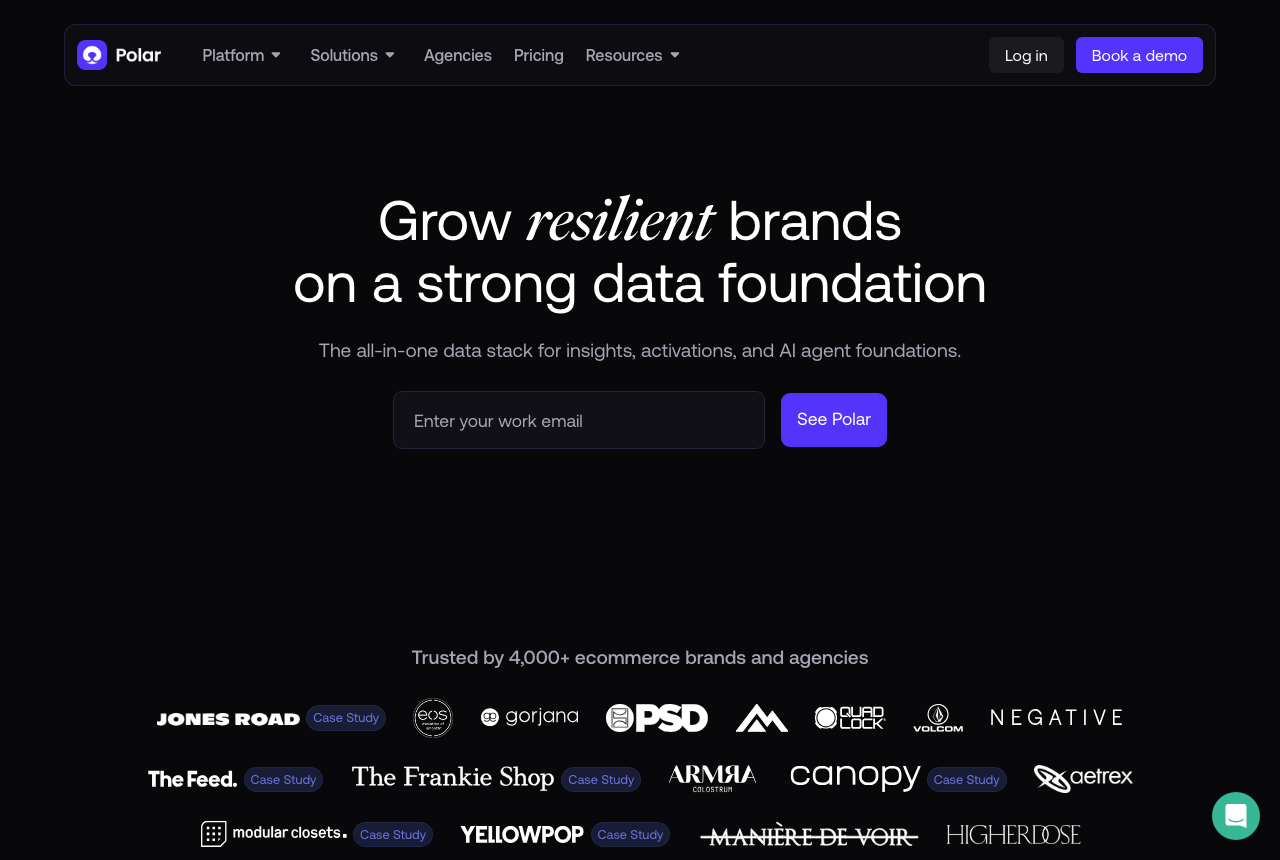
Triple Whale is a prebuilt profit dashboard. A first-party pixel feeds MER, blended CAC and contribution margin into one operator screen a founder opens every morning. Polar Analytics is a business-intelligence layer. It centralizes Shopify, the ad platforms, email and SMS into one place and lets a data-literate operator build their own reports, closer to a reporting canvas than a fixed screen. One lays the answer out. The other gives you the tools to lay it out yourself.
What each one actually measures
Be precise about the output, because that is the real fork. Triple Whale gives you a blended, operator-facing picture of the whole store: spend in, revenue out, margin after costs, on one screen the whole team will read the same way. Its strength is that single profit view across channels, and its weakness is that a blended number hides which specific click drove which sale, and it is only as clean as the UTMs feeding it.
Polar gives you a place to see everything at once and slice it yourself. Its server-fed pixel, which Polar itself calls directional, feeds custom reports you assemble across Shopify, the ad platforms and Klaviyo. Its strength is reporting flexibility and data centralization. Its weakness, by repeated buyer accounts, is that it tightens up the moment you need to go deep into custom attribution, where a purpose-built tool does more.
An operator who wants the profit answer laid out every morning wants the prebuilt dashboard. A team that wants to own its reporting and slice the business its own way wants the BI layer. If you know which of those two sentences describes your week, you already know which tool this is.
Triple Whale: the profit dashboard your team opens
Triple Whale is the operator-facing tool for a Shopify or DTC brand, built so the founder and the media buyer read the same profit numbers each morning. It enters far below Polar and below the modeled-attribution platforms, at $219 a month on the Foundation tier, which is why most brands under roughly $10M in GMV should start here before paying for a BI canvas they will not fully use.
The first dashboard is rarely right. Users report early inaccuracies, and the usual cause is missing or messy UTMs, because attribution is only as clean as the parameters feeding it. Paid plans are also 12-month commitments scaled by your GMV, so the entry number climbs with your revenue, and buyers have flagged data quirks such as VAT being counted inside revenue. Reconcile its figures against your Shopify backend for the first few weeks.
Polar Analytics: a BI layer you build yourself
Polar is the tool for a Shopify brand that has outgrown a fixed dashboard and wants to build its own. It brings Shopify, Meta, Google, Klaviyo and the rest together, then lets an operator assemble custom reports, with unlimited users and full historical data on the Core plan. Polar says plainly that its attribution is directional, with a warm-up period of roughly two weeks and a default lookback window, so it will not rebuild exact history. For a Shopify brand doing real GMV that wants reporting flexibility and a team that will actually use it, that is the draw, and the Shopify App Store rating backs it up at 4.9 across 117 ratings, with setup and data centralization the parts buyers praise most.
The honest cost is money. Core opens at $750 a month and is priced on your GMV, which is why buyers on Reddit call revenue-linked pricing a tax and put a mid-market brand's real bill well into five figures a year. Support is praised overall, but a dedicated success manager only arrives on a $10,000 annual contract, and reviewers below that report slow responses on connector problems.
The price gap tells you who each is for
The sticker difference is large, and each price describes its buyer. Triple Whale's entry tier suits a founder who wants margin and CAC on one screen and a bill a growing store can carry. Polar's GMV-scaled Core plan is priced for a brand at real revenue that wants to build its own reporting across every source and has a team to do it. If the gap feels absurd for your situation, one of the two is probably not built for you.
Price both on your own revenue. Both are GMV-scaled commitments, so both bills climb as the store grows. A smaller shop overpays for Polar's flexibility, and a larger brand may find Triple Whale's fixed screen too shallow.
The decision is your size and your team
Line the two up and the fork is clear. If you run a Shopify or DTC brand under roughly $10M in GMV and your pain is not seeing blended profit across channels on one screen, that is Triple Whale, and it is built for exactly that view at a price a growing store can carry. Polar fits a Shopify brand doing real GMV whose questions a prebuilt screen cannot answer, with someone on the team who will build the reports.
Triple Whale is our default pick. More of this site's readers run a store themselves and want a ready-made profit view than staff a data team that wants a canvas, and its lower entry price suits them. For a large brand that has genuinely outgrown a fixed dashboard, Polar is plainly the better fit, and we rank it right behind Triple Whale for ecommerce attribution for that reason. Our ecommerce attribution ranking puts both in context against the modeled-attribution platforms above them.
The overlap is large enough that few brands pay for both. If a budget forces one choice, the deciding facts are your GMV and whether you have a data-literate operator to build reports. Without that person, Polar's canvas is flexibility you will not use, and Triple Whale's prebuilt screen is the more honest buy. If you also weigh either against a modeled-attribution engine, our Triple Whale vs Northbeam and Northbeam vs Polar Analytics pages take that next step.
Both reward discipline
Whichever you pick, the setup work is yours. Triple Whale's dashboard depends on clean, consistent UTMs, and the first numbers rarely reconcile until the tagging is right. Polar's model needs its warm-up period before it settles, and its reports depend on the connectors and parameters behind them. Plan for the wiring either way, because both tools report exactly what your tracking sends them.
Which one for you
You run a Shopify or DTC brand under roughly $10M in GMV and want blended profit on one screen: Triple Whale. MER, blended CAC and contribution margin in an operator-friendly dashboard pay off once the whole team opens it daily, provided you keep your UTMs clean and reconcile against your backend.
You run a Shopify brand at real GMV and want to build your own reporting: Polar Analytics. Centralized data across Shopify, the ad platforms and email, plus custom dashboards and full history, earn the higher fee once a team actually builds on them, provided your revenue justifies the GMV-scaled bill and you accept that the attribution is directional.
Triple Whale
What works
- Built for Shopify: first-party pixel, MER, blended CAC and profit in one dashboard
- Lower entry cost than the other serious attribution tools here
- Fast, operator-friendly dashboards the whole team will actually open
What to watch
- The first dashboard is rarely right until your UTMs are clean and consistent
- Paid plans are 12-month commitments priced by GMV
- Users report data quirks such as VAT counted in revenue, so reconcile against the backend
Polar Analytics
What works
- Pulls Shopify, ad platform and email or SMS data into custom dashboards you build yourself, not a fixed template, with unlimited users and historical data on the Core plan
- First-party pixel and server-side tracking, so the numbers survive the browser better than a pixel-only setup
- Rated 4.9 out of 5 across 117 Shopify App Store ratings, with setup and data centralization the most-praised parts
What to watch
- Core opens at $750 a month and is priced on your GMV, so the bill climbs with revenue and a small store overpays
- Buyers report it gets restrictive when you need deep or custom attribution, where Triple Whale goes wider on ecommerce metrics and Northbeam goes deeper on modeling
- A dedicated success manager only arrives at a $10,000 annual contract, and some reviewers below that flag slow support and connector delays
Pricing
Triple Whale: from $219/mo. The free plan needs no credit card and includes the Moby AI assistant. The paid tiers, Foundation, Automate and Enterprise, are quoted after a walkthrough and scale with your store revenue. The vendor publishes no dollar figure for them.
Polar Analytics: from $750/mo, priced on GMV. Pricing is tiered by annual gross merchandise value and quoted after a demo, and the pricing page publishes no dollar figure. The Core Plan bundles Business Intelligence, AI Agents and Data Activations, which the vendor says saves 20% on buying the products one by one. The Custom Plan lets a buyer pick products. Every plan includes a dedicated Snowflake database, an ecommerce semantic layer, a first-party pixel, unlimited users, unlimited historical data and a dedicated success manager. An instant demo runs on sample data without signup.
Prices as of 23 September 2026
Our pick
Triple Whale
It is the pick if you run a Shopify or DTC brand and want attribution and profit dashboards in one place, and you will keep your UTMs clean.
Frequently asked questions
Which is cheaper, Triple Whale or Polar Analytics?
Do Triple Whale and Polar Analytics do the same thing?
Is Polar Analytics worth $750 a month for a smaller store?
Do I need to be on Shopify to use either one?
Is Triple Whale's attribution accurate out of the box?
Sources
Other sources
9 discussions and reviews read for this page. Quotes are excerpts; open a link to read the original in context.
- [reddit-must-4yr] Is triple whale a must?
- [reddit-must-50k] Is triple whale a must?
- [reddit-must-overlap] Is triple whale a must?
- [reddit-vsmeta-unprofitable] Triple Whale vs Meta Reporting?
- [reddit-vsmeta-confused] Triple Whale vs Meta Reporting?
- [reddit-ecom-convoluted] Triple Whale?
- [reddit-ecom-repeats] Triple Whale?
- [reddit-ecom-amazing] Triple Whale?
- [reddit-ecom-sonar-100k] Triple Whale?

Written by
Dana Rourke
Lead reviewer
Dana Rourke is the lead reviewer at Campaign Buyer. She owns the tracker and attribution coverage: reading what long-term users report about each tool, checking its documentation and pricing, and verifying prices with the vendor before writing the verdict. Keeping the rankings honest mostly means writing down what the top pick gets wrong, so she does that first.
Last checked 2026-09-24