Head-to-headmedia buyer software
Triple Whale vs BeMob
By Dana Rourke, Lead reviewer. Reviewed by Campaign Buyer Editorial. Updated 23 September 2026.

Quick answer
Pick Triple Whale if you run a Shopify or DTC brand and want blended profit and attribution in one dashboard your whole team will open; pick BeMob if you are an affiliate or solo media buyer who needs to track which clicks, sources and offers actually convert, and want a genuine free tier with nothing to install.
Side by side
| Triple Whale | BeMob | |
|---|---|---|
| What it is | Shopify profit dashboard | Cloud click tracker |
| Best-fit operation | Shopify or DTC brand | Affiliate or solo buyer |
| What it measures | Blended store profit | Clicks, sources, offers |
| How it tracks | First-party Shopify pixel | Redirects and S2S postbacks |
| Pricing model | From $219/mo, on GMV | Free tier, then $49/mo |
| Who runs it | Founders and operators | The buyer, self-serve |
| Best-fit stage | Running a store | Testing and low volume |
If you are down to Triple Whale and BeMob, the first thing worth saying is that these two rarely measure the same thing. Both help you see which of your ads actually made money, but they were built for two different operations. Triple Whale is a profit and attribution dashboard for a Shopify or DTC brand. BeMob is a cloud click tracker for an affiliate or a solo media buyer. The reader stuck between them is really deciding what kind of operation they run.
Triple Whale feeds a first-party pixel into one dashboard that shows MER, blended CAC and margin, so a founder can open one screen every morning and see ad spend against profit across the whole store. BeMob stamps a click, catches the conversion server-side, fires postbacks to your networks, and tells you which source, campaign and offer converted. One reads a store's profit for an operator. The other tracks the clicks for a buyer. They sit at different ends of the market, and the pricing says so: Triple Whale bills a GMV-scaled annual plan, and BeMob starts free.
The one question that decides it: what you run
Answer this before you compare a single feature: are you running a store, or are you buying traffic to offers? If your problem is seeing blended profit across Meta, Google and email for a Shopify or DTC brand, and reading MER and margin without stitching four exports together, that is Triple Whale's problem to solve. If your problem is knowing which ad, traffic source and landing page produced a conversion so you can cut the losers and scale the winners across campaigns, that is what BeMob is for.
The shape of your business decides it. Triple Whale is built around Shopify: its pixel, its connectors and its profit view assume a storefront, and its paid plans are 12-month commitments scaled by your GMV. BeMob is a self-serve click tracker with a genuine free tier, built for a buyer who wires their own postbacks in an afternoon. Without a store, most of Triple Whale has nothing to read. Without campaigns to track click by click, BeMob answers a question you are not asking.
Triple Whale: a profit dashboard for a Shopify brand
Triple Whale is the operator-facing tool for a Shopify or DTC brand. A first-party pixel feeds MER, blended CAC and contribution margin into one dashboard that founders open every morning alongside their analysts. It starts below the modeled-attribution platforms at $219 a month on the Foundation tier, which is why most brands under roughly $10M in GMV should start here rather than pay for a heavier measurement stack they will not fully use. Its strength is that single blended profit view across channels, laid out for the whole team.
The honest part is that the first dashboard is rarely right. Users report early inaccuracies, and the usual cause is missing or messy UTMs, because attribution is only as clean as the parameters feeding it. Paid plans are also 12-month commitments scaled by your GMV, so the entry number climbs with your revenue. Reconcile its numbers against your Shopify backend for the first weeks.
BeMob: a free click tracker for a buyer
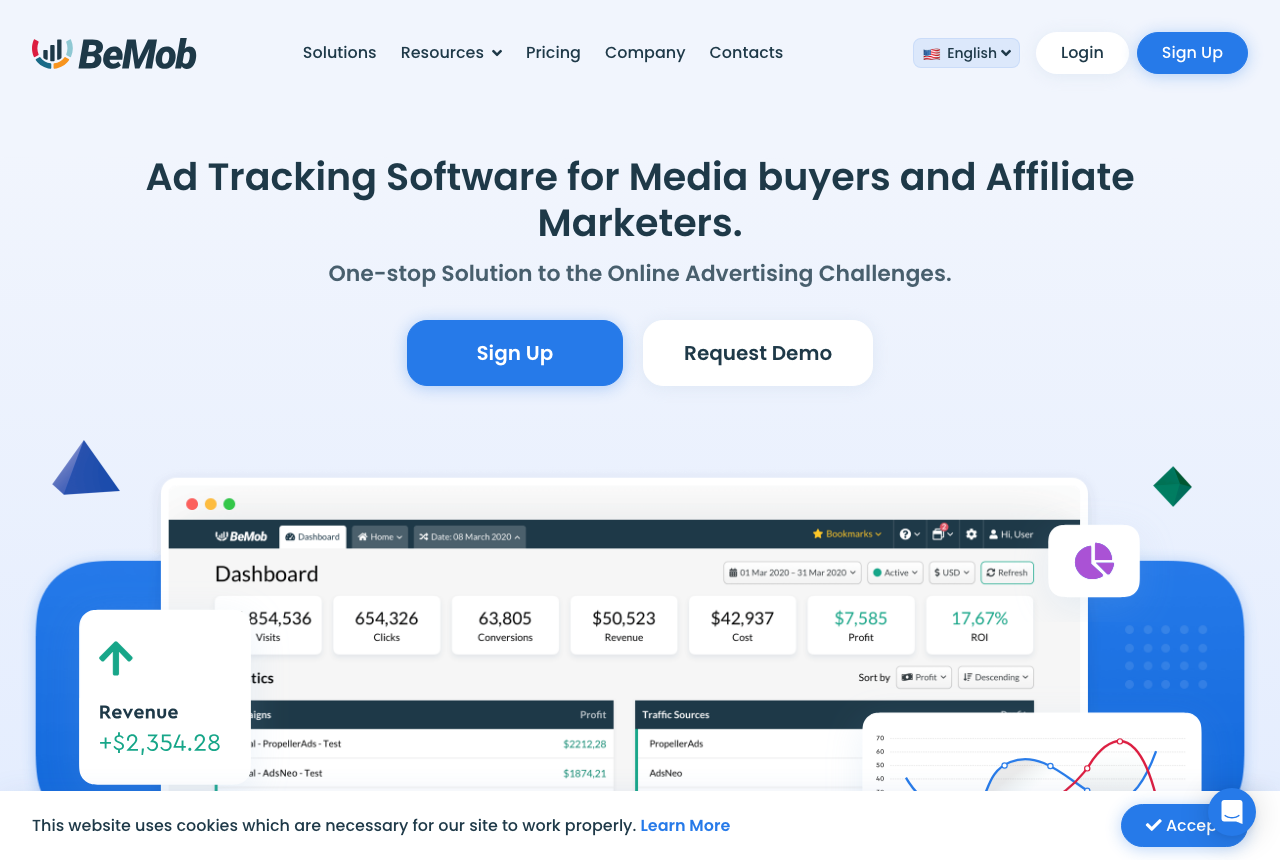
BeMob is the gentlest on-ramp into tracking that exists, and for a working affiliate it is often all the tracking they need. The free plan is a working tool. You get 100,000 events a month, ten campaigns, real landing-page and offer management, and reporting good enough to see which source, campaign and offer converted. Paid entry is cheap too, at $49 a month for 1M events, and because it is cloud-hosted there is nothing to install or patch.
Its limits are depth and volume. BeMob counts every impression, visit, click and conversion as an event, so the free allowance disappears fast once you run impression-heavy native or push traffic. Custom tracking and cloaking domains, which serious campaigns need, only start on the $249 Business plan. Like any tracker, it reports which click converted and never sets ad spend against COGS and margin the way Triple Whale does for a Shopify store.
Two answers to two questions
Underneath the price gap sit two questions. Triple Whale answers what your store's profit is after spend and costs, laid out for an operator who runs a Shopify brand. BeMob answers which click, source and offer made money, for a buyer who needs that today and wants it free or cheap. Put a solo affiliate into Triple Whale and they pay for a profit dashboard with no store to point it at. Put a Shopify brand's blended-profit question into BeMob and it cannot see COGS, margin or MER.
So the tie-break is your operation. A store owner who wants profit across channels on one screen buys Triple Whale. A buyer tracking campaigns starts on BeMob.
Where the pricing diverges
The two do not price on the same axis, and that itself tells you who each is for. Triple Whale's Foundation tier is a 12-month commitment scaled to your GMV, priced for a store where seeing blended profit accurately is worth the subscription. BeMob starts free and its first paid tier is priced for a buyer validating offers. There is no crossover to calculate here the way there is between two trackers. If a GMV-scaled annual commitment sounds wrong for your situation, Triple Whale is built for someone else, and if you need blended store profit across channels, BeMob cannot provide it at any tier.
Size both against your own numbers. Ask Triple Whale for the figure at your revenue, since the commitment moves with GMV, and run BeMob's tiers against your real event volume, since impression-heavy traffic climbs its plans faster than the free tier suggests.
A third path if you host the funnel yourself
Plenty of BeMob users start on affiliate offers and later launch a product of their own, and that product does not have to live on Shopify for Triple Whale to read. ElasticFunnels is built for that stage. It is a funnel platform for teams running paid traffic that builds the pages, hosts the checkout, and keeps ad-spend and conversion reporting on the same data layer as the pages, the CRM and the sale. A sale in its checkout is a first-party event it records directly, and it fires server-side postbacks to your networks on purchase, refund, chargeback and renewal, covering the affiliate-tracking job BeMob does and part of the reporting Triple Whale does, in one system. It starts with a 14-day free trial that takes no card, on plans from $97 a month, plus 0.5% of revenue processed through its hosted checkout.
It is newer than either tool here, with very little independent review coverage, so until you run real volume through it you are largely taking the vendor's word for how its reporting holds up. Triple Whale and BeMob, by contrast, have years of public setups behind them. Its reporting also covers only the funnels it hosts, so a Shopify store still needs Triple Whale, and traffic sent to offers on other people's domains still needs BeMob. It suits the buyer moving from other people's offers to their own.
Which one for you
You run a Shopify or DTC brand and want blended profit on one screen: Triple Whale. MER, blended CAC and margin in an operator-friendly dashboard are worth the Foundation price once the whole team opens it daily, provided you keep your UTMs clean, accept the GMV-scaled annual commitment, and reconcile against your Shopify backend.
You are an affiliate or solo buyer tracking campaigns and offers: BeMob. A genuine free tier, nothing to install, and clean source and offer reporting are the right start, and often all a buyer needs until volume or cloaking-domain needs push them to a paid tracker.
You host your own funnel and checkout end to end: look at ElasticFunnels alongside them, with the newness caveat above in mind, and keep Triple Whale for a Shopify store or BeMob for traffic sent to offers outside your own domains.
BeMob is our default pick because more readers who reach this comparison are affiliates or media buyers than Shopify or DTC brands. A buyer weighing a free tracker against a store-profit dashboard almost always belongs at the tracker end of that line. For a Shopify or DTC brand that wants profit in one place, Triple Whale is plainly the better tool, and we rank it first in our ecommerce attribution ranking for exactly that buyer. If you are actually choosing between two store-side measurement tools rather than a dashboard and a tracker, our Triple Whale vs Polar Analytics and Triple Whale vs Northbeam pages take the next step.
Triple Whale
What works
- Built for Shopify: first-party pixel, MER, blended CAC and profit in one dashboard
- Lower entry cost than the other serious attribution tools here
- Fast, operator-friendly dashboards the whole team will actually open
What to watch
- The first dashboard is rarely right until your UTMs are clean and consistent
- Paid plans are 12-month commitments priced by GMV
- Users report data quirks such as VAT counted in revenue, so reconcile against the backend
BeMob
What works
- A genuinely usable free plan: 100K events, 10 campaigns and real reporting
- Cheap paid entry at $49/mo for 1M events
- Cloud-hosted, so there is nothing to install or maintain
What to watch
- 100K free events disappear fast once you log impressions or run any volume
- Custom tracking domains only start on the $249 Business plan
- Less depth than Voluum or RedTrack once you scale past testing
Pricing
Triple Whale: from $219/mo. The free plan needs no credit card and includes the Moby AI assistant. The paid tiers, Foundation, Automate and Enterprise, are quoted after a walkthrough and scale with your store revenue. The vendor publishes no dollar figure for them.
BeMob: from free, then $49/mo. The Free plan covers 100,000 events a month with one month of data retention. Professional costs $49/mo for 1M events and one month of retention. Business is $249/mo for 10M events and three months, and Enterprise $499/mo for 30M events and six months. BeMob counts every impression, visit, click or conversion as an event. Overage is billed per 1,000 events at $0.05 on Professional, $0.025 on Business and $0.02 on Enterprise. Custom tracking and cloaking domains start on the Business plan.
Prices as of 23 September 2026
Our pick
BeMob
BeMob is the pick if you are new to tracking or spending lightly and want a real free tier before you commit.
Frequently asked questions
Which is cheaper, Triple Whale or BeMob?
Do Triple Whale and BeMob do the same thing?
Is Triple Whale worth it for a solo affiliate?
Can BeMob replace Triple Whale, or the other way around?
Sources
Other sources
2 discussions and reviews read for this page. Quotes are excerpts; open a link to read the original in context.

Written by
Dana Rourke
Lead reviewer
Dana Rourke is the lead reviewer at Campaign Buyer. She owns the tracker and attribution coverage: reading what long-term users report about each tool, checking its documentation and pricing, and verifying prices with the vendor before writing the verdict. Keeping the rankings honest mostly means writing down what the top pick gets wrong, so she does that first.
Last checked 2026-09-23